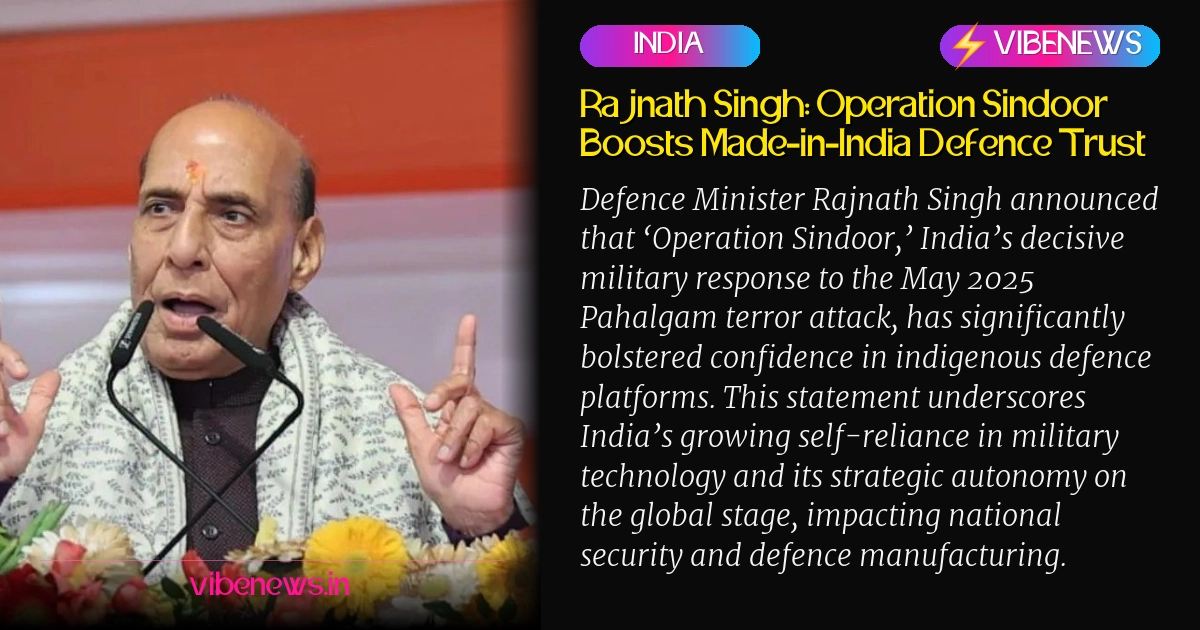

Defence Minister Rajnath Singh today affirmed that Operation Sindoor, India’s decisive military action in May 2025, has significantly enhanced trust in ’made-in-India’ defence platforms. This pivotal statement follows the successful response to the Pahalgam terror attack, marking a critical milestone in India’s journey towards strategic autonomy and self-reliance in military technology.
The minister’s remarks highlight the tangible success of indigenous defence capabilities in a real-world operational scenario, providing a strong validation for the government’s ‘Atmanirbhar Bharat’ (Self-Reliant India) initiative within the defence sector. This success is expected to further accelerate domestic defence production and potentially boost India’s defence exports.
Operation Sindoor: A Turning Point for Indigenous Defence
Operation Sindoor, conducted in May 2025, was a critical military response by India’s security forces. It directly addressed the aftermath of the Pahalgam terror attack, demonstrating India’s resolve and capability to counter threats effectively. While specific details of the operation remain classified, its outcome has been publicly acknowledged by the Defence Minister as a success that leveraged domestic defence technology.
The operation’s success is not merely about a military victory; it’s about the performance of the equipment, systems, and platforms developed and manufactured within India. This includes everything from surveillance drones and communication systems to weaponry and logistical support, all of which are crucial for modern warfare.
Context of the Pahalgam Terror Attack 2025
The Pahalgam terror attack in 2025 served as a stark reminder of the persistent security challenges faced by India. Such incidents necessitate swift and decisive action to protect national interests and ensure the safety of citizens. Operation Sindoor was a direct and robust response, designed to neutralize the threat and restore stability in the affected region.
The ability of India’s defence forces to execute such a complex operation successfully, relying on domestically produced equipment, underscores a significant leap in operational readiness and technological independence. This reduces reliance on foreign suppliers, a long-standing strategic goal for the nation.
India’s Push for Self-Reliance in Defence (Atmanirbhar Bharat)
The ‘Atmanirbhar Bharat’ initiative has placed a strong emphasis on reducing import dependency in critical sectors, with defence being a top priority. The government has implemented various policies, including negative import lists for defence items, to encourage domestic manufacturing and innovation. Rajnath Singh’s statement serves as a powerful endorsement of these policies.
The enhancement of trust in ‘made-in-India’ defence platforms directly translates into greater confidence for the armed forces to deploy and rely on these systems. It also provides a strong incentive for private sector participation in defence manufacturing, fostering a robust ecosystem of research, development, and production.
Impact on Defence Manufacturing and Exports
A proven track record in real-world operations is invaluable for the defence industry. The success of Operation Sindoor, attributed partly to indigenous platforms, is likely to significantly boost the morale and investment in India’s defence manufacturing sector. This could lead to increased orders for domestic companies and greater innovation.
Furthermore, enhanced trust and proven performance can open new avenues for defence exports. Countries looking for reliable and cost-effective defence solutions may now view India as a more credible supplier, contributing to India’s economic growth and geopolitical influence. This aligns with the broader vision of making India a net defence exporter.
Strengthening India’s Strategic Autonomy
Achieving self-reliance in defence is fundamental to India’s strategic autonomy. It ensures that the nation’s security decisions are not influenced by the availability or restrictions imposed by foreign suppliers. The success of operations like Sindoor, powered by indigenous technology, reinforces India’s position as a self-sufficient and capable global power.
This move towards greater independence in defence technology is crucial for maintaining national sovereignty and projecting power effectively in a complex geopolitical landscape. It signifies a shift from being a major defence importer to a significant player in global defence innovation and production.
TL;DR
- Defence Minister Rajnath Singh stated that ‘Operation Sindoor’ significantly boosted trust in ‘made-in-India’ defence platforms.
- Operation Sindoor was India’s decisive military action in May 2025, responding to the Pahalgam terror attack.
- The success validates India’s ‘Atmanirbhar Bharat’ initiative for defence self-reliance and strategic autonomy.
- This development is expected to accelerate domestic defence manufacturing and enhance India’s defence export potential.
- The minister’s remarks underscore the proven operational capability of indigenous military technology in a real-world scenario.