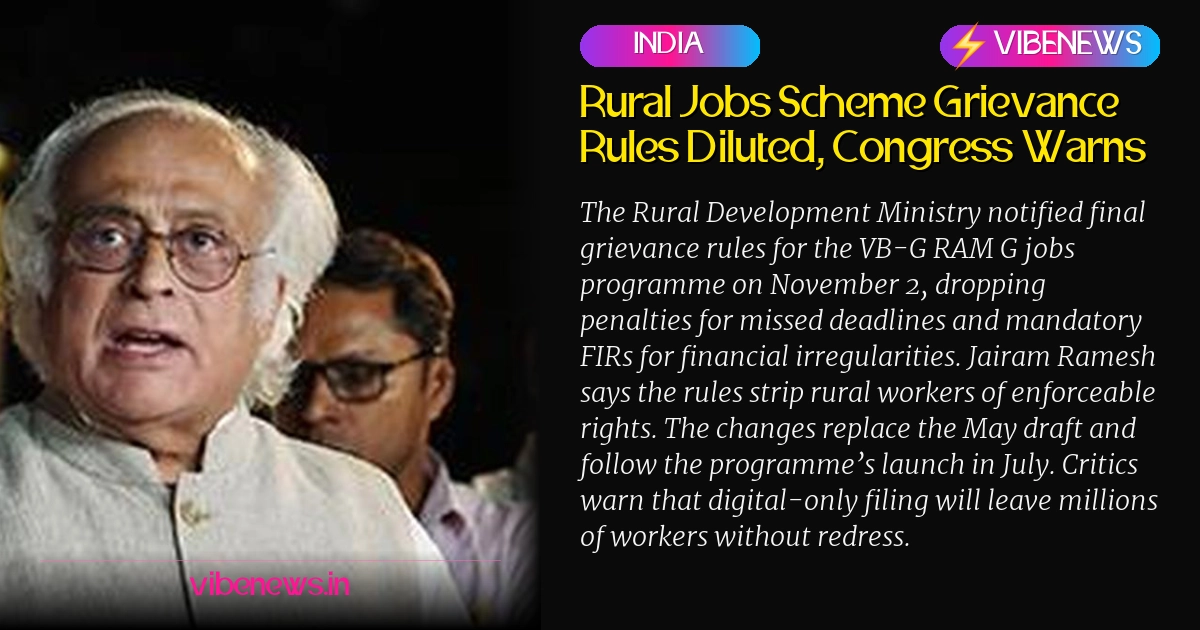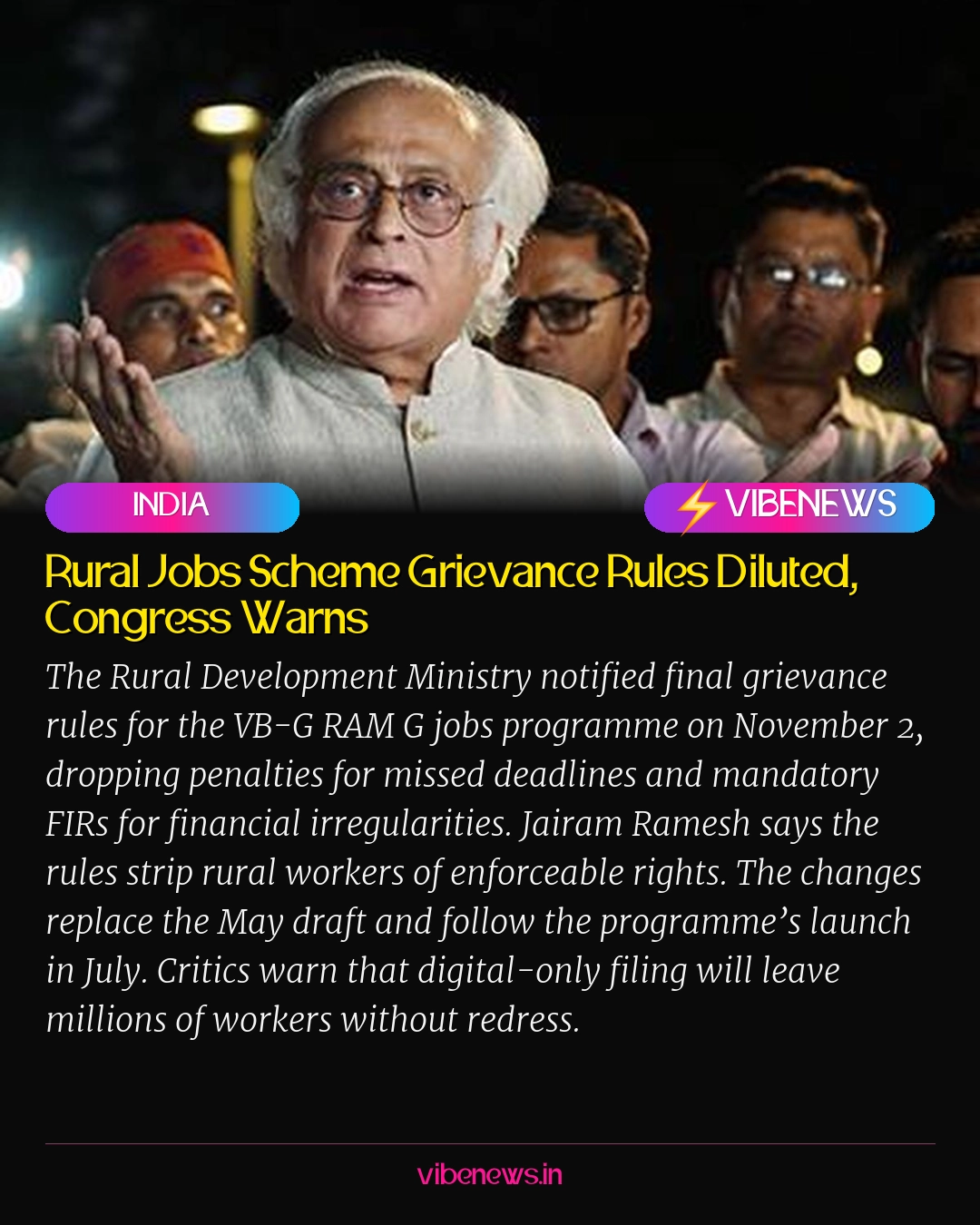

The Union Ministry of Rural Development has notified final grievance redressal rules for the VB-G RAM G rural employment programme, stripping out several enforcement provisions from the draft circulated in May. Congress general secretary (communications) Jairam Ramesh says the changes reduce India’s most significant rights-based law to an administrative scheme.
The rules were notified on 2 November 2026. The programme replaced the Mahatma Gandhi National Employment Guarantee Act in July this year, and the new grievance framework is the government’s rulebook for how rural workers can challenge violations of their entitlements.
Ramesh was responding to a report on the government dropping several provisions that appeared in the May draft. Some of those provisions had also been part of the previous rural jobs programme. He did not mince words in a post on X, writing that the government had an opportunity to strengthen mechanisms for addressing violations and had instead “removed those avenues altogether.”
The penalty that disappeared
The most consequential change, according to Ramesh and the reporting he cited, is the deletion of a penalty clause. The draft said that failing to dispose of a grievance within seven working days would count as a contravention of the Act and could attract action under Section 27. That clause is gone from the final rules.
Timelines remain on paper. But there is no longer an explicit provision holding officials accountable when they miss them. For a worker waiting on a complaint about unpaid wages, that gap is the difference between a deadline and a consequence.
No FIRs, no mandatory action on fraud
The draft required the District Programme Coordinator, after obtaining legal advice, to make sure an FIR was lodged and proceedings initiated where preliminary enquiries or social audit findings showed prima facie evidence of financial irregularities. That provision has been deleted entirely.
The final rules also remove the requirement to place action-taken reports before local bodies. Under the draft, action on grievances had to go before Intermediate and District Panchayat meetings for review and monitoring. That mandatory oversight by elected Panchayati Raj Institutions is now gone, which Ramesh argues weakens democratic scrutiny of how complaints are handled.
Fewer doors for workers to knock on
The draft mandated grievance redressal desks at every Block and District to register complaints and provide information about how the Act was being implemented. Those desks have been deleted. It also required officials at every level to be available to receive grievances on at least one designated day each week. That requirement has been removed.
Taken together, the changes make it harder for workers to know where to go and when. The rules remove the fixed weekly day, remove the dedicated desks, and leave workers to find an official who is willing to take the complaint.
Spot checks replaced by record reviews
The draft explicitly required enquiries through spot verification or inspection. The final rules permit officials to examine records and other information but no longer expressly require physical verification. Ramesh’s criticism focused on this change in particular, because it bears on complaints about falsified muster rolls, fraudulent payments and gaps between official records and what happens on the ground.
Quarterly reporting has also gone. The draft required the District Programme Coordinator to submit quarterly reports to the State Government on the number, nature and categories of grievances, along with their disposal and pendency. That provision is deleted, and with it goes a regular public record of how many complaints are piling up.
Escalation rules were softened too. The draft required grievances unresolved within fifteen days to be automatically escalated to the next higher authority through the digital platform. The final rules keep mandatory escalation after fifteen days but drop the explicit word “automatic.”
State mechanisms and appeals shrink
The draft required State Governments to set up grievance redressal mechanisms at Gram Panchayat, Block, District and State levels. The final rules specify only the Gram Panchayat, Block and District levels, although they allow other levels to be designated. The State-level layer is no longer explicitly required.
The appeals process has also been reshaped. The draft spelled out the appellate hierarchy, a 45-day window for filing appeals and a 30-day deadline for disposing of them. The final rules replace those details with a reference to Schedule I of the Act. Whether that reduces the substantive right of appeal depends on the parent Act’s provisions, and the rules themselves no longer set out the timelines.
On digital platforms, the draft recognised grievance platforms provided by either the Central or State Government. The final rules put greater emphasis on a Central Government-designated platform, which cuts the express flexibility States had to run their own systems.
Digital governance and workers left behind
Ramesh’s sharpest objection is about who gets left out when grievances move online. He argued that the increasing reliance on digital platforms could further disadvantage rural workers who already struggle with the National Mobile Monitoring System, which is used for recording attendance, and the Aadhaar-Based Payment System, through which wages are paid.
He pointed to millions of workers who cannot record attendance through NMMS and cannot receive wages because of ABPS. In his telling, grievances are now being pushed into the same digital pipeline without accountability attached at the other end.
Ramesh also said that without sufficient financial allocations, ensuring the realisation of guarantees becomes the sole burden of the State, with no avenue for people to secure redress for what he described as daily violations.
The sharpest line in his statement captures the argument in full:
“Using the mirage of digital governance, the rules clearly demonstrate that the rights will remain on paper and in the cloud,” he said.
The rules, as described in the reporting Ramesh responded to, leave workers with timelines but without penalties, complaint desks without fixed days, and digital filing without guaranteed follow-up. This report does not carry a response from the ministry to Ramesh’s criticism. What it does show is a set of changes that, on paper, move the enforcement machinery of India’s rural jobs guarantee further from the workers who depend on it.
TL;DR
- Final grievance rules for the VB-G RAM G rural jobs programme were notified on 2 November 2026 and dropped several enforcement provisions from the May draft.
- The rules delete the penalty for failing to resolve grievances within seven working days, leaving timelines without explicit accountability for officials.
- The FIR requirement for prima facie financial irregularities has been removed entirely, along with mandatory oversight by Panchayati Raj Institutions.
- Congress’s Jairam Ramesh says the changes reduce India’s most significant rights-based law to an administrative scheme that leaves rural workers without redress.
- Ramesh argues that digital-only filing will fail workers already struggling with attendance and wage systems.