Jonathan Swift’s Gulliver’s Travels first appeared in October 1726, and it has now reached 300 years. A new essay by Pramod K Nayar, Senior Professor of English and UNESCO Chair in Vulnerability Studies at the University of Hyderabad, argues that the book still works as a sharp satire on human folly, vanity and moral failure.
Nayar opens with the context that shaped the book. The novel arrived in a Europe that had spent generations reading travel accounts. English voyages to Asia and the Americas, recorded by Richard Hakluyt in 1589 and Samuel Purchas in 1625, had already given readers a taste for distant peoples. Daniel Defoe’s Robinson Crusoe (1719) had pushed that appetite into fiction. Swift took the form and turned it on its head.
The book was reprinted three times in the year it came out, and it was translated into Dutch, French and German within a year. Nayar calls it one of the most widely read English novels to this day. That reach, he suggests, is part of why its ideas have lasted.
A Hero Who Is Anything But Heroic
Gulliver is not the bold European explorer that the travel genre often produced. He gets into trouble, he is mocked, he is captured, and he is frequently anxious. Nayar points out that he shows little of the wonder that critic Stephen Greenblatt associated with the Columbian "discovery" of the New World. The joke is on the traveller, not on the people he meets.
The creatures in the book add to that effect. The intelligent Houyhnhnms, the savage Yahoos, the tiny Lilliputians and the gigantic Brobdingnagians are funny, but they also unsettle. Their odd forms sit close to the grotesque, and that is deliberate. Nayar reads the strangeness as a way of showing how much life and culture varies across the planet, and how often what people call "normal" is really a set of social rules that the powerful enforce.
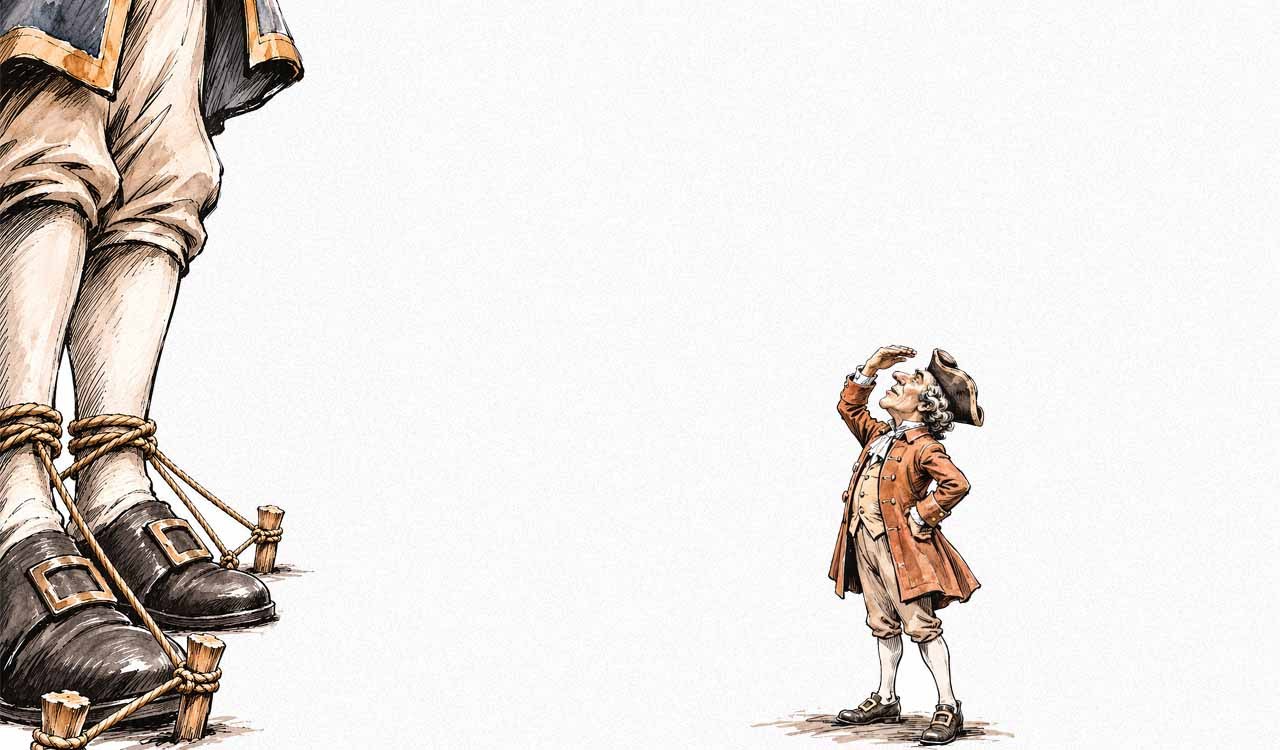
Size and appearance do not decide who is wise or who holds power, Nayar says. In Lilliput, the small people hold real authority. In Brobdingnag, Gulliver is the one who feels powerless, even though the 40-foot girl Glumdalclitch looks after him. The book makes a simple point: people who look or live differently are not automatically evil or stupid. Nayar notes that this is exactly the kind of thinking that racism has always rejected.
Swift’s treatment of the Yahoos is especially pointed. Gulliver sees "a perfect human figure" in these creatures, but then finds that the ones who resemble humans are more savage and animal-like. The horse-like Houyhnhnms turn out to be the intelligent and more civilised ones. Nayar sees a hierarchy in that choice, one that places Europe below the beings Gulliver once assumed were beneath him.
Satire Aimed at Rituals and Rulers
Nayar also reads the book as a critique of the rules and ceremonies people accept without thinking. In Lilliput, officials rise or fall based on how high they can jump over a rope. Court oaths require awkward contortions, with the swearer holding one foot, touching his head and pinching an ear. Swift, Nayar argues, shows how customs are invented to enforce conformity, and how they would look absurd to an outsider.
The same mockery reaches today’s institutions. Nayar says the book suggests that empty rituals, from school assemblies to official programmes, often make little sense even inside the culture that practises them. He connects this to modern oath-taking and loyalty pledges, which the state often makes mandatory, and which can be sworn by people with little integrity.
Gulliver’s criticism stretches across professions. He describes lawyers as biased against truth and equity, and he sees courtiers and government employees bending to favour. Nayar says no profession escapes the satire, which is why the book has remained relevant as institutions have changed around it.
War, Empire and the Greed Behind Them
The book also looks hard at conquest. When Gulliver destroys the Blefuscu navy, Nayar sees a clear case of power used against a people who had never harmed him. In Laputa, the rulers threaten to block out the sun to frighten their neighbours. Swift’s description of war, with its ships sunk, bodies trampled and fields left for dogs, wolves and birds of prey, is blunt and brutal.
Nayar highlights a passage that he says gets less attention than it deserves. Gulliver hesitates to tell his own king about the lands he has seen, because he suspects the king would want to conquer them. Swift describes a crew of pirates who land on a peaceful shore, murder and kidnap the locals, claim the land for their king and then see it turned into a colony. Nayar says the passage shows how an empire starts, through theft and violence dressed up as a divine mission.
Swift then turns the lens on England, and his praise of British colonial conduct reads, in Nayar’s account, like a deliberate irony. Gulliver also warns that the lands he visited do not want to be conquered, and that they hold nothing that should attract European greed. Nayar presents this as the satire’s final sting.
Freedom, Censorship and the Mirror
Nayar raises a question that he leaves open. He wonders whether a novel that mocks governments, professions and rituals could be written in an era of autocratic politics and a shrinking space for creative expression. He does not answer it directly, but the question gives the essay its present-day edge.
His central argument comes back to the idea of the Other. Gulliver learns about himself by meeting other cultures, and Nayar says that the Other works like a mirror. Every culture, in his view, is the silvered backing that makes a reflection possible. Without it, people cannot see themselves clearly.
Without the Other there is no us.
That line sums up why Nayar thinks the book deserves a fresh look. The novel was written three centuries ago, yet its questions about power, belonging and cruelty still press on readers who live in a very different world.
TL;DR
- Jonathan Swift’s Gulliver’s Travels, first published in October 1726, marks 300 years in 2026.
- A new essay by Pramod K Nayar argues the satire still exposes human vanity, power abuse and empty rituals.
- Nayar says the book shows that what people call normal is often a set of rules enforced by the powerful.
- Swift’s Yahoos and Houyhnhnms challenge European assumptions about who is civilised.
- The essay reads the pirate passage as a sharp account of how empires begin through plunder.
- Nayar concludes that understanding ourselves requires encountering the Other.