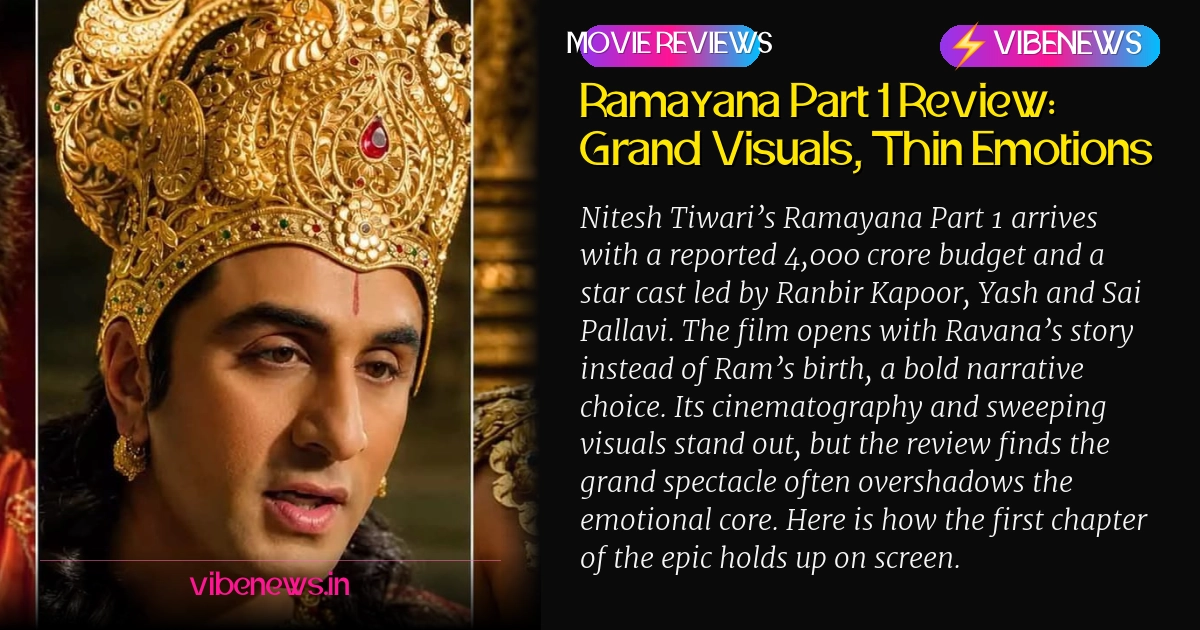
The first part of Nitesh Tiwari’s Ramayana is in cinemas, and the early verdict is clear: the spectacle is real, but the emotional heart is harder to find. The film carries a reported budget of 4,000 crore, which means audiences are asking one question before they buy a ticket. Does the scale justify the hype?
The answer depends on what you came for. If you want huge frames, sweeping visuals and a mythological world that feels built to be seen on the biggest screen, this film delivers. If you want to feel the story in your chest, the film makes you work harder.
A Ramayana that starts with Ravana
The biggest surprise is structural. Instead of opening with Ram’s birth, the film begins with Ravana, played by Yash. It explains who he is, where he comes from, and why his pride hardens into arrogance. Most adaptations treat the demon king as a villain waiting in the wings. Here, he gets the first act.
From there, the story follows Ram, played by Ranbir Kapoor, through his childhood and the hardships that shape him. Under the guidance of sage Vishwamitra, he masters weapons and proves his valour by slaying the fierce demoness Tataka. He then travels to Mithila, where he lifts the Shiva bow with ease at Sita’s swayamvara and marries Sita, played by Sai Pallavi.
A twist before the throne
Just as Ram is set to be crowned, the plot turns. His stepmother Kaikeyi, played by Lara Dutta, uses the boons she once earned to deny Ram his kingdom and send him into exile for 14 years. Ram accepts the decision to honour his father’s word and dharma. He leaves with Sita and his younger brother Lakshman, played by Ravi Dubey, for the dangerous Dandakaranya forest.
Life in the forest is peaceful until Ravana disrupts it. The demon king sends Maricha in the form of a golden deer, then abducts Sita with a carefully planned scheme. The first part closes with Ram and Lakshman beginning their difficult search for her, laying the groundwork for the great war to come.
Direction: global clarity, uneven rhythm
Tiwari clearly designed this version for audiences beyond one region. He builds the story around the original Valmiki narrative and presents each element with patience and clarity. The film frames the epic as a clash between dharma and adharma, compassion and arrogance, and it sells that idea well in its best moments.
The Ram and Ravana characterisation is the strongest part of the screenplay. Ram is calm and steady, almost unshakeable. Ravana is restless, angry and hungry for power over the world. The film keeps the two balanced, and the contrast gives the story its tension.
The problem is pacing. The first half spends a long time introducing characters and their backgrounds. The story moves forward through a series of big set pieces, one after another, rather than flowing as one smooth narrative. The film does build suspense around the abduction and the events leading up to Hanuman’s entry, but the transitions feel stitched together in places.
The visuals are the main attraction
Flying elephants, charging rhinos and shape-shifting demons fill the frame. The film constantly pushes viewers into a world of illusion, and that is where it earns its ticket price. The cinematography by Pankaj Kumar and Mahesh Limaye is the film’s biggest asset. Nearly every frame looks carefully composed.
The visual effects are mostly effective, though not flawless. Several sequences could have looked sharper, and the review suggests the effects would have raised the film’s scale even further if they had been polished more. For a project of this budget, that gap stands out.
Audio is a mixed picture. Music by A.R. Rahman and Hans Zimmer is described as acceptable, but the background score could have hit harder. For a film that wants to feel epic, the score should be doing more of the lifting.
Where the emotion gets lost
The main criticism goes deeper than effects or pacing. The film’s enormous visuals seem to absorb attention that could have gone to emotional beats between characters. Scenes that should land quietly end up competing with the next big spectacle.
On the surface, the narrative looks grand and powerful, but on deeper thought, we cannot fully connect emotionally with the characters.
That is the film’s central tension. It has the bones of a timeless story and the budget to make it look dazzling. Yet the connection between audience and characters often feels distant, as if viewers are watching the epic from across a grand hall rather than standing beside its heroes.
Performances: strong anchors at the centre
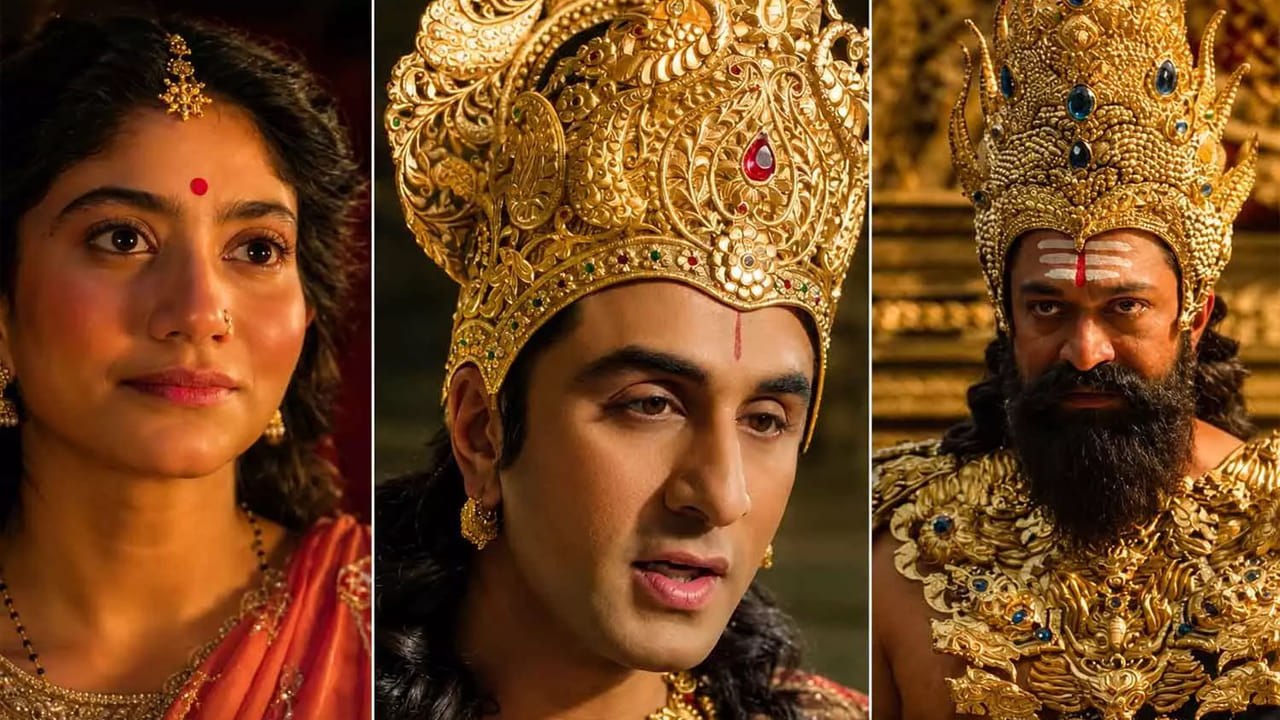
The casting largely works. Ranbir Kapoor plays Ram with a settled, composed performance. The reviewer says the character’s purity and gravitas come through in his eyes. Sai Pallavi brings natural warmth to Sita, giving the role life without strain. Ravi Dubey gives Lakshman solid support.
Yash is the performance that lingers. Every time he appears on screen, the film rises to another level. He captures Ravana’s arrogance and fearsome presence, and the review singles him out as the film’s most important strength. Vivek Oberoi, who plays Vidyut Jihva, and the supporting cast including Rakul Preet Singh, Kajal Aggarwal, Shobhana and Arun Govil also work within the limits of their roles. Their characters move alongside the main story rather than stealing it.
Who should watch it
This is not a film that rewards passive viewing. It rewards audiences who enjoy big canvases, mythological detail and a fresh way into a familiar story. Viewers who want the original epic explained in full, from a different angle, may find it especially rewarding. The film is more analytical than most retellings of the Ramayana, and that depth is a genuine plus.
Viewers hoping for an emotionally overwhelming experience may leave wanting more. The film is grand, polished and ambitious, but it asks for emotional investment that it does not always earn.
The closing line of the review sums it up: this is a fresh Ram and Ravana battle that every viewer should know about, even if it does not fully connect at every turn. For a film carrying 4,000 crore worth of expectation, that may be the honest answer audiences were waiting for.
TL;DR
- Ramayana Part 1, directed by Nitesh Tiwari, is in cinemas with a reported budget of 4,000 crore.
- The film opens with Ravana, played by Yash, instead of Ram’s birth, a bold structural choice.
- Ranbir Kapoor plays Ram, Sai Pallavi plays Sita, and Yash’s Ravana is the standout performance.
- Cinematography by Pankaj Kumar and Mahesh Limaye is described as the film’s biggest asset.
- The visuals dominate so much that the emotional connection with characters often feels distant.
- The first part ends with Sita’s abduction and Ram’s search, setting up the future war.