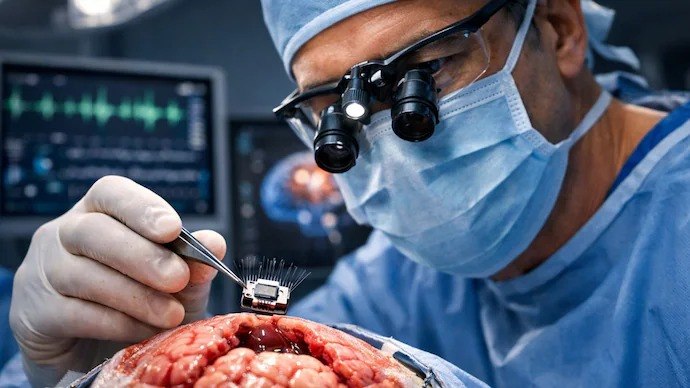
Dr. Matthew Willsey, an individual uniquely positioned at the intersection of electrical engineering and neurosurgery, is now actively involved in implanting advanced brain-computer interface (BCI) devices into human brains. This groundbreaking work offers a new frontier in medical technology, aiming to restore vital functions like communication and movement for individuals grappling with severe neurological conditions.
Willsey’s journey into this specialized field began not in a medical school, but at the Massachusetts Institute of Technology (MIT), where he earned both his undergraduate and master’s degrees in electrical engineering. His academic focus on digital signal processing, under the guidance of renowned pioneer Professor Alan Oppenheim, laid a crucial foundation for his later work. Digital signal processing involves extracting meaningful information from complex data streams, a skill directly applicable to interpreting the intricate signals of the human brain.
The pivotal moment that redirected his career path occurred around 2009. Willsey witnessed a demonstration where a person controlled a computer cursor and a robotic arm using only their thoughts, facilitated by electrodes implanted in the brain. This experience profoundly impacted him. "I remember thinking, ‘That is the coolest thing I’ve ever seen in my life,’" he recalled, a sentiment that ignited his passion for combining engineering with medicine.
Driven by this revelation, he pursued a medical degree at Baylor College of Medicine, followed by a neurosurgery residency at the University of Michigan. He further solidified his expertise by earning a PhD specifically focused on brain-computer interfaces. Today, his clinical practice centers on functional neurosurgery, encompassing procedures like deep brain stimulation for Parkinson’s disease and epilepsy treatment, while his research laboratory continues to push the boundaries of BCI technology.
Brain-computer interfaces are sophisticated systems designed to bypass damaged neural pathways. They are particularly vital for patients whose brains remain functional but have lost the ability to communicate or move due to conditions such as Amyotrophic Lateral Sclerosis (ALS) or spinal cord injuries. These individuals may possess clear thoughts and intentions but are trapped within their bodies, unable to express themselves.
The technology functions by recording neural activity directly from the brain. It then identifies specific patterns linked to a person’s intended actions or thoughts. These neural signals are subsequently converted into digital commands, which can be used to type text on a screen, manipulate a computer cursor, or even control advanced robotic prosthetics. This direct neural pathway offers a lifeline, potentially giving a voice back to those who have lost theirs.
This field has garnered significant global attention, with numerous companies vying to commercialize BCI solutions. Elon Musk’s Neuralink, for instance, is currently conducting human trials in the United States, while China recently approved its own commercially available brain-chip system, known as NEO. These developments underscore the rapid pace of innovation and the immense potential seen in this technology.
Dr. Willsey recently participated in implanting a BCI developed by Paradromics, a company focused on creating fully implantable systems for long-term use. A key distinction of the Paradromics system is its design to operate entirely within the body, eliminating the need for wires to pass through the skin and connect to external computers. This internal operation aims to enhance patient comfort, reduce infection risks, and allow for more seamless integration into daily life without visible external hardware.
The surgical procedure itself is a complex yet refined process. It begins with a craniotomy, where a section of the skull is temporarily removed to expose the brain. Surgeons utilize advanced imaging and navigation tools to precisely identify the optimal placement for the implant. An electrode array is then carefully positioned and inserted into the brain’s cortex, the outer layer responsible for higher-level functions.
Following the implant’s secure placement, the protective layers surrounding the brain are reconnected, and the removed bone section is replaced. A separate transceiver, which processes and transmits the neural signals, is implanted in the patient’s chest. A lead runs discreetly beneath the skin to connect these two components, completing the internal system. The entire operation typically takes around four hours.
Willsey notes that the procedure, while advanced, is not dramatically different from other functional neurosurgeries already performed. This familiarity is crucial for the widespread adoption of BCI technology. "If you want to scale BCI technology, you want neurosurgeons to be able to pick it up very easily," he explained, highlighting the importance of integrating new techniques with existing surgical expertise.
Despite his extensive training and research, Willsey admitted to moments during the operation when the profound significance of the technology became palpable. As the implant was being placed, he reflected on the immense implications for the future of medicine. However, his immediate focus quickly returned to patient safety, the paramount concern during any surgical intervention. Only after the patient’s successful recovery did the full impact truly resonate. "Wow, I can’t believe we’re at this point now where we have somebody implanted with a novel brain-computer interface," he remarked.
This convergence of engineering and medicine, exemplified by Dr. Willsey’s career, represents a significant leap forward. It promises not just incremental improvements but potentially transformative changes for individuals living with debilitating neurological conditions. As BCI technology continues to evolve, the focus remains on refining these devices, ensuring their long-term safety and efficacy, and ultimately making them accessible to those who stand to benefit most from regaining control over their lives.
TL;DR
- Dr. Matthew Willsey, an MIT-trained electrical engineer, has become a neurosurgeon specializing in implanting brain-computer interface (BCI) devices.
- His unique dual expertise allows him to bridge the gap between advanced technology and complex medical procedures.
- BCIs aim to restore communication and movement for patients with severe neurological conditions like ALS by translating neural activity into digital commands.
- Willsey’s journey was inspired by a 2009 demonstration of a person controlling a computer cursor and robotic arm with brain signals.
- He is involved in implanting a fully internal BCI system developed by Paradromics, which eliminates external wires for long-term use.
- The surgical procedure, lasting about four hours, is designed to be integrated into existing neurosurgical practices for scalability.
- This work signifies a major step towards making futuristic brain-chip technology a practical reality in medical treatment.