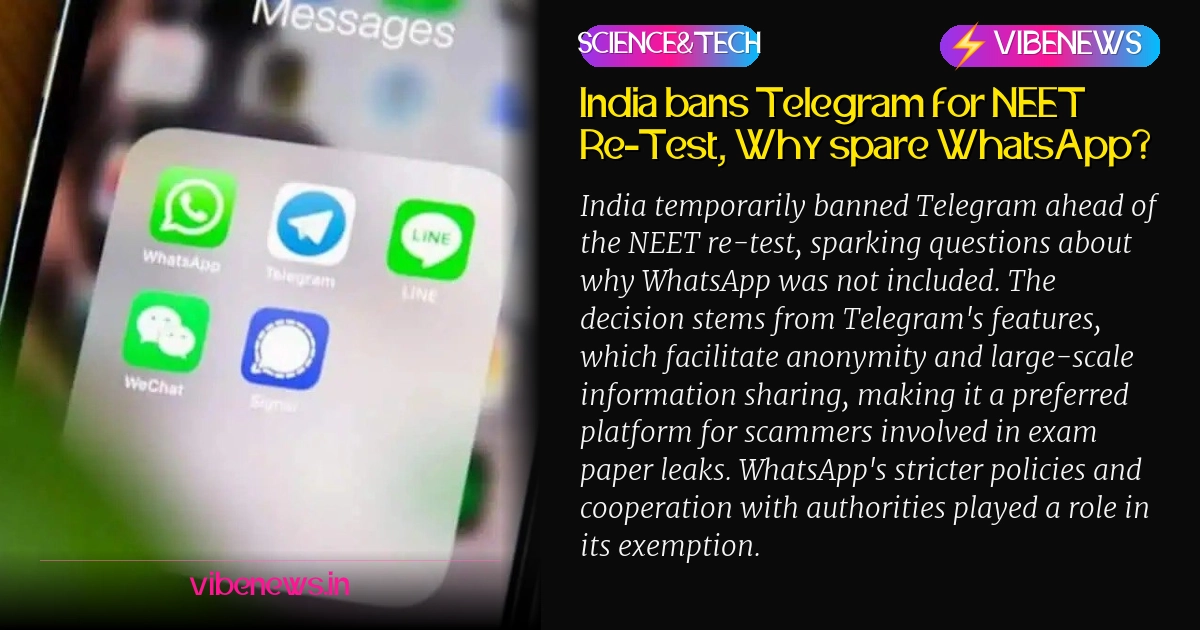

The Indian government has imposed a temporary ban on the messaging application Telegram in the lead-up to the National Eligibility cum Entrance Test (NEET) re-test. This significant move has prompted widespread discussion, particularly concerning why a similar restriction was not placed on WhatsApp, another widely used messaging platform. The differential treatment, according to experts and official statements, lies in the fundamental design, features, and operational policies of the two applications.
The National Testing Agency (NTA), responsible for conducting the NEET examination, reportedly recommended action against Telegram. It identified numerous Telegram channels, operating under names such as 'Paper Leaked NEET' and 'Re-NEET 2026', that were actively engaged in defrauding students. These channels allegedly collected substantial sums, often in lakhs of rupees, by falsely promising access to leaked examination papers. Despite repeated efforts to shut them down, these fraudulent channels would quickly resurface under new identities, making enforcement a continuous challenge.
A primary reason for Telegram becoming a preferred tool for such illicit activities is its inherent design, which offers a high degree of anonymity to its users. Unlike WhatsApp, Telegram allows individuals to operate accounts using only a username, effectively concealing their phone numbers. This feature makes it exceedingly difficult for authorities to identify and trace the actual administrators behind these deceptive channels. Furthermore, Telegram supports the creation of channels with millions of members, enabling scammers to reach a vast audience of potential victims with relative ease.
The platform's capability to facilitate the sharing of large files, including PDFs, also plays a crucial role. Fraudsters exploit this feature to distribute fake question papers or other misleading documents, lending a false sense of legitimacy to their scams. Another critical distinction lies in the message editing functionalities of the two apps. While WhatsApp imposes a time limit for editing sent messages, Telegram permits users to modify even old posts. The NTA highlighted that some channel administrators exploited this feature to manipulate past messages, adding PDFs to create fabricated evidence of paper leaks retrospectively.
Industry analysts suggest that WhatsApp's parent company, Meta, demonstrates a more proactive approach to implementing government directives and monitoring suspicious activities on its platform. This greater cooperation and responsiveness from Meta are believed to be key factors in the government's decision to exempt WhatsApp from similar restrictions. The ability to track and hold accountable those misusing the platform is significantly enhanced when the service provider is willing and able to collaborate with law enforcement.
The government's action against Telegram underscores the escalating challenges faced by examination bodies in combating digital malpractices. As technology evolves, so do the methods employed by those seeking to undermine the integrity of national examinations. This temporary ban serves as a stark reminder of the constant vigilance required to protect students from exploitation and ensure a fair testing environment. The focus now shifts to how effectively this measure will curb fraudulent activities and whether further regulatory adjustments will be necessary to safeguard the examination process in the digital age.
TL;DR
- The Indian government temporarily banned Telegram before the NEET re-test to combat paper leak scams.
- The ban was prompted by the National Testing Agency's (NTA) reports of fraudulent Telegram channels defrauding students.
- Telegram's design allows for high anonymity, enabling users to operate accounts with only a username, making administrators hard to trace.
- Telegram channels can host millions of members and facilitate easy sharing of large files, features exploited by scammers.
- A key difference is Telegram's ability to edit old posts, which fraudsters used to create fake paper leak evidence.
- WhatsApp was spared due to its stricter message editing policies and its parent company Meta's more proactive cooperation with government directives and monitoring.
- The action highlights the ongoing struggle to maintain exam integrity against evolving digital malpractices.