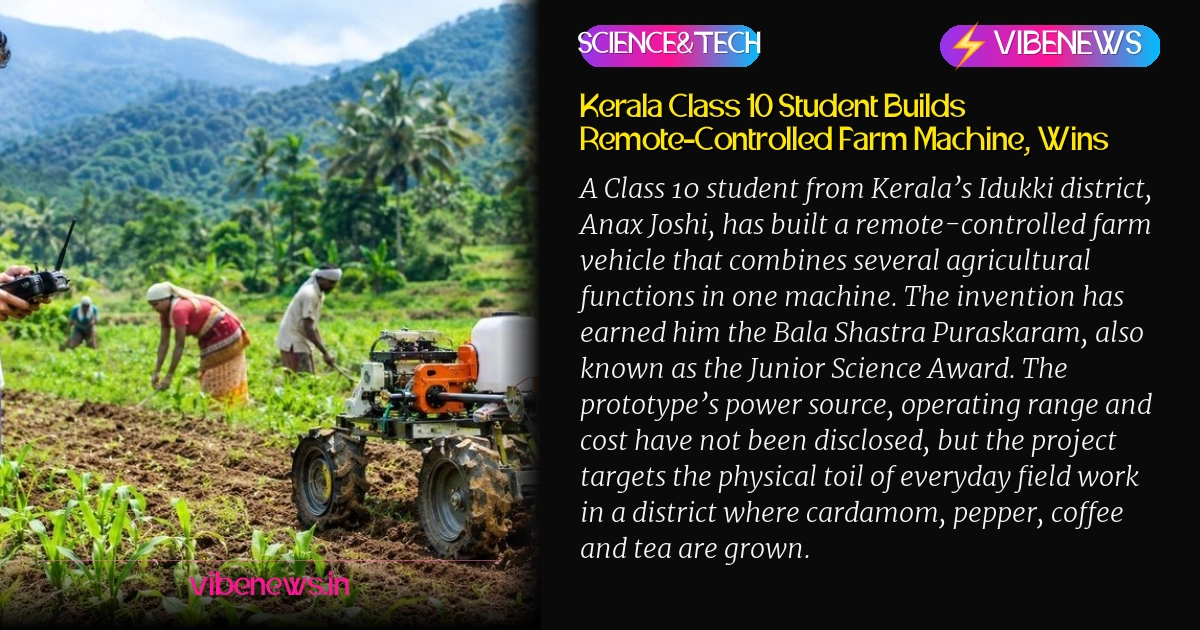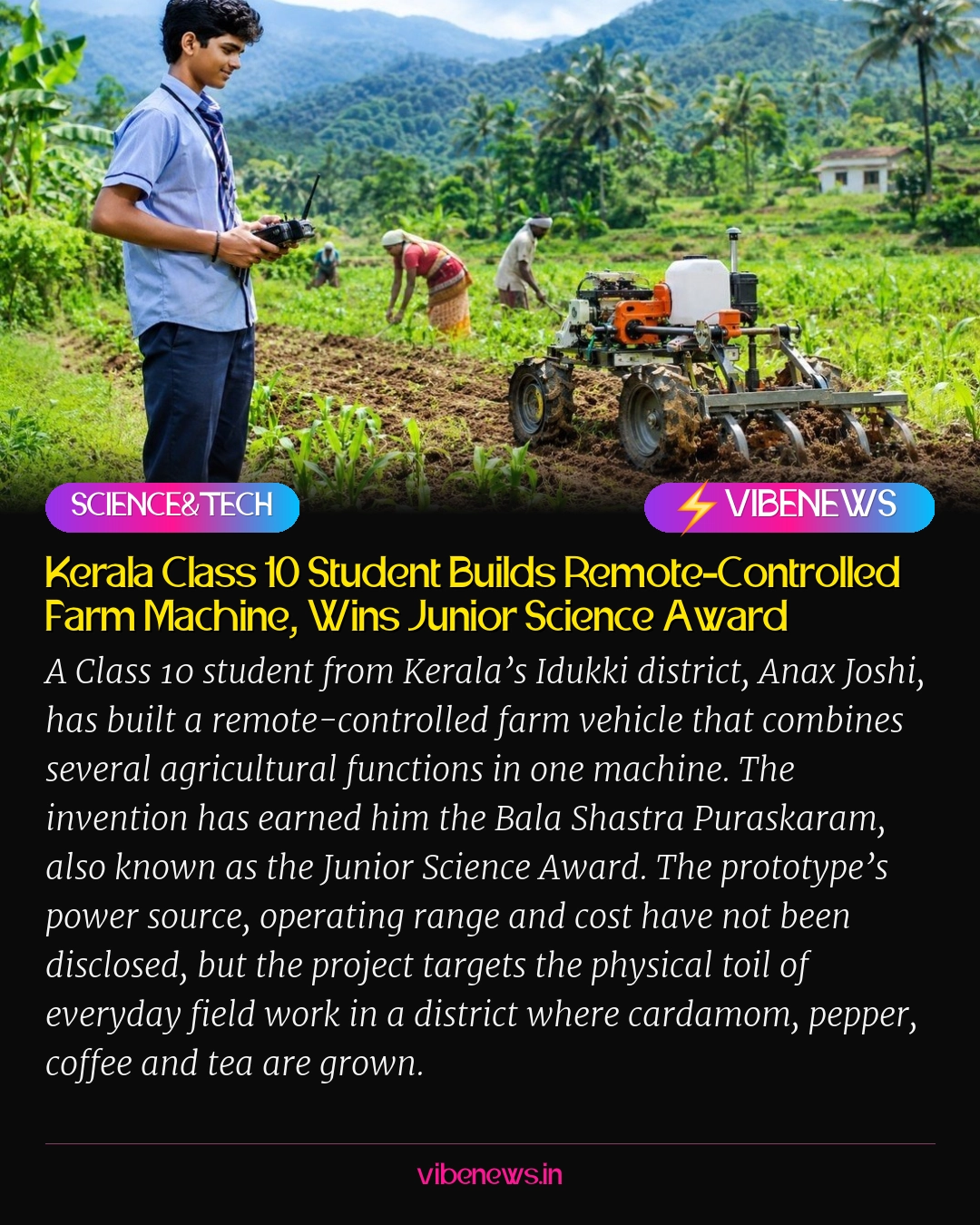
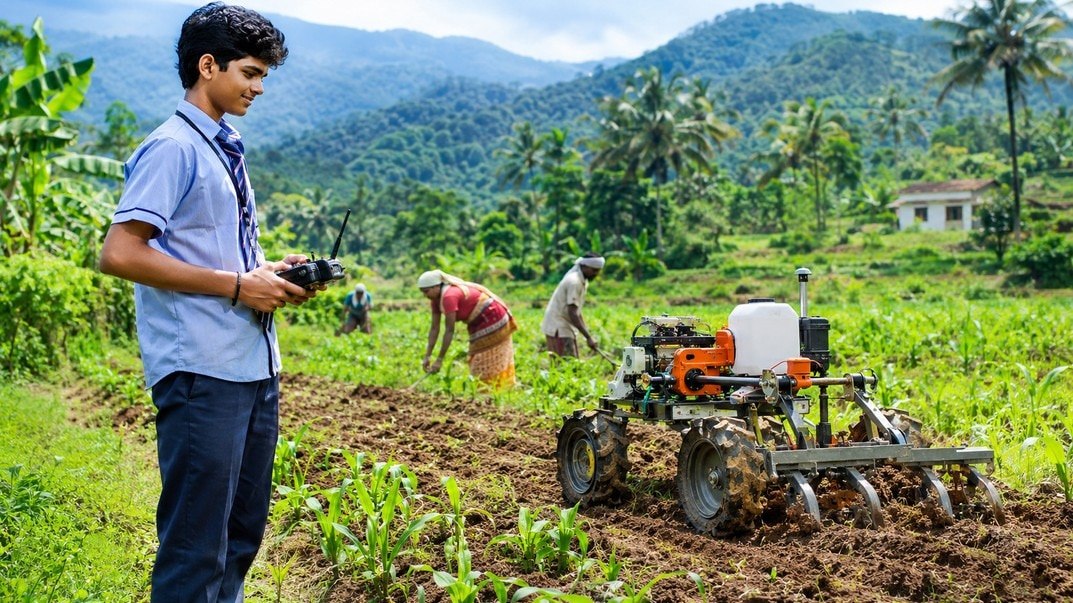
A Class 10 student from Kerala’s Idukki district has built a remote-controlled multipurpose farm vehicle to ease the physical work of running a farm, and the project has won him the Bala Shastra Puraskaram, also known as the Junior Science Award. Anax Joshi, who studies at St Mary’s High School in Vazhavara, Kattappana, developed the machine to reduce farmers’ workload and simplify everyday field operations.
The award is instituted by the Kerala State Sasthravedi to recognise scientific curiosity and innovation among students. For a teenager working on a school project, it is a rare moment when a classroom idea gets formal recognition from a state science body.
Remote control at the centre of the design
The main feature of Anax’s invention is its remote-control mechanism. A farmer can operate the vehicle from a distance rather than standing beside the equipment for the entire time it runs. That matters on uneven ground and during repetitive tasks, where a person working alongside a machine can tire quickly.
The machine is also built to handle more than one job. Its multipurpose design brings different farming functions together in a single unit, which could cut the need to buy and store separate equipment for each task. The remote-operated system is also meant to limit the physical effort involved in certain field operations, giving farmers a more convenient way to get routine work done.
The project grew out of a practical problem. The report describes it as an effort to take scientific learning beyond textbooks and point it at challenges that affect local communities. Few students at that age get the chance to build something that answers a question their own families and neighbours face every season.
What the farm life around Idukki looks like
Agriculture remains a core part of the local economy in Idukki. Farmers in the district grow cardamom, pepper, coffee and tea, and many of these crops demand considerable time, physical effort and regular attention. Managing several different operations can be exhausting, especially for farmers with smaller holdings or limited access to machinery.
That is where a machine that does several jobs could make a difference. Instead of moving between separate tools for separate tasks, a farmer could rely on one vehicle, operated from a distance. The idea speaks directly to the daily grind of small-scale farming, where time and labour are often the scarcest resources.
What is still unknown
The available report stops short of giving a full technical picture. It does not specify the exact farming functions the machine performs, its operating range, its power source or its manufacturing cost. It also does not say whether the prototype has gone through field trials or when, if ever, it might be commercially available.
Those gaps matter. A machine’s real value on a farm depends on how it performs on slopes, in wet conditions and across different crops, and none of that has been detailed in the available reporting. The report is clear that practical effectiveness would need to be assessed through further development and field testing. Until then, the invention is best understood as a promising concept with a working design behind it, rather than a finished tool ready for farmers to buy.
Even so, the award itself signals that the idea caught the attention of the people who judge scientific innovation in the state. The recognition gives Anax a platform, and it gives other students a clear example of what a school project can become when it starts with a real problem.
Why this story stands out
Stories about young people solving practical problems tend to stick, and this one has a simple, relatable core. A student looked at the hard, repetitive work that farmers do every day and asked whether technology could carry some of that load. The answer he built, a remote-controlled machine that brings several farming functions together, shows how curiosity can take shape outside a laboratory.
The innovation also demonstrates how scientific curiosity among school students can translate into practical ideas, with young minds exploring technology-driven solutions to challenges faced by local communities.
That line captures what makes the story worth telling. Agriculture is changing, and automation is moving into fields that have long relied on manual labour. A school student in Idukki has added his own piece to that shift, and the next step for his prototype will be the testing and refinement that turns a promising idea into something farmers can use.
TL;DR
- Anax Joshi, a Class 10 student from Idukki, Kerala, developed a remote-controlled multipurpose farm vehicle.
- The machine combines several farming functions in one unit, reducing the need for separate equipment.
- He earned the Bala Shastra Puraskaram, also known as the Junior Science Award.
- The award is instituted by the Kerala State Sasthravedi to recognise scientific curiosity among students.
- Prototype details on operating range, power source, cost and field trials have not been provided.