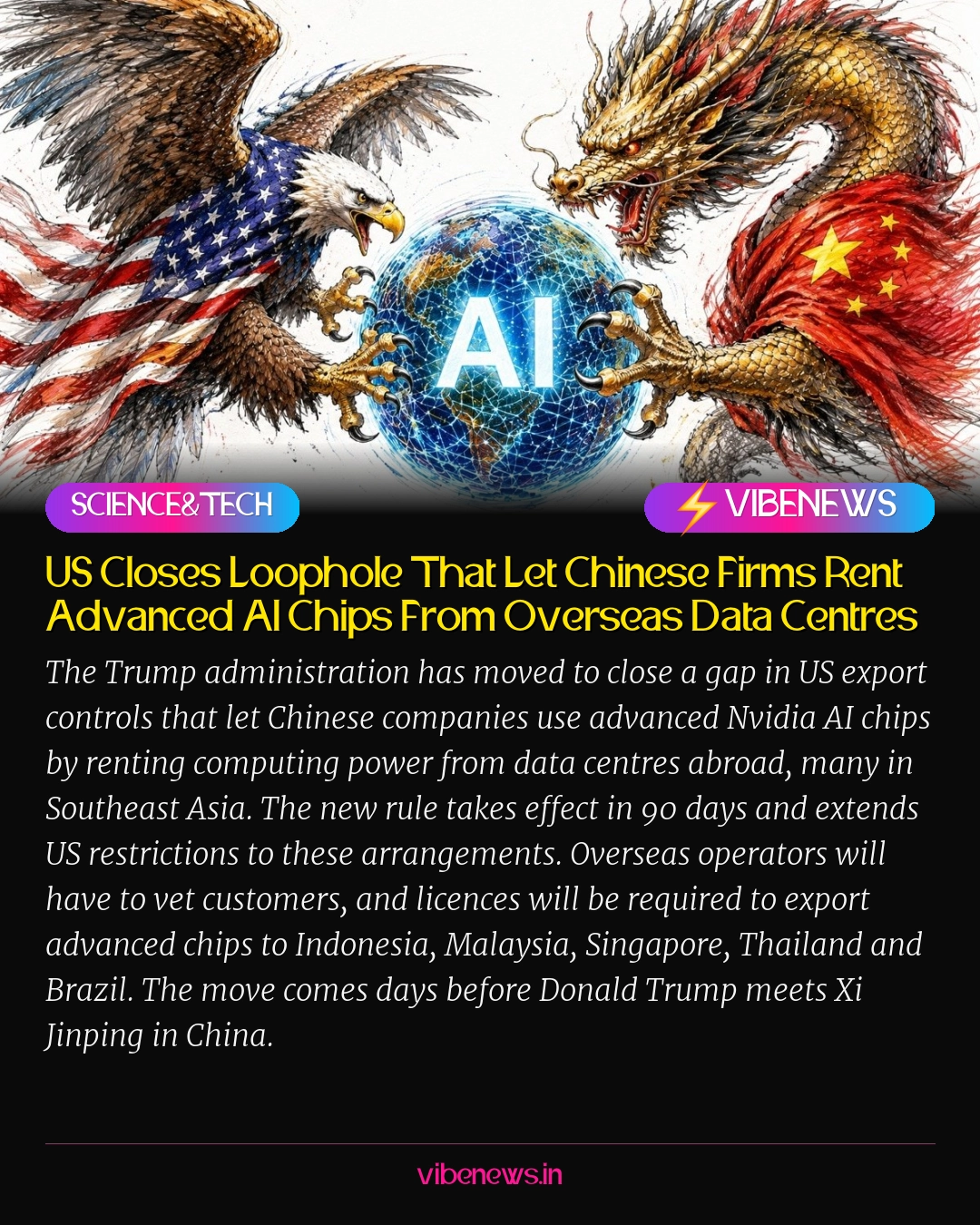

The Trump administration has moved to close a gap in US export controls that lets Chinese companies use advanced American AI chips by renting computing power from data centres abroad, according to reports published on Monday.
The gap is simple to describe and hard to police. Chinese companies are generally barred from buying Nvidia’s most advanced chips. But they can still use them remotely, by running their workloads through overseas data centres, many of them in Southeast Asia. The chips never change hands, so the buyer never technically imports anything.
Washington now wants that arrangement covered too. The new rule, which takes effect in 90 days, will extend US restrictions to those remote-access deals. In practice, a company barred from buying the hardware outright will not be able to get the same computing power simply by renting it.
What overseas data centres will have to do
The burden shifts to the facilities themselves. Overseas data centres will have to vet their customers before handing over large amounts of computing power. They will also face restrictions on supplying that power to companies based in countries the US considers high-risk. The reporting names China, Russia and Iran as the countries of concern.
For operators in the region, that means knowing who is on the other end of a server rental. A data centre that once sold capacity to any paying client will now need to check ownership and location before the deal goes ahead. Those checks are the core of the new approach, because the controls apply to the access itself rather than only to the physical sale of chips.
Licences for five more countries
The rule also requires licences to export advanced chips to companies based in Indonesia, Malaysia, Singapore, Thailand and Brazil. The US says there is a higher risk of chips being diverted through those countries.
Diversion is the key word. Officials are worried that hardware sent to a permitted market could be passed on to a restricted buyer. Requiring a licence for these five countries gives Washington a checkpoint on shipments that would otherwise move with little scrutiny. Brazil stands out on that list because it sits far from Asia, which signals that the concern is not limited to the region.
The timing with Trump and Xi
The move comes days before US President Donald Trump is due to meet Chinese President Xi Jinping in China. That timing matters. A rule of this kind lands in the middle of a high-level diplomatic window, and it will be read in Beijing as much as in Washington.
The reporting does not say how Chinese authorities or the affected data centre operators have responded. Nor does it say whether the 90-day window could change before the rule takes effect. Those gaps leave room for a lot of questions over the coming weeks, particularly about how the two governments will handle the issue when they sit down together.
Export controls on advanced chips have become one of the sharpest points of friction between the two countries. This rule adds a new layer to that dispute by reaching beyond the physical hardware and into the cloud services that run on it.
The new rule, which takes effect in 90 days, will extend US restrictions to those arrangements.
Why the remote-access gap mattered
Advanced AI models need enormous amounts of computing power, and the chips that supply it are expensive and tightly controlled. Renting capacity from a data centre offers a way to get that power without owning the hardware. That is what made the arrangement attractive, and what made it a gap for regulators to close.
The Trump administration is now treating remote access as a form of export. That is a notable shift in how the rules apply. It means the question is no longer only what leaves the country on a shipping manifest, but who can use the most advanced American technology from anywhere in the world.
For readers following the broader contest over artificial intelligence, the story is less about a single chip and more about where the line now sits. The 90-day runway gives companies and governments a short window to adjust. After that, the new restrictions will apply to the rented capacity as well as the hardware.
TL;DR
- The Trump administration is closing a gap that let Chinese firms use advanced Nvidia AI chips through overseas data centres.
- Chinese companies are generally barred from buying the most advanced chips, but they could still use them remotely.
- The new rule takes effect in 90 days and extends US restrictions to remote-access arrangements.
- Overseas data centres will have to vet customers and limit computing power for firms in China, Russia and Iran.
- Licences will be required to export advanced chips to companies in Indonesia, Malaysia, Singapore, Thailand and Brazil.
- The move comes days before Donald Trump is due to meet Xi Jinping in China.