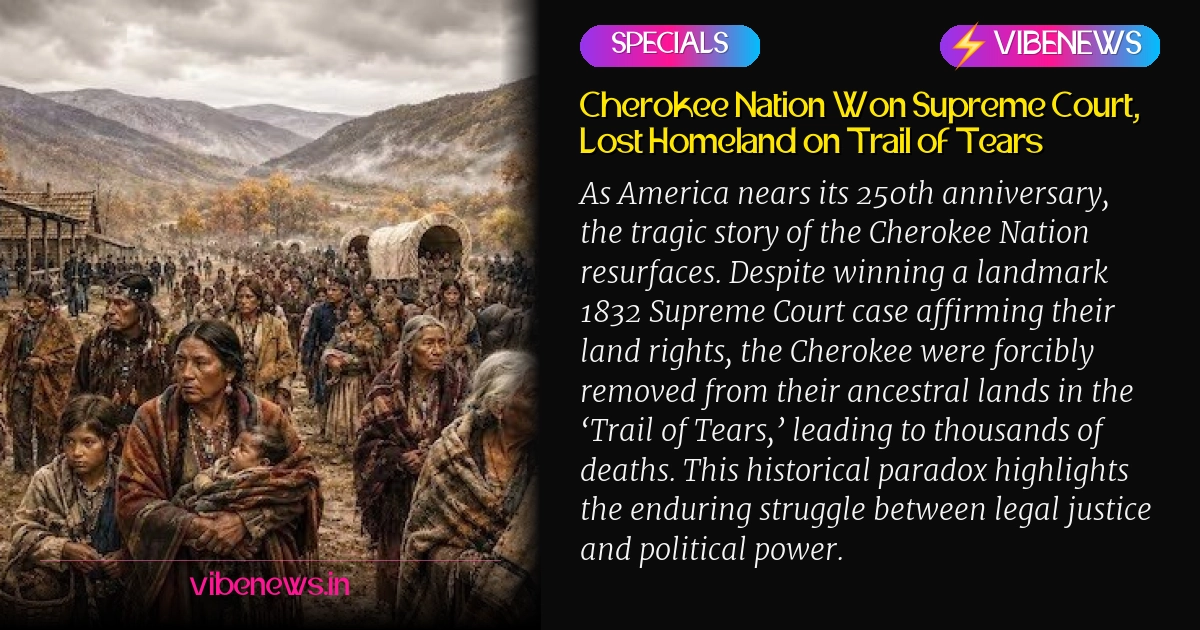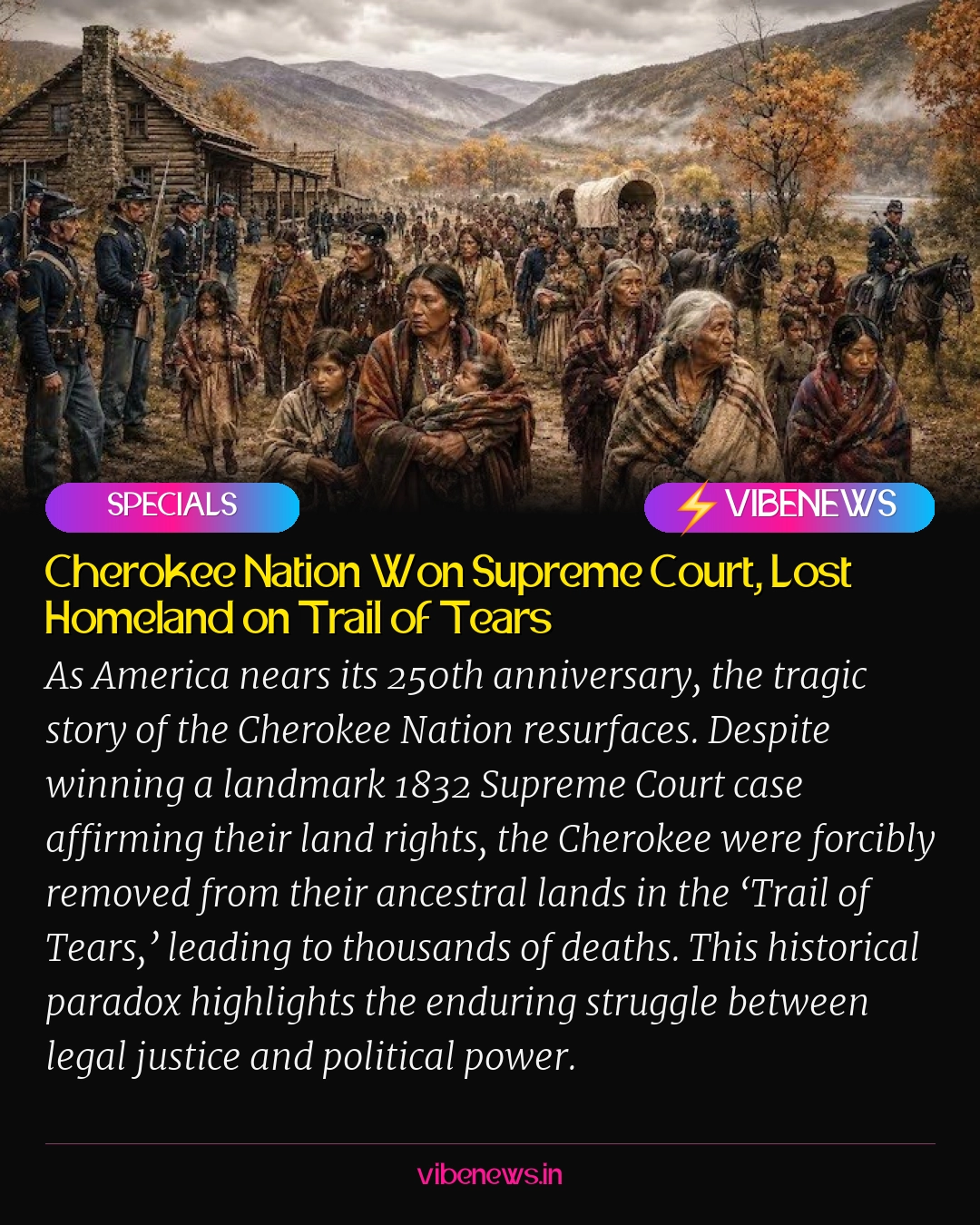
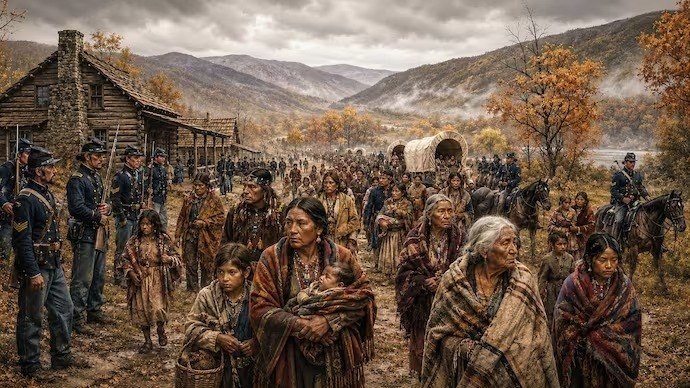
In a profound historical paradox, the Cherokee Nation secured a landmark victory at the U.S. Supreme Court in 1832, affirming their sovereign rights and ancestral lands, only to be forcibly removed from their homes in what became known as the Trail of Tears, a devastating journey that claimed approximately 4,000 lives. This tragic episode, unfolding despite the highest legal ruling, serves as a stark reminder of the complex interplay between justice and political power as America approaches its 250th anniversary.
The story of the Cherokee Nation is not merely a historical footnote but a critical lesson in the limitations of legal triumph when confronted by political will. It underscores how a nation, recognized by the highest court, could still face the loss of its ancestral homeland, impacting generations and shaping the narrative of Indigenous peoples in the United States.
The Cherokee Nation: A Civilization Before America
Long before the United States declared independence in 1776, the Cherokee Nation thrived as one of North America’s largest and most influential Native American civilizations. Their roots in the forested Appalachian Mountains, spanning what is now Georgia, Tennessee, North Carolina, South Carolina, and Alabama, trace back over a thousand years.
Cherokee communities developed sophisticated societies, complete with permanent towns, council houses for governance, extensive trade networks, and rich oral traditions. They cultivated maize, beans, and squash, and hunted in the abundant forests, establishing a deep connection to their land.
Early Adaptations and the Gold Rush Catalyst
In the late 18th and early 19th centuries, the Cherokee Nation demonstrated remarkable adaptability. They embraced aspects of American culture, establishing schools, adopting a constitutional government, creating a court system, and achieving widespread literacy.
A pivotal moment was the creation of the Cherokee syllabary by scholar Sequoyah in 1821, which rapidly enabled thousands to read and write their own language. This led to the publication of the Cherokee Phoenix, the first Native American newspaper, printed in both Cherokee and English, advocating for their rights and land.
However, the discovery of gold in northern Georgia in 1828 dramatically altered their fate. This sparked a rush of settlers onto Cherokee territory, prompting the state of Georgia to assert its laws over their lands, directly violating existing treaties.
A Legal Battle for Sovereignty: Worcester v. Georgia
Faced with encroachment and the federal government’s Indian Removal Act of 1830, which authorized negotiations for relocating Native American nations, the Cherokee chose a path of legal resistance. They placed their faith in the American judicial system, believing the Constitution and federal treaties would protect their sovereignty.
Their initial legal challenge, Cherokee Nation v. Georgia (1831), resulted in a setback, with the Supreme Court ruling the Cherokee a "domestic dependent nation" unable to sue as a foreign entity. However, a year later, a new case presented another opportunity.
Chief Justice Marshall’s Landmark Ruling
The case of Worcester v. Georgia (1832) directly questioned Georgia’s authority within Cherokee territory. The dispute centered on Samuel Worcester, a missionary arrested for living on Cherokee land without a state license, but the core issue was who controlled the land.
Chief Justice John Marshall delivered a celebrated ruling, declaring the Cherokee Nation a "distinct community" with its own territorial boundaries. Marshall affirmed that Georgia had no legal power to impose its laws within Cherokee lands, as relations with Native nations fell under federal jurisdiction via treaties.
This decision was a monumental legal victory for the Cherokee, validating their nationhood, treaties, and right to their ancestral domain. It should have been the definitive end to the dispute, but political power intervened.
The Trail of Tears: A Supreme Court Victory Ignored
Despite the Supreme Court’s clear ruling, President Andrew Jackson, a staunch proponent of Native American removal, refused to enforce the decision. While the exact quote, "John Marshall has made his decision; now let him enforce it," is debated by historians, Jackson’s administration undeniably ignored the court’s judgment.
Without executive branch support, the legal victory became largely symbolic. Georgia continued its aggressive policies, tightening its grip on Cherokee lands and intensifying pressure for removal.
President Jackson’s Defiance and Forced Removal
In 1835, a minority faction of the Cherokee signed the Treaty of New Echota, agreeing to cede all eastern Cherokee lands for territory in present-day Oklahoma. The vast majority of the Cherokee Nation, led by Principal Chief John Ross, vehemently rejected this treaty, arguing the signatories lacked authority to sell communal land.
Nevertheless, Congress ratified the treaty. By the spring of 1838, the deadline for removal expired. Thousands of U.S. soldiers and state militia entered Cherokee country, forcibly removing families from their homes with little warning, leaving behind entire communities and ancestral sites.
The Cherokee were first confined to crowded stockades, where disease spread rapidly. Then began the infamous "Trail of Tears," a forced march of nearly 16,000 Cherokee across more than 1,000 miles to Indian Territory. The journey, fraught with bitter winter weather, inadequate food, and rampant disease, led to the deaths of an estimated 4,000 Cherokee, roughly one in four of those removed.
Enduring Legacy: A Nation That Survived
The forced removal was a profound tragedy, but it did not erase the Cherokee Nation. Those who survived the Trail of Tears rebuilt their communities, schools, churches, and government in what is now Oklahoma. Today, the Cherokee Nation stands as one of the largest federally recognized Native American nations in the United States, boasting over 450,000 enrolled citizens.
Their language, traditional ceremonies, and Sequoyah’s syllabary continue to be preserved and taught, demonstrating the resilience of a people who endured immense hardship. Yet, the memory of the lost homeland in the southern Appalachians, with its sacred sites and ancient towns, remains a powerful part of their identity.
Lessons from a Historical Paradox
As the United States commemorates its 250th anniversary, the Cherokee story serves as a crucial reminder that American history predates 1776, built upon lands where Indigenous civilizations had flourished for centuries. The paradox of winning a legal battle but losing one’s homeland highlights the enduring tension between the rule of law and the exercise of political power.
Worcester v. Georgia remains a cornerstone of American constitutional law, studied for its implications on federal-state relations and Indigenous sovereignty. The Cherokee Nation’s experience teaches that while a court can declare what is just, the ultimate outcome often depends on whether governments choose to uphold those declarations. This tragedy at the heart of the Cherokee story continues to resonate, offering vital insights into justice, power, and national identity.
TL;DR
- The Cherokee Nation won a landmark 1832 U.S. Supreme Court case, Worcester v. Georgia, affirming their sovereignty and land rights.
- Despite this legal victory, President Andrew Jackson defied the ruling, leading to the forced removal of the Cherokee people.
- The forced migration, known as the "Trail of Tears," resulted in the deaths of approximately 4,000 Cherokee individuals.
- This historical event underscores the critical conflict between judicial decisions and executive power in early American history.
- The Cherokee Nation rebuilt in Oklahoma and remains one of the largest federally recognized Native American nations today, preserving its culture and language.