
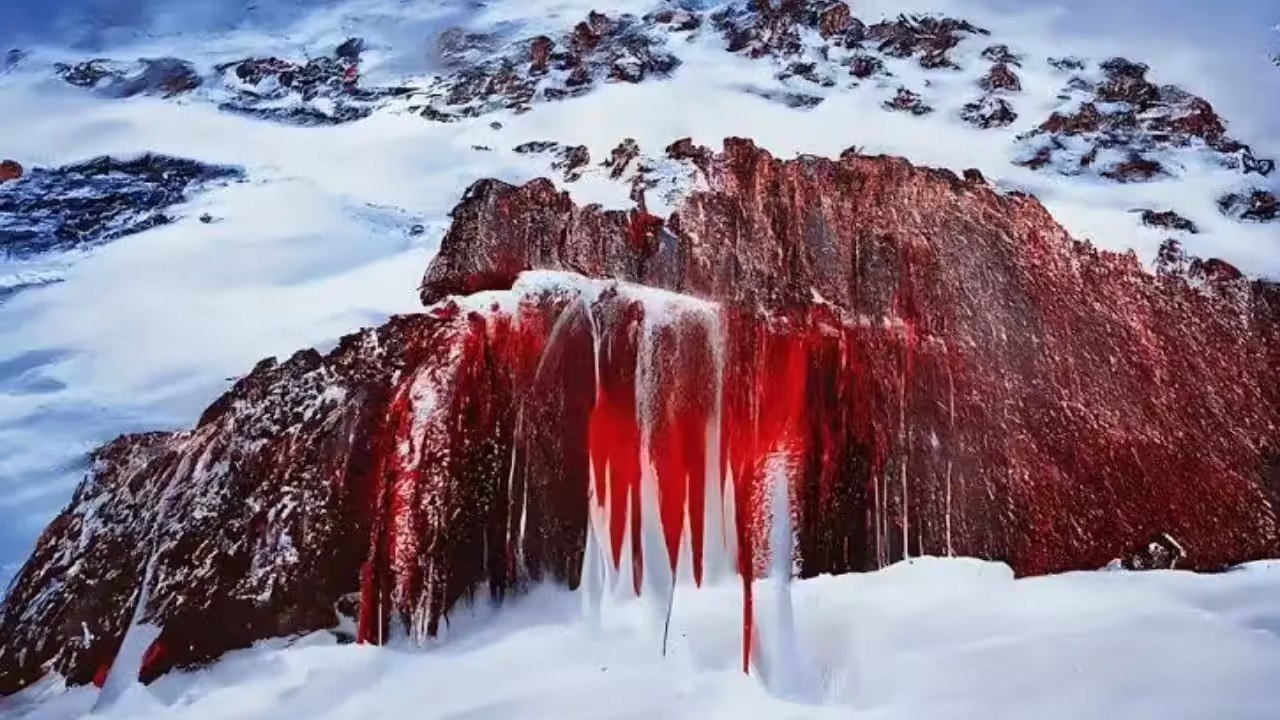
Antarctica’s enigmatic Blood Falls, a crimson stain on the pristine white landscape of Taylor Glacier, has finally yielded its century-old secret. Scientists have confirmed that the waterfall’s striking red hue is not due to algae, as once believed, but rather the oxidation of iron-rich saltwater emerging from a vast, ancient reservoir hidden beneath the ice.
This dramatic natural phenomenon, first observed in 1911, has long puzzled explorers and researchers alike. The water, which appears to bleed from the glacier’s face, turns a vivid rust color upon contact with the atmosphere, a process identical to how iron rusts when exposed to oxygen.
The source of this unique brine lies approximately 400 meters beneath the Taylor Glacier, within a subglacial lake estimated to be around 1.5 million years old. This ancient body of water became trapped when rising ice sheets isolated a portion of the ocean, leading to an extreme concentration of salt over millennia.
The exceptionally high salinity of this trapped water is what prevents it from freezing, even in the frigid Antarctic temperatures that typically hover well below zero degrees Celsius. This liquid state allows it to flow through a network of fissures and channels within the glacier, eventually reaching the surface.
Australian geologist Griffith Taylor was the first to document the Blood Falls, initially speculating that red algae were responsible for the unusual coloration. However, subsequent investigations disproved this theory, deepening the mystery and prompting further scientific inquiry into its true origins.
A significant breakthrough came in 2017 when scientists from the University of Alaska employed radar technology to map the intricate pathways within the glacier. Their findings revealed a complex system of hidden conduits through which the highly pressurized saltwater is forced upwards, eventually emerging at the glacier’s edge.
Further clarity emerged from a recent study published in the ‘Antarctic Science’ journal. This research pinpointed that the saltwater periodically seeps out through small cracks that form in the glacier, providing a more precise understanding of how the brine reaches the surface and contributes to the falls’ distinctive appearance.
Beyond solving a geological riddle, the Blood Falls ecosystem presents an even more astonishing discovery: a thriving community of ancient microbes. These microorganisms have adapted to survive for millions of years in the complete absence of sunlight and oxygen, relying instead on chemical reactions for their energy. Their existence challenges conventional understanding of life’s requirements.
This unique subglacial environment, devoid of light and oxygen, offers a rare terrestrial analogue for conditions that might exist on other icy celestial bodies in our solar system, such as Jupiter’s moon Europa or Saturn’s moon Enceladus. Studying these resilient microbes provides invaluable insights into the potential for extraterrestrial life and the limits of biological adaptation.
The ongoing research at Blood Falls is therefore not just about understanding a peculiar Antarctic phenomenon. It’s about expanding our knowledge of life’s adaptability and informing the search for life beyond Earth, making this remote, crimson waterfall a focal point for astrobiological exploration and a testament to nature’s enduring mysteries.
TL;DR
- Antarctica’s Blood Falls gets its red color from iron-rich saltwater.
- This saltwater reacts with oxygen in the air, causing it to rust.
- The water originates from a subglacial lake, trapped under the Taylor Glacier for 1.5 million years.
- High salinity prevents the water from freezing, allowing it to flow through glacier cracks.
- Scientists used radar to map hidden channels within the glacier, explaining the water’s emergence.
- Microbes have been found living in this extreme environment for millions of years without sunlight or oxygen.
- This discovery offers crucial insights into the potential for life on other icy planets and moons.