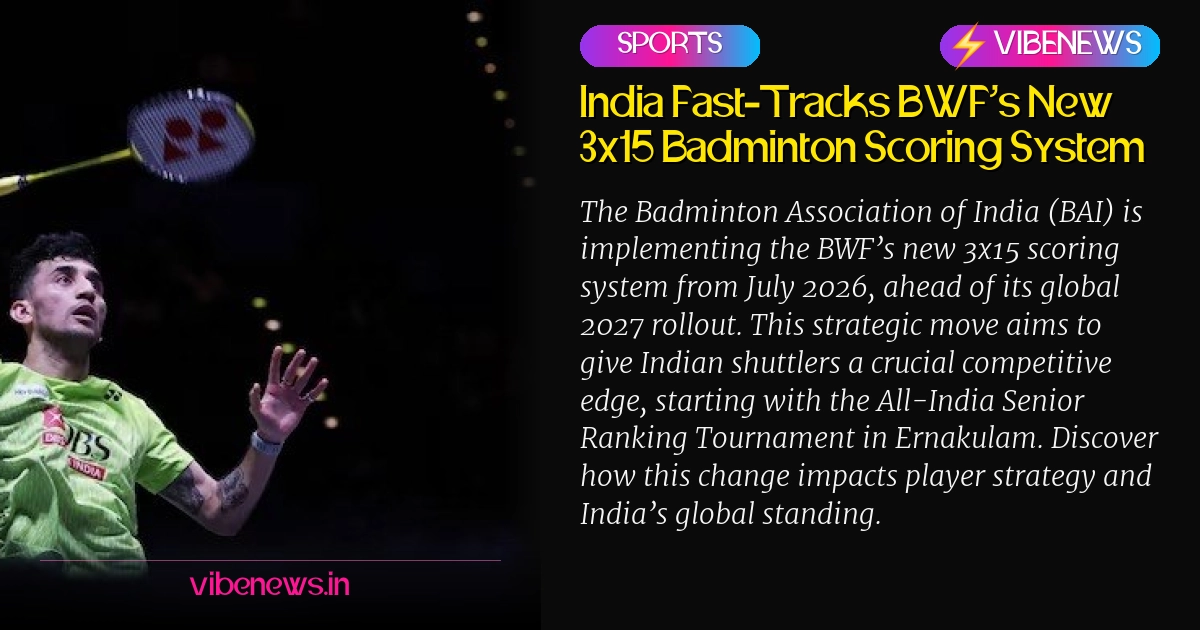

The Badminton Association of India (BAI) has announced the immediate implementation of the Badminton World Federation (BWF)’s new 3x15 scoring system across its domestic circuit from July 2026, a full six months before its mandatory global rollout in January 2027. This proactive strategic shift, debuting at the All-India Senior Ranking Tournament in Ernakulam from July 7-14, 2026, aims to provide Indian shuttlers with a critical competitive advantage, ensuring they master the high-intensity format well ahead of international competition.
This bold move positions India uniquely on the global badminton stage, demonstrating a clear strategic foresight to insulate its players, coaches, and technical officials from potential ‘format shock’. By embedding the new rules into all age groups, from Under-11 to Senior and Masters Nationals, the BAI is cultivating a generation of players inherently adapted to the future of the sport, potentially solidifying India’s status as a badminton powerhouse.
Why India is Adopting the New System Early
The decision by the Badminton Association of India to fast-track the 3x15 scoring system is a calculated strategic maneuver. Rather than waiting for the BWF’s international transition in January 2027, India’s domestic circuit will begin using the new format in July 2026.
Sanjay Mishra, General Secretary of the BAI, emphasized the necessity of this early transition. He stated, "This decision has been taken to ensure that players across all age groups develop familiarity and competitive adaptability to the revised scoring format, thereby ensuring a smooth transition when the system is adopted internationally." This approach is designed to give Indian players a significant head start, allowing them to refine their strategies and physical conditioning for the new, faster-paced game.
The Ernakulam Debut: Setting a National Precedent
The All-India Senior Ranking Tournament in Ernakulam, Kerala, will mark the official debut of the new 3x15 scoring system in India. This event, scheduled from July 7 to 14, 2026, will be a crucial testing ground, providing invaluable data and experience for players, coaches, and officials. The successful implementation in Ernakulam will set a precedent for its rollout across all other domestic tournaments nationwide, including those in states like Telangana and Andhra Pradesh, ensuring a unified adaptation.
Understanding the New 3x15 Badminton Scoring System
The core of the new system revolves around a best-of-three, rally-point format, but with significant adjustments to game length and intervals. These changes are designed to make matches more dynamic and predictable.
Game Cap: Games are now won at 15 points, a reduction from the previous 21 points.Setting Rule: A two-point margin is still required from 14-all. However, if the score reaches 20-all, a sudden death rule kicks in, capping the game at 21 points.Mid-Game Intervals: Structural breaks during a game will now occur at 8 points, down from 11 points. This 60-second interval also includes a change of ends in the deciding third game.Between-Game Pause: The 120-second pause between games remains unchanged.BWF’s Rationale Behind the Rule Change
The Badminton World Federation Council’s decision to move away from the long-standing 21-point structure was the culmination of years of data collection and stakeholder consultations. The global governing body identified three primary reasons for this revolutionary shift:
1. Eliminating the Mid-Game Dead Zone: Under the 21-point system, matches often experienced a tactical lull between points 7 and 14, where players conserved stamina. The 15-point limit forces players into high-stakes, "endgame" pressure almost immediately, demanding relentless intensity from the first serve.
2. Television and Commercial Optimisation: Modern broadcasting demands predictable schedules. Extended, attritional 90-minute singles matches frequently disrupted television programming. The 15-point limit streamlines match durations, creating a punchier, consumer-friendly product optimized for prime-time audiences and streaming platforms.
3. Player Longevity and Injury Mitigation: The extreme physical load of the current circuit has led to a spike in player burnout and severe knee and ankle injuries. By curbing marathon attrition battles, the BWF aims to reduce physical wear and tear, shifting the tactical premium away from pure defensive endurance toward explosive speed, reflex, and sharp court craft.
Impact on Indian Badminton Players and Strategy
The early adoption of the 3x15 scoring system will significantly influence training methodologies and match strategies for Indian shuttlers. Players will need to adapt to a more aggressive, high-intensity style from the outset of each game, with less room for error or tactical experimentation.
Coaches will focus on developing explosive power, quick reflexes, and mental fortitude to handle constant pressure. This shift could particularly benefit players known for their attacking prowess and quick decision-making, while those reliant on long, attritional rallies may need to re-evaluate their game plans. The BAI’s foresight ensures that Indian athletes will be at the forefront of this tactical evolution, potentially giving them a crucial edge in future international tournaments and Olympic cycles.
TL;DR
- The Badminton Association of India (BAI) will implement the BWF’s new 3x15 scoring system domestically from July 2026, six months before its global rollout.
- This strategic move aims to give Indian shuttlers a competitive advantage by allowing early adaptation to the high-intensity format.
- The new system debuts at the All-India Senior Ranking Tournament in Ernakulam from July 7-14, 2026.
- Key changes include games to 15 points (from 21), a 2-point margin from 14-all with sudden death at 20-all, and mid-game intervals at 8 points.
- The BWF introduced the 3x15 system to eliminate mid-game lulls, optimize for television broadcasts, and reduce player injuries.
- BAI General Secretary Sanjay Mishra highlighted the importance of this transition for player familiarity and competitive adaptability across all age groups.