
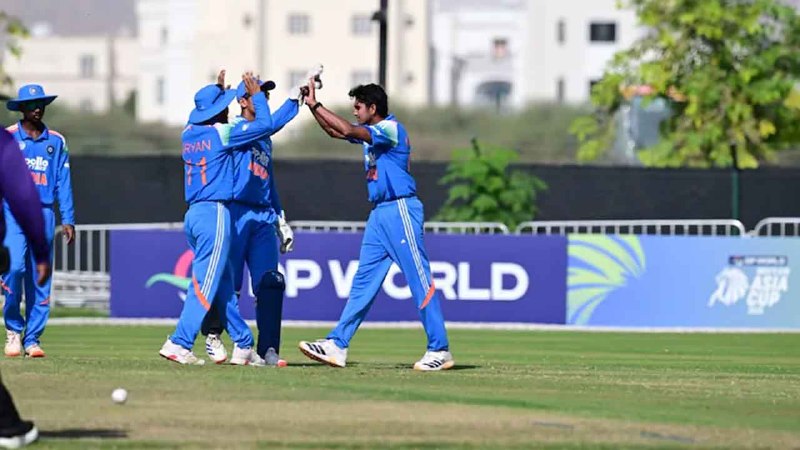
Pakistan set India a target of 338 runs in the Under-19 Asia Cup final, posting 337 for nine wickets in their 50 overs at Al Amirat on November 14, 2026. The total gives India a steep chase in a match that already carries plenty of history between the two sides.
Pakistan’s innings was built around opener Usman Khan. He took his time early and then accelerated to a century, scoring 107 off 111 balls with 11 fours and three sixes. That knock gave Pakistan a platform to push toward a total well beyond what the Indian bowlers would have wanted to defend.
Usman Khan hit 107 off 111 balls with 11 fours and three sixes, anchoring Pakistan’s 337 for nine in the U19 Asia Cup final against India.
He was not alone in doing the damage. Abdul Qadir contributed 80 runs, and captain Farhan Yousuf chipped in 63. Those three innings together gave Pakistan the kind of middle-order and top-order support that turns a good score into a big one, and it is the reason the total looks so imposing on the scoreboard.
India did not let Pakistan run away with the innings completely. The Indian bowlers took six wickets in the final six overs, which slowed Pakistan’s momentum at the death and kept the total from climbing even higher. Pace and spin both had a role in that late collapse of wickets, and it is the kind of late pressure that can decide a final.
Kavya Patel was the standout bowler for India. He took four wickets in the match, the best return in the Indian attack. C Venkata also made an impact with three wickets. Their combined spell turned a batting display that threatened to go past 350 into a total that India can at least target.
The result matters for India beyond the scorecard. The Indian team lost to Pakistan earlier in the tournament, during the group stage, and that defeat has been hanging over this match. Winning the final would give India a chance to avenge that loss on the biggest stage of the competition, and the team is clearly aware of the opportunity.
A target of 338 in a one-day international format is demanding for any side. Batsmen have to balance the need for quick runs against the risk of losing wickets, and a chase of this size usually requires at least one or two batters to build a long innings. India’s top order will have to find rhythm quickly if they want to stay in the contest, because the required rate will not wait for them to settle.
Pakistan’s innings also showed the value of a well-timed late assault. Their lower order and the closing overs produced enough runs to keep the total climbing, even after India’s bowlers had started to tighten the screws. That late pressure is what separates a competitive score from a commanding one, and Pakistan made sure the total ended up on the right side of that line.
For the Indian batters, the key question is whether they can handle the pressure of the chase in a high-stakes final. Early wickets would put the innings under strain, while a strong start could change the mood of the stadium and the match. Everything depends on how the top order responds to the Pakistan total in the first powerplay.
The match is a reminder of how quickly a final can turn. Pakistan built a total that looked very difficult, and India answered by taking wickets in the closing overs. Now the ball is in India’s court, and the chase will decide whether that late fightback was enough.
TL;DR
- Pakistan posted 337 for nine wickets in 50 overs in the U19 Asia Cup final against India, setting a target of 338 runs.
- Opener Usman Khan scored 107 off 111 balls, with 11 fours and three sixes.
- Abdul Qadir made 80 and captain Farhan Yousuf scored 63 for Pakistan.
- India took six wickets in the final six overs to slow Pakistan’s late charge.
- Kavya Patel took four wickets, while C Venkata picked up three.
- India lost to Pakistan in the group stage and is looking to win the final.