
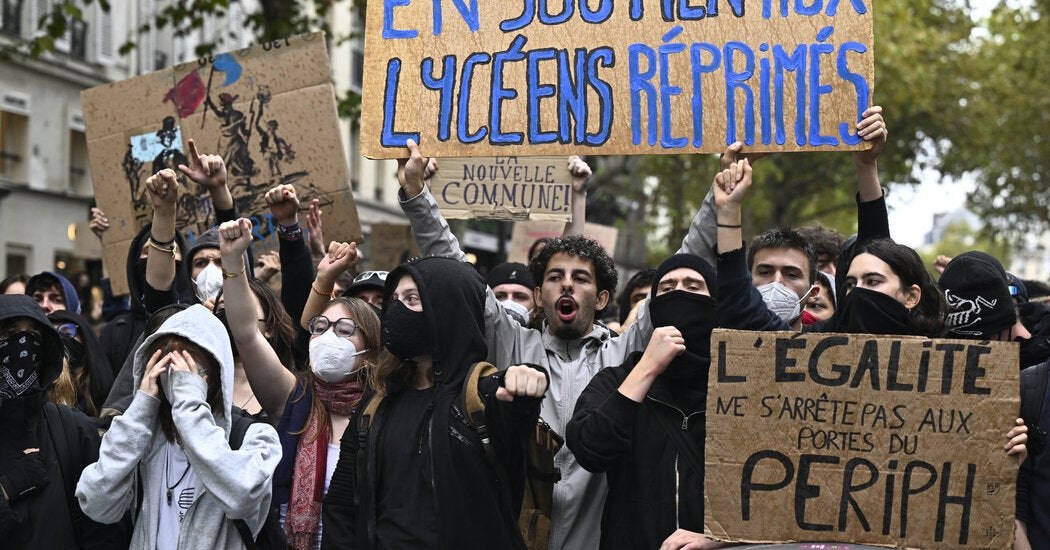
Mass antigovernment demonstrations are planned for Saturday in France, and they are part of a wider revolt by frustrated young people across Europe. Recent protests driven by young people have also erupted in Belgium, Germany, Greece, Italy and Portugal. At the center of the anger is a question that is now pressing on European budgets: as Europeans live longer, should the needs of the young be eclipsed by the pensions of their parents and grandparents?
The stakes are large because pensions are routinely the biggest single items in Europe’s national budgets. Every year that people live longer adds to the bill, and every euro that goes to retirees is a euro that cannot go somewhere else. That arithmetic sits at the heart of the current unrest.
A budget fight inside the same family
Sébastien Ducros, a 36-year-old French data analyst, supports the student protests in his country. He has a clear view of where the money is going. He argues that a lack of government funds for dilapidated schools has an obvious culprit, and it is the pension system. “A huge portion of the money is going toward retirees, while many other things are being neglected,” he said.
Ducros goes further than many people his age would. He says that people like his parents, who are about to retire, are in a position where they should and could give up some of their pension payments. He admits the idea feels strange to say out loud. He says it anyway, because he believes the imbalance is too large to ignore.
Laurent Grinwald, 72, sees the same problem from the other side of the table. He retired recently after decades as a postal worker, and he is not eager to see his pension reduced to pay for other state-funded services. His objection is not abstract. Rents and the cost of living have shot up, and his pension is what he has to live on now.
His frustration is pointed and personal. Grinwald described the moment he and others of his generation have reached, and the way the rules seem to be changing around them.
“We’ve been working all this time, and now, suddenly, the stance is, ‘Well, no, we’re going to start taking a bit more?’”
Grinwald is not arguing that the young have no claim on public money. He is arguing that his generation paid in for a long time and now expects to be able to draw on that promise without being asked to give more back. Ducros hears the same facts and draws the opposite conclusion. The two men share a country, a budget and a frustration with rising costs, yet they reach opposite answers about who should bear the strain.
Why the argument is so hard to settle
The disagreement is not confined to France. The protests in Belgium, Germany, Greece, Italy and Portugal were driven by young people who feel that the welfare systems built after the Second World War are now tilted against them. The reporting from the sources describes frustration among the young in those countries, but it does not provide a full account of each government’s policy, so the specifics vary from country to country.
Jorge Galindo, director of EsadeEcPol, an independent think tank in Spain, put the dispute in the simplest terms. “It’s a generational clash,” he said. Spain has some of the most generous pensions in Europe, which makes it a useful case for anyone trying to understand what happens when a welfare system is very good for one group and expensive for the rest.
That is what makes the French protests more than a local fight over a single budget line. Young workers are being asked to accept higher costs for housing and daily life while watching a large share of public spending flow to people who have already retired. Older workers, meanwhile, are being asked to accept that the deal they signed up for may not be the deal they get. Neither group is wrong to feel what it feels, and that is why the argument keeps turning bitter.
The reporting does not say whether the French government intends to change pension rules in response to the protests. It does not say how large the turnout will be on Saturday, or whether the demonstrations will lead to a shift in policy. Those answers will decide whether this is a passing protest or the start of a longer confrontation over who pays for an aging continent.
TL;DR
- Mass antigovernment demonstrations are planned for Saturday in France.
- Young people in Belgium, Germany, Greece, Italy and Portugal have also protested recently over the cost of public services and budgets.
- Pensions are routinely the largest items in Europe’s national budgets, and Europeans are living longer.
- Sébastien Ducros, 36, says retirees should give up some pension payments to fund neglected public services.
- Laurent Grinwald, 72, says he worked for decades and rents and living costs have shot up.
- Jorge Galindo of EsadeEcPol calls the dispute a generational clash.