The Federal Aviation Administration halted nearly all departures across the United States on Friday afternoon, in a rare nationwide ground stop that officials tied to a major outage in the air traffic control system. The stoppage began shortly before 4 p.m. Eastern, and by evening, the disruption had spread to airports from coast to coast.
Homeland Security Secretary Markwayne Mullin described the problem as a telecommunications outage. He also admitted that the Trump administration did not yet know what caused it, and he warned that repairs would take an extended period of time.
“This isn’t another 9/11,” he said. “I just can’t repeat that enough. People are making that assumption.”
Mullin’s remarks were aimed at a fear that spread quickly once the grounding hit. Multiple U.S. officials said there were no signs the outage came from a malicious cyber incident or other nefarious activity. They all cautioned that their understanding could change.
The FAA’s own advisory stated that “all airports are ground stopped,” citing “extraordinary circumstances and for reasons of safety.” It told departing traffic to stay on the ground until further notice. Inbound international landings would be handled case by case. Shortly after that advisory went out, an FAA website that lists air traffic control system notices appeared to go down, erasing dozens of notices that had been posted.
Transportation Secretary Sean Duffy confirmed the outage in a social media post, citing “a communication issue impacting all Air Route Traffic Control Centers.” “FAA technicians are investigating the issue,” he added. “We will provide immediate updates as we have them.”
The numbers behind the chaos
The scale of the disruption grew fast. As of about 4:45 p.m., FlightAware, a flight tracking website, showed more than 7,800 flights delayed in the United States and about 350 canceled. By 6:30 p.m. Eastern, the count of canceled flights had passed 3,000, and more than 370 flights had already been canceled for Saturday.
The Transportation Security Administration screens more than 2 million people on a typical day. It had screened nearly 2.5 million on Thursday. Cirium, an aviation data firm, said more than 1.5 million people were scheduled to fly on flights departing after the pause took effect. By 6 p.m. Eastern, about 600 flights had been diverted to airports other than their intended destinations. Chicago’s O’Hare led with 28 diversions, and Denver International followed with 26.
FlightRadar24 counted more than 1,000 airborne aircraft bound for U.S. airports during the stoppage. Some of them were still landing. About half an hour after the ground stop was declared, planes could be seen touching down at O’Hare. Passengers on the ground were not so lucky, and many of them waited for word on when they could leave.
Stranded at the gate
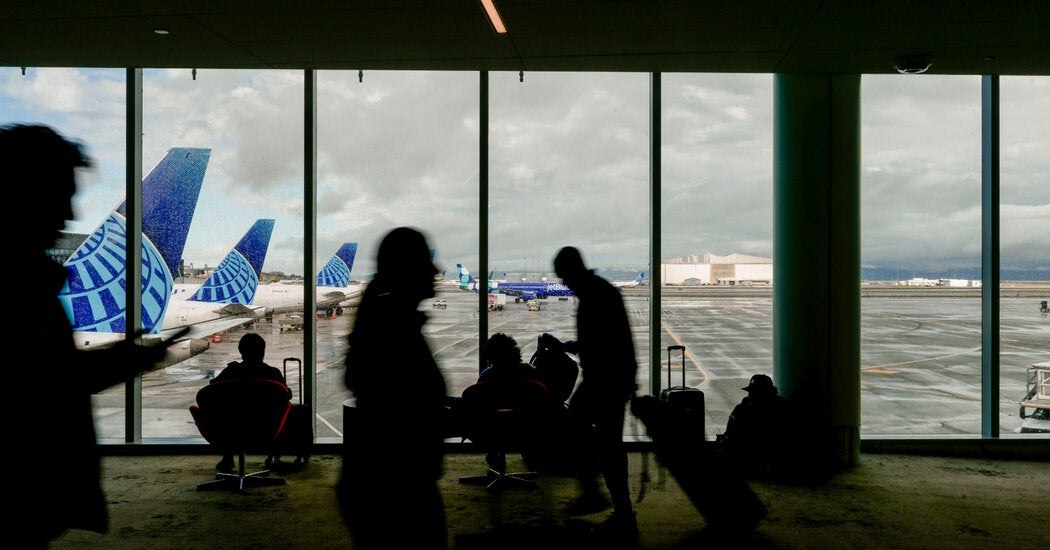
At O’Hare, the terminal turned into a scene of confusion. Travelers crowded around their phones, trying to rebook flights or figure out whether they could leave the city that night. Gate agents told frustrated passengers they had no information and no idea when the situation would end. Some people settled onto the floors for what looked like a long night, while others gave up on their trips and headed into the city.
In Denver, passengers were taken off their planes with their luggage. A few began rebooking for the next day, but most waited for an update. A Southwest flight attendant announced that the airline expected one within 30 minutes.
Lauren Elwell, 32, flew into Chicago at 1 p.m. local time, but she was not allowed off her plane for more than two hours. By then, she had missed her connection to Los Angeles, where friends were waiting for a weekend music festival. At 6:20 p.m., she was at baggage claim. “I need my bag, so I can then try and get a hotel room,” she said. “Then I’ll try again in the morning.”
In Atlanta, a customer service line stretched from a desk past three airport entrances. Many people in it had already checked bags before their flights were delayed or canceled, and they had waited nearly an hour to retrieve them.
International flights and a rare precedent
Not every flight stopped. Some international departures continued from Honolulu and San Francisco to destinations in Asia, and several left Kennedy International in New York for Europe, according to FlightAware. The FAA has not said which international flights are cleared to fly. The agency also asked Eurocontrol, its European counterpart, to suspend flights to the United States from 42 European countries. It asked Mexico’s federal aviation agency to keep aircraft at Mexican airports with scheduled U.S. flights on the ground.
Major Asian hubs were running for the day. Three U.S.-bound flights from Seoul’s Incheon International were delayed by two hours or more, according to FlightRadar24, though an airport employee said none had been canceled.
Friday’s stoppage is only the third nationwide ground stop in recent history. The FAA issued earlier ones on Sept. 11, 2001, after the terrorist attacks on the World Trade Center, and on Jan. 11, 2023, when an outage in the agency’s system for alerting pilots to safety issues lasted about 90 minutes. Friday’s grounding has now outlasted that 2023 episode.
The timing adds pressure. The stoppage came about two weeks before Thanksgiving, one of the busiest travel periods of the year. Airlines for America, an industry trade group, expects U.S. carriers to fly about 2.7 million passengers each day over the holiday period.
What passengers are owed
Travelers hoping for quick help may be disappointed. Airlines will rebook passengers on another flight after a cancellation or significant delay, or at least try to. But when a delay stems from an air traffic control outage rather than from the airline, carriers are not obligated to do as much. Hotel rooms, ground transportation and meal vouchers are not guaranteed.
Passengers are entitled to a refund if their flight is canceled, regardless of the reason. They are also entitled to a refund if a flight is significantly delayed or changed and they choose not to travel. Airlines including United, Delta and Alaska have issued waivers that let travelers change or cancel flights without change fees or fare differences.
Jamie Larounis, a travel industry analyst, said waiting in an airport line may not be the best move. “This won’t be a quick fix,” he said, adding that disruptions would likely spill into the weekend. He recommended booking a hotel quickly for anyone stranded away from home and considering train travel if it was an option. Scott Keyes, founder of Going.com, a travel deals alert site, suggested calling an airline’s international hotline, which may have fewer callers, or rebooking through the airline app. “It’s a race for any remaining seats, so the sooner you’re able to rebook, the better your odds,” he said.
For now, the most important unknown is when planes will fly again. Mullin has said the cause is still under review, and the FAA has not released a timeline. Senator Tammy Duckworth, the leading Democrat on aviation in the Senate transportation committee, said in a statement that “whatever led to the nationwide ground stop will warrant a thorough and complete investigation.” She added that she would demand answers from the FAA.
Watch Video: https://vp.nyt.com/video/2026/11/13/183562_1_13vid-aviation-shutdown-52968_wg_1080p.mp4
TL;DR
- The FAA halted nearly all U.S. departures on Friday afternoon in a rare nationwide ground stop tied to a major air traffic control outage.
- Homeland Security Secretary Markwayne Mullin said the cause was a telecommunications outage, but officials did not yet know what triggered it.
- Mullin said the outage was not a terrorist attack, and officials said there were no signs of a malicious cyber incident.
- More than 7,800 flights were delayed and about 350 canceled by 4:45 p.m., according to FlightAware.
- Roughly 600 flights were diverted by 6 p.m. Eastern, with O’Hare and Denver seeing the most diversions.
- The ground stop is only the third nationwide halt in recent history, and it comes about two weeks before Thanksgiving travel.