Tamil Nadu Chief Minister Vijay, former Andhra Pradesh chief minister YS Jagan Mohan Reddy and BRS working president K T Rama Rao met at a wedding ceremony recently, and the friendly exchange alone set off a wave of political guessing across the country.
The moment was watched closely across India. In an opinion column published on November 15, 2026, senior commentator Dr Ayachitam Sridhar argues that the photograph is only a symptom. The real story is that the BJP and Congress, the two national parties that ruled the Centre and several states for decades, no longer have the confidence to fight elections alone.
The three leaders share a common thread. Their parties, the TVK, the YSRCP and the BRS, are regional outfits that came to power without forging pre-poll alliances. The column notes that both national parties tried every tool in the political playbook to woo them, from inducements to pressure, and failed. For southern voters who feel their identity is often overlooked in New Delhi, the encounter looked like a rare sign of unity.
How the BJP got here
The column traces the arc of the last four decades. Congress, led by Rajiv Gandhi, won a huge majority in the 1984 Lok Sabha election. No party reached the majority mark for the next 30 years. Then, in 2014, Narendra Modi led the BJP to a majority of its own, even though it contested with allies. In 2019, the party strengthened that position, and Modi’s first two governments ran without depending on partners.
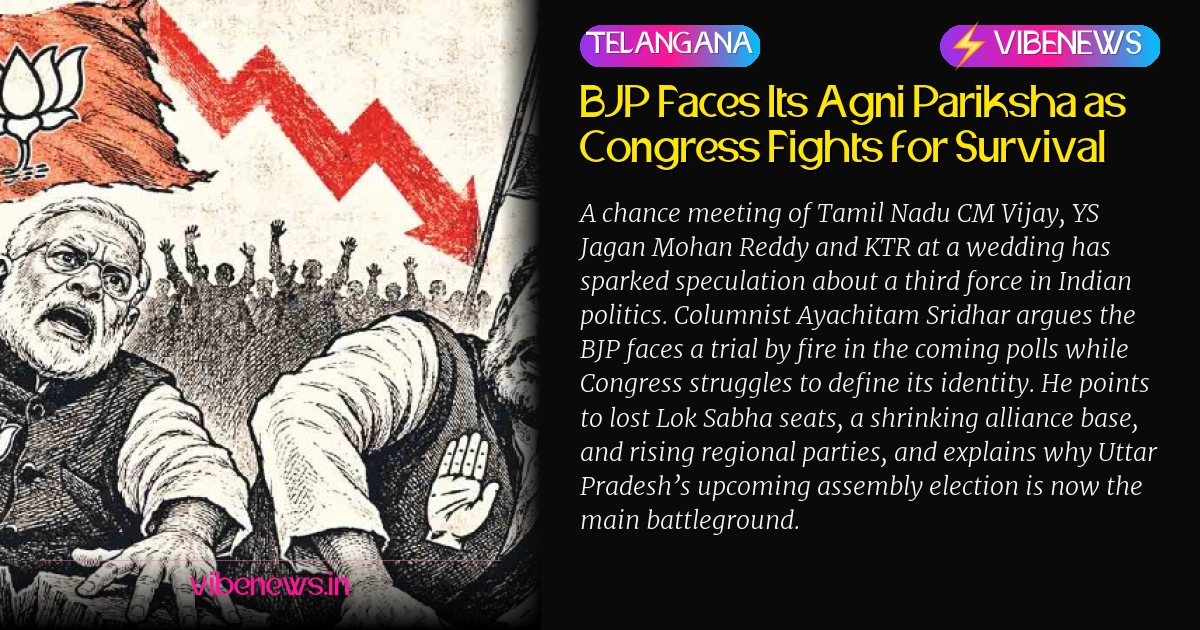
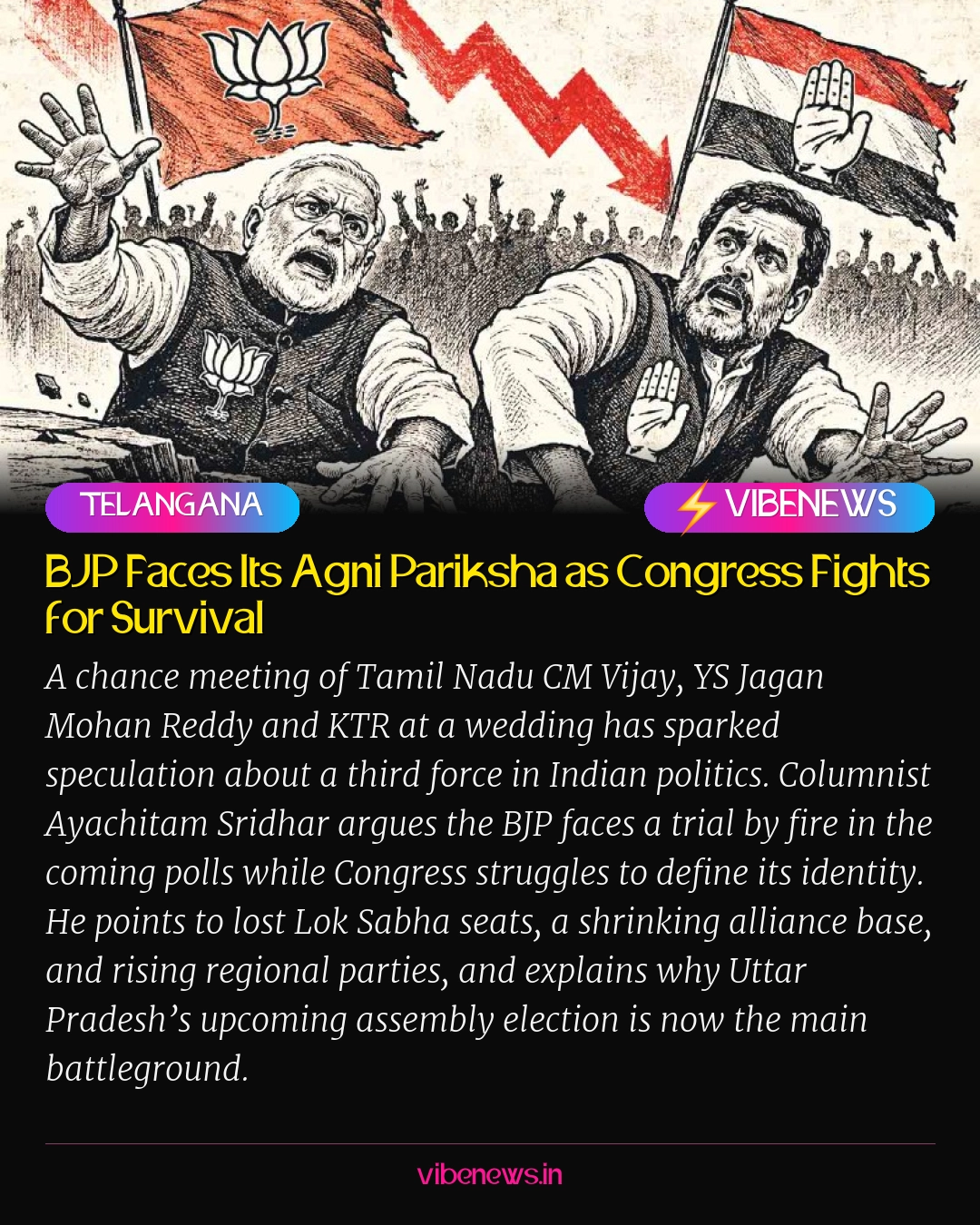
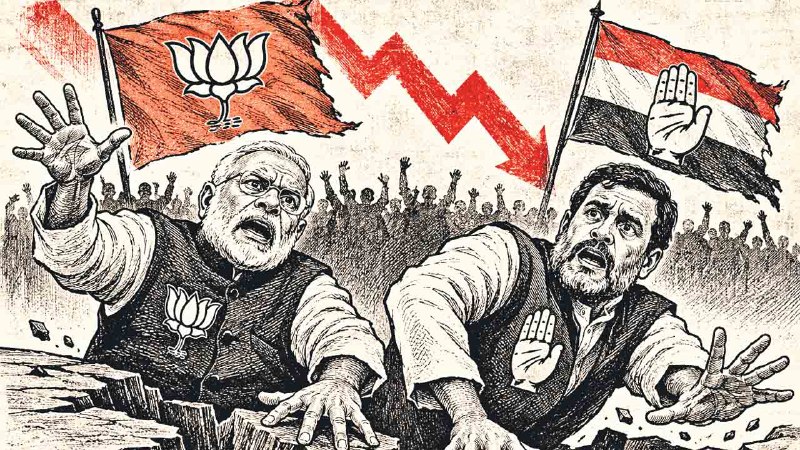
That momentum faded. The column says the BJP’s graph fell in the last Lok Sabha election, when the party finished at 240 seats in the 543-member house and lost 63 seats nationwide. It now governs with the support of allies. In Uttar Pradesh, the party lost 29 seats compared with 2019, despite the completion of the Ayodhya Ram temple. Sridhar writes that the result surprised political observers, especially in a state that Modi has represented for 12 years.
Cracks in the alliance and the Varanasi warning
Allies are also restless. According to the column, the BJP’s partners have grown more divided, and the party was forced to have Union minister Dharmendra Pradhan resign after pressure from a newly emerging political force and youth movements. The column describes the BJP as having been gripped by a sense of insecurity for two years.
Recent local elections in Uttar Pradesh added to that unease. In the council contests for graduate and teacher constituencies, the BJP lost both seats in Varanasi, the constituency Modi represents. Congress did not even contest. Sridhar argues that a party in power in the state, and a prime minister representing the seat, should not be losing so badly.
Congress and the question of identity
The column is just as harsh on Congress. It says the party has not crossed triple digits in the Lok Sabha even with allies behind it. Rahul Gandhi is described as failing to protect the political legacy of Nehru, Lal Bahadur Shastri, Indira Gandhi and Rajiv Gandhi, all of whom rose from Uttar Pradesh. The column also notes that Congress is far from power in the state Rahul Gandhi represents.
Surveys cited in the column suggest Congress could lose Karnataka, Telangana and Himachal Pradesh, the states it currently governs apart from Kerala, which it recently won. DMK, once a long-standing ally, has distanced itself after what the column calls a failure to honour friendship. Akhilesh Yadav has also chosen his own path. Sridhar argues that Congress is becoming isolated while its critics accuse it of ignoring pressing issues. He says the party’s protests have failed to draw ordinary people into the movement.
What it means for Telangana and Andhra Pradesh
For Telangana and Andhra Pradesh, the column’s argument carries direct weight. Telangana is cited as an example of the corruption and favouritism the author links to Congress-ruled states. At the same time, the presence of Jagan Mohan Reddy and K T Rama Rao at the same event puts two of the region’s most prominent opposition figures in the frame of a possible non-BJP, non-Congress realignment. The column does not say how or whether such a front will take shape, but its speculation puts both states at the centre of the national conversation.
The Uttar Pradesh test ahead
Assembly elections in Uttar Pradesh, Punjab, Uttarakhand, Goa and Manipur are due. The column says Uttar Pradesh will draw the most attention because the state sends 80 members to the Lok Sabha and is widely seen as the decisive route to power at the Centre. Based on the recent Lok Sabha and council results, Sridhar writes that Akhilesh Yadav’s victory in the upcoming Uttar Pradesh assembly polls appears likely.
The column also widens the lens to global politics. It points to recent elections abroad in which voters rejected leaders such as Donald Trump and Benjamin Netanyahu, and to internal turmoil in Islamic countries under Sharia law as evidence that extreme religious politics cannot last. Sridhar argues that the BJP’s reliance on religion and fear of war with neighbours may stop working, and that the party’s old tactics are wearing thin.
’Without us, you have no survival,’ the column says of the two national parties, describing a posture like a tree questioning its own shade.
Sridhar’s final point is that voters are tired of two parties that, in his view, have failed to deliver for 25 years. He calls for leadership that offers development and optimism, and he argues that regional parties must step forward to provide it.
TL;DR
- Vijay, Jagan Mohan Reddy and KTR met at a wedding, fueling talk of a third force in national politics.
- The column argues the BJP faces its toughest test in the coming polls, especially in Uttar Pradesh.
- Congress has not crossed triple digits in the Lok Sabha, even with allies, according to the column.
- Surveys cited in the column warn Karnataka, Telangana and Himachal Pradesh could slip from Congress.
- BJP lost 63 Lok Sabha seats nationwide and finished at 240 in the last election.
- Upcoming assembly polls in Uttar Pradesh, Punjab, Uttarakhand, Goa and Manipur will test both parties.