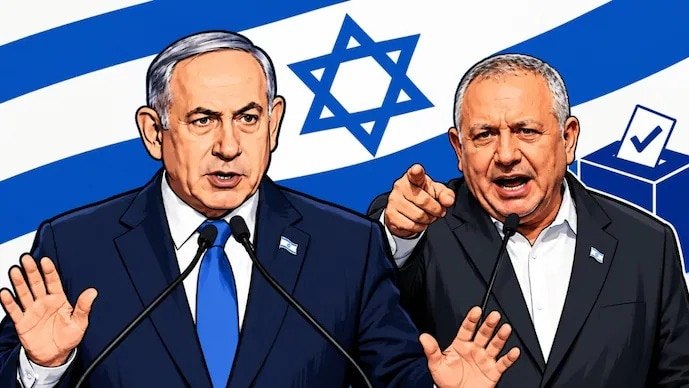
Israel’s political deadlock deepened on Tuesday after the newly elected 26th Knesset took its oath, and the numbers show that neither of the two leading camps has a path to a majority yet. Former military chief Gadi Eisenkot, who leads the Yashar party, said he is determined to build a national emergency government as quickly as possible.
The arithmetic is the problem. Benjamin Netanyahu’s coalition, anchored by his right-wing Likud party and its far-right and ultra-Orthodox allies, won 53 seats in the 120-member chamber. That is better than many in his camp had expected, but it is still eight short of the 61 seats needed for a majority. Eisenkot and his partners have 48 seats. Neither side can govern alone.
That leaves the Arab-led parties, which together hold 19 seats, as the group everyone is watching. They are fierce opponents of Netanyahu and are seen as possible partners for Eisenkot. But no formal agreement has been reached with them, and Eisenkot still has to find a way to pull together a working majority.
A speech that drew a sharp response
The swearing-in ceremony turned personal almost immediately. Netanyahu used his speech to accuse the Joint List and Ra’am, both Arab-led parties, of trying to destroy the Jewish state. He also called for a government of national unity.
Eisenkot did not let it pass. He posted a furious reply on X, calling the speech divisive and hateful, and said it was shameful. He wrote that he had been sitting in the chamber listening to what he described as the outgoing prime minister’s delusional, society-dividing and hate-filled address, and accused Netanyahu of misusing an official state occasion.
"I was sitting there listening to the outgoing prime minister’s delusional, divisive, hate-filled and shameful speech. He misused an official state event, the swearing-in of the 26th Knesset. This only reinforces my conviction that he does not deserve to remain in this position for even one minute."
Eisenkot went on to say he was committed to forming a national emergency government as soon as possible. He said his camp had set a direction that had guided it over the past year and that he had no intention of abandoning it. He framed that direction as a commitment to a Jewish, democratic and liberal Israel in which all citizens have equal rights.
He also accused Netanyahu’s rule of tearing Israel apart and putting its security at risk. Those are strong charges, and they come from a man who now needs to convince the country that he can hold together a fractured parliament.
The Arab parties hold the key
For Eisenkot, the biggest challenge is the Arab-led bloc. Those parties are Netanyahu’s most determined critics, which makes any alliance with them politically risky. Yet without their 19 seats, it is hard to see how Eisenkot reaches 61. Any deal would have to be built carefully, and nothing has been signed.
The same math makes Netanyahu’s position uncertain too. His bloc is short of a majority even with its allies, and his appeal for a unity government suggests he is looking beyond his own camp. Until a new government is formed, he will continue as caretaker prime minister.
What happens if no government forms
If neither Netanyahu nor Eisenkot can assemble the support needed to form a government, Israel could be forced back to the polls. That prospect hangs over every negotiation in the coming days. Parties know that a failed attempt could mean another campaign, and voters would be asked to decide again.
For now, the fight over the government has moved well beyond seat counts. It is a direct clash between Netanyahu and Eisenkot, with the Arab parties suddenly central to the outcome. The coming days will show whether Israel gets a new coalition government or heads into another election.
TL;DR
- Gadi Eisenkot says he is committed to forming a national emergency government as soon as possible.
- Netanyahu’s bloc won 53 of the 120 Knesset seats, eight short of the 61 needed for a majority.
- Eisenkot and his allies hold 48 seats, so neither camp can govern alone.
- The 19 seats held by Arab-led parties have become the key to forming a government.
- Eisenkot called Netanyahu’s swearing-in speech divisive, hate-filled and shameful.
- If no coalition is formed, Israel could face another election, with Netanyahu staying on as caretaker prime minister.