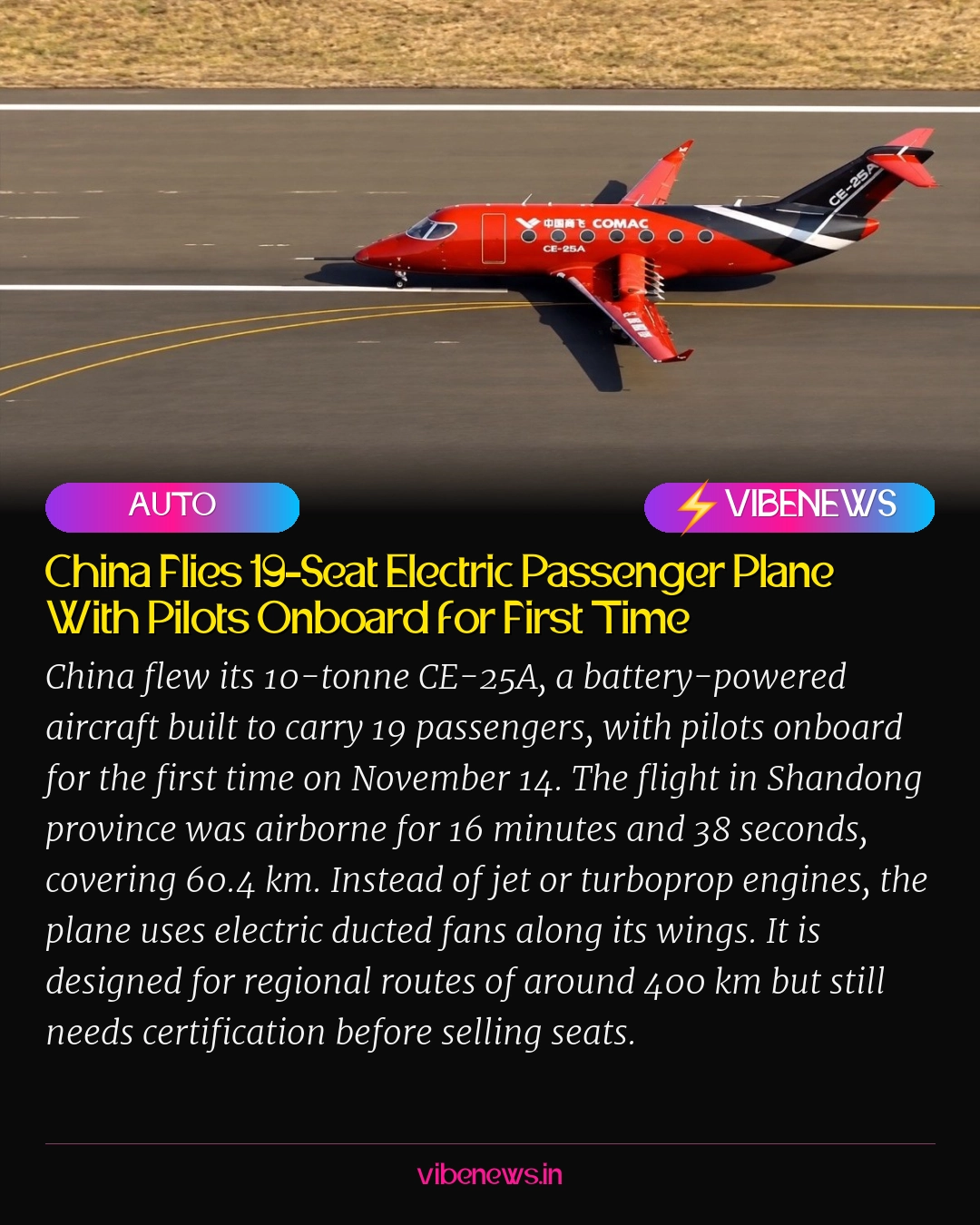
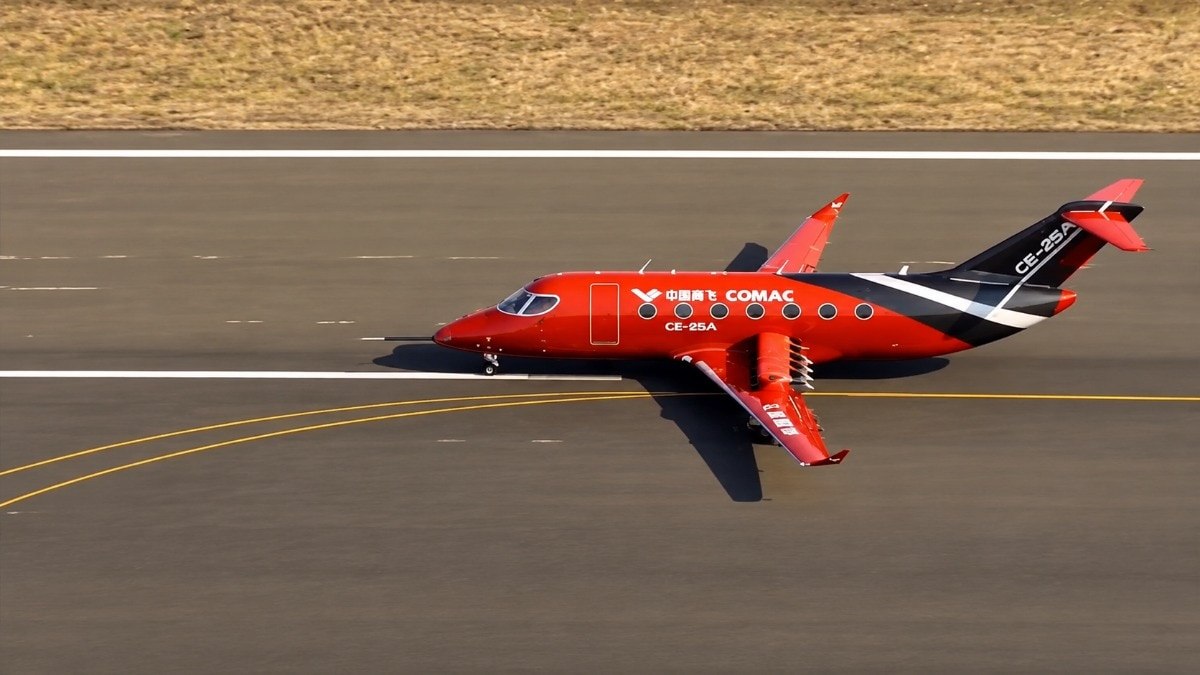
China has flown a 19-seat battery-powered passenger aircraft with people onboard for the first time, completing a piloted test flight on November 14 in Shandong province. The aircraft, the 10-tonne CE-25A, was developed by the Commercial Aircraft Corporation of China, better known as COMAC.
China has long dominated the global market for electric vehicles. Now it is trying to bring that same battery expertise into the sky. Electric planes themselves are not new. What makes this test stand out is the size of the machine and the fact that a crew was flying it.
Two pilots and a flight-test engineer were onboard. According to COMAC, as cited by Chinese state media, the aircraft performed normally during the test and all of its performance indicators met expectations.
The aircraft performed normally during the test, with all performance indicators meeting expectations.
A flight that was longer on paper than in the air
The total flight lasted 57 minutes and 46 seconds. The aircraft was airborne for 16 minutes and 38 seconds of that time, covering a distance of 60.4 km. The gap between the two numbers is a reminder that this was a test campaign, not a demonstration of routine airline service.
The CE-25A is built for short trips. It is designed to carry up to 19 passengers over distances of around 400 km, with a maximum takeoff weight of 10 tonnes, a cruising speed of 300 km/h and a cruising altitude of 2,400 metres. In practical terms, it is aimed at regional hops between nearby cities rather than long-haul journeys.
How the plane gets off the ground
Conventional airliners rely on jet or turboprop engines that burn fuel. The CE-25A does not. It uses an electric propulsion system built around multiple ducted fans mounted along the wings. Electric motors drive those fans, and the motors draw power from the aircraft’s battery system.
That arrangement spreads the thrust across several fans rather than a single engine installation. Whether it delivers real gains in efficiency or performance is still unknown. Those answers will depend on how the aircraft behaves over a longer run of testing.
The question that immediately follows is what a battery-powered airliner could mean for green travel. If electric aircraft can handle regional routes, they could change how short flights are planned and operated. But this single test does not prove that yet. It shows the aircraft can fly with a crew, nothing more.
The road from test flights to ticket sales
The CE-25A did not begin with pilots onboard. It completed an autonomous unmanned flight on February 2, 2026, followed by 19 unmanned flight-validation exercises. The November test marks the next step, bringing human crew into the program.
The project is a joint effort. COMAC is developing the aircraft alongside Chinese battery maker CATL, Shanghai Jiao Tong University and other partners. The team spans aircraft manufacturing, battery technology and academic research, with the stated aim of making electric aviation practical for larger passenger aircraft.
Passengers still cannot book a seat, and that is the part of the story that matters most for the near future. The CE-25A is being developed under China’s CCAR-25 transport-category airworthiness regulations. The Civil Aviation Administration of China has accepted the company’s application for a type certificate.
That acceptance is an important step toward certification. It does not mean the aircraft is approved for commercial passenger service. The gap between a successful test flight and a ticket on sale is still wide, and regulators will decide how quickly it closes.
What comes next
The next phase will focus on whether the aircraft can prove its performance claims across more flights and conditions. Engineers and regulators will need to confirm the propulsion system, the battery setup and the aircraft’s safety margins before any commercial route can be considered.
For now, the story is about a milestone rather than a service launch. A 19-seat electric plane has left the ground with people onboard in China. Whether that becomes a regional airline option will depend on the tests and certification steps still ahead.
TL;DR
- China’s 19-seat CE-25A electric plane completed its first piloted flight on November 14 in Shandong province.
- The 10-tonne aircraft is designed to carry up to 19 passengers over distances of around 400 km.
- Electric ducted fans mounted on the wings replace the jet or turboprop engines used in conventional passenger planes.
- The flight lasted 57 minutes and 46 seconds, with 16 minutes and 38 seconds spent airborne across 60.4 km.
- The aircraft still needs type certification before any commercial passenger service can begin.