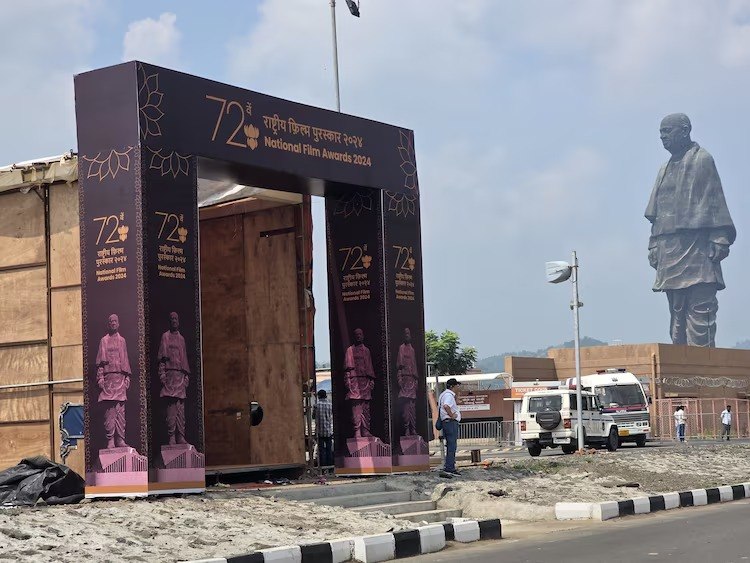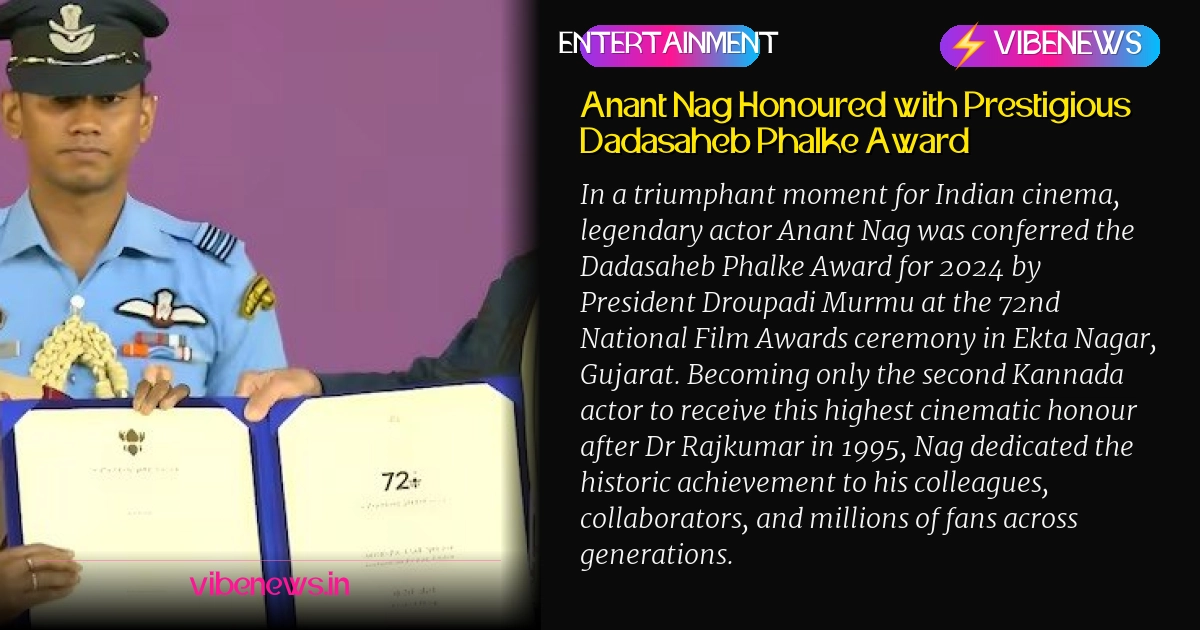
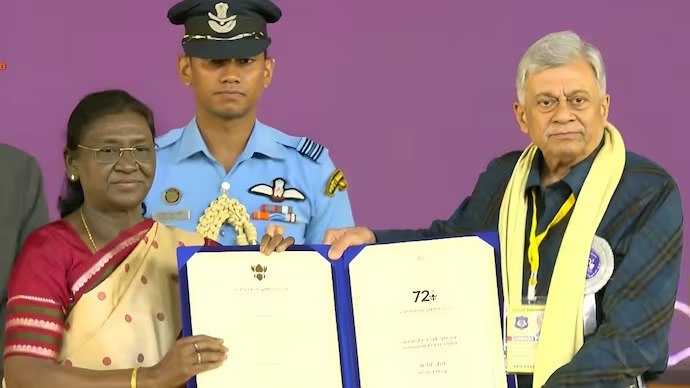
Veteran actor Anant Nag received the Dadasaheb Phalke Award for 2024 from President Droupadi Murmu at the 72nd National Film Awards ceremony in Ekta Nagar, Gujarat, on Tuesday, September 22.
The prestigious ceremony, hosted for the first time outside New Delhi at Ekta Nagar, witnessed a stirring standing ovation as the 78-year-old cinema icon walked to the stage accompanied by his wife, actor Gayathri. Luminaries from across the film fraternity—including Mammootty, Dhanush, Yami Gautam, Kartik Aaryan, and Sanjay Mishra—rose to applaud Nag’s extraordinary five-decade journey. A special video retrospective chronicled his rise from Mumbai theatre stages to defining roles in parallel and mainstream Indian cinema.
"This award doesn’t belong to me alone. It also belongs to everyone – producers, directors, associate directors, assistance directors. The awards belongs to millions of people who opened their hearts and minds to my characters over decades."
A Legacy Spanning Languages and Generations
Born on September 4, 1948, Nag began his journey in Mumbai theatre before making his feature film debut in 1973 with the Kannada film Sankalpa. He quickly established himself as a prominent figure in India’s parallel cinema movement through acclaimed collaborations with director Shyam Benegal in landmark films like Ankur, Manthan, and Bhumika. Nag seamlessly transitioned into mainstream Kannada cinema with beloved hits such as Bayalu Daari, Naa Ninna Bidalaare, and Chandanada Gombe, ultimately amassing over 300 film credits across Kannada, Hindi, Telugu, Tamil, Malayalam, Marathi, and English languages.
Beyond feature films, Nag’s versatile talent reached millions of Indian homes through television, notably as the lead in the iconic Doordarshan adaptation Malgudi Days, directed by his late younger brother Shankar Nag. In recent years, Nag captivated an entire new generation of filmgoers playing the crucial role of narrator Anand Ingalagi in the blockbuster franchise KGF: Chapter 1 and KGF: Chapter 2, alongside acclaimed performances in Mungaru Male, Godhi Banna Sadharana Mykattu, and Raajakumara.
Cross-Regional Impact and Telugu Cinema Connections
Nag’s extensive career includes notable contributions to Telugu cinema among his multi-language filmography. The 72nd National Film Awards also celebrated broad South Indian cinematic excellence, highlighting the epic Telugu film Kalki 2898 AD as the Best Popular Film Providing Wholesome Entertainment, underscoring the interconnected vibrancy of regional industries where stalwarts like Nag have long acted as unifying ambassadors.
A Journey of Gratitude and National Pride
The Dadasaheb Phalke Award—instituted in 1969 to commemorate the director of India’s first full-length feature film Raja Harishchandra—marks the second major national honour for Nag in consecutive years, following his Padma Bhushan award in 2025, also presented by President Murmu. Nag expressed profound gratitude during his acceptance address, reflecting on his childhood spent in an ashram and invoking philosophical wisdom from Adi Shankaracharya and Kanakadasa on human endeavor and livelihood.
Closing his moving address to heartfelt applause, Nag emotionally declared that while India is his janmabhoomi and Bharat his dharmabhoomi, Karnataka has been his karmabhoomi. With this historic honour, Nag stands alongside Dr Rajkumar, who was recognized in 1995, as only the second Kannada actor to receive India’s highest cinematic recognition, capping a legendary career defined by artistic brilliance, humility, and devotion.
TL;DR
- Anant Nag received the Dadasaheb Phalke Award for 2024 from President Droupadi Murmu in Ekta Nagar, Gujarat.
- He is only the second Kannada actor to win the country’s highest cinematic honour after Dr Rajkumar in 1995.
- The 78-year-old icon has featured in over 300 films across Kannada, Hindi, Telugu, Tamil, Malayalam, Marathi, and English.
- Standing ovations from film industry peers greeted Nag as he walked up to receive the coveted award.
- Nag dedicated the milestone award to directors, technicians, and millions of cinema lovers across five decades.