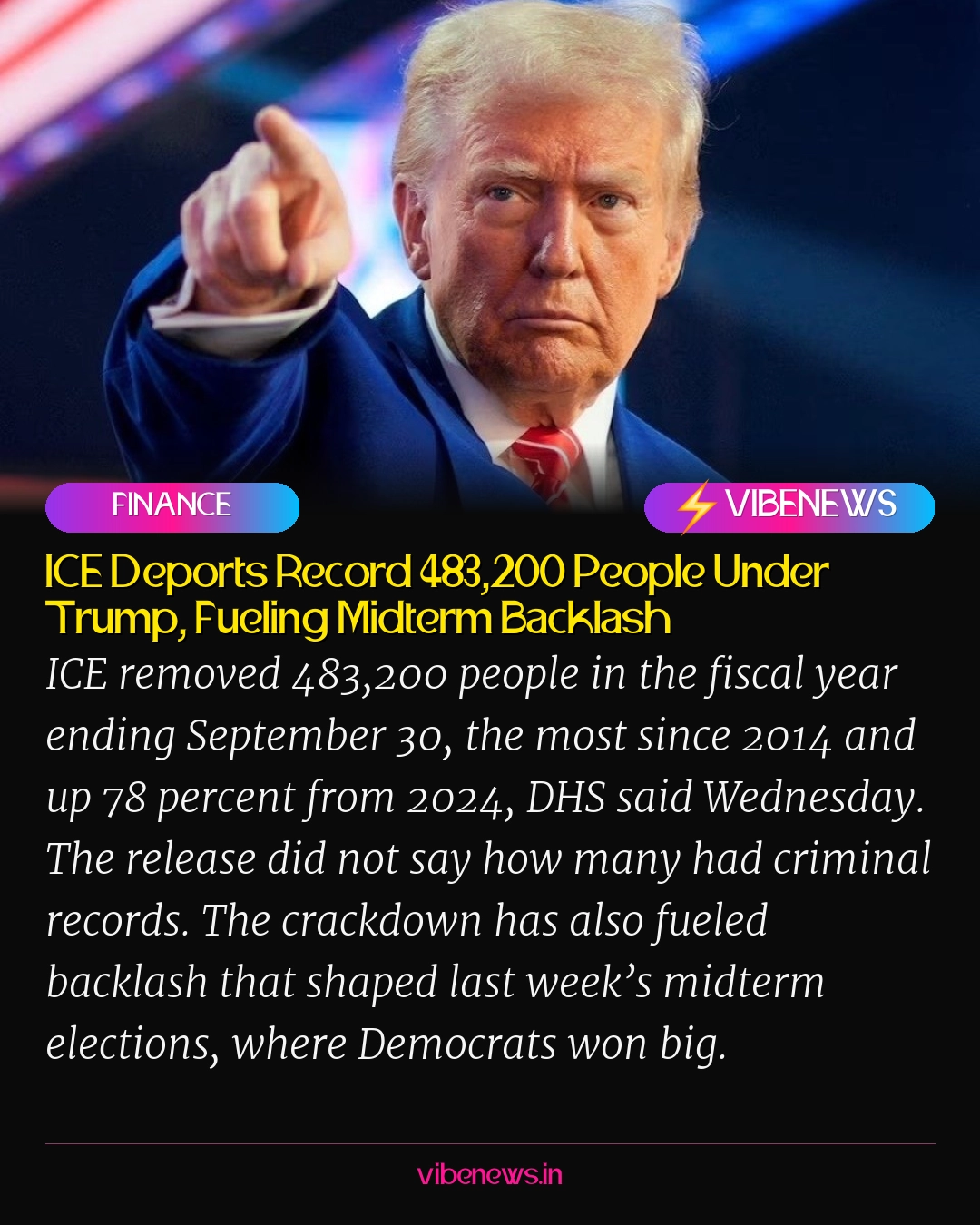

U.S. Immigration and Customs Enforcement removed 483,200 people from the country in the fiscal year that ended September 30, the Department of Homeland Security said Wednesday. It is the largest number the agency has deported in its 23-year history, and the figure arrived just days after Democrats won a sweeping victory in the midterm elections.
The total is 9 percent higher than the 442,640 removals recorded the year before. Compared with 2024, the last full year of the Biden administration, when 271,480 people were removed, the number has jumped 78 percent. The DHS data also shows that the current pace is far above the 405,090 removals carried out in 2014 under President Barack Obama.
The only higher total on record goes back to 1954, when about 1.1 million people were removed under President Dwight D. Eisenhower. That is the benchmark the current administration now sits behind, though it is still well short of the White House goal of removing one million people a year.
What the numbers do not show
The DHS press release is missing one detail that matters most to the public debate. It does not say how many of the people removed had criminal histories. That gap has become the central question for critics and researchers who track deportations.
Trump promised to go after the worst criminals. But data from the Deportation Data Project found that only about a quarter of the people removed in July had criminal convictions, and more than half had no charges at all. The contrast between the campaign pledge and the removal profile is at the heart of the political fight now.
Marc R. Rosenblum, a visiting fellow at the Migration Policy Institute, said ICE is making record arrests and has roughly double the staff and resources it once had. The problem, he argued, is that incomplete figures make it hard to see what is really happening on the ground. Without clear breakdowns, he said, it is difficult to judge the scope and the effects of the campaign.
Homeland Security Secretary Markwayne Mullin framed the numbers as a success. In his statement, he said:
Because of the leadership of President Trump, ICE has been given free rein to target and remove illegal aliens so we can save American lives.
The statement focused on public safety, but it did not answer questions about who was actually removed. That silence is one reason the numbers have become a political flashpoint rather than a simple policy scorecard.
Minneapolis changed the tone of the crackdown
The deportation drive produced some of its sharpest confrontations in Minneapolis. More than 2,000 federal officers were deployed there, and clashes followed during the operation. Two American citizens, Renee Good and Alex Pretti, both 37, were killed in those confrontations.
The deaths pushed the administration to change its methods. After the Minneapolis violence, enforcement shifted toward quieter, unannounced raids instead of highly visible public operations. Officials appear to have hoped that lower visibility would reduce the risk of more street clashes. Instead, the change may have shifted the political fallout to a different group of voters.
The midterms and the farm vote
The raids had a direct effect at the ballot box. Arrests of long-time migrant workers on farms and inside factories angered communities that had long supported Republicans. In many rural areas, traditional Republican voters cast their ballots for Democrats in protest against the arrests of neighbors and people they had worked alongside for years.
That shift matters for the bigger political picture. Immigration enforcement has often been treated as a base-mobilizing issue. This year, it appears to have cut into a part of the coalition that Republicans had counted on, especially in agricultural and manufacturing communities where undocumented workers are a visible part of daily life.
The economic stakes are just as sharp. Farms and factories depend on workers who have been in the country for years, and removing them can leave employers scrambling for replacements. Those costs have been part of the argument from business owners and local leaders, and they are now meeting a national debate over how far enforcement should go.
What comes next
The administration is likely to point to the record removals as proof that its strategy is working. Opponents will focus on the criminal-history gap, the Minneapolis deaths, and the political damage in the midterms. Neither side can settle the argument until the government releases fuller data on who was removed and why.
For now, the story is a collision between two numbers. One is the headline total of 483,200 removals, a figure that has not been matched in more than a decade. The other is the much smaller share of those removed who had criminal convictions, and the political price the campaign has paid at the polls.
TL;DR
- ICE removed 483,200 people in the fiscal year ending September 30, the most in its history since the 2014 peak, DHS said Wednesday.
- The 78 percent jump over 2024 is one of the sharpest increases in recent years.
- DHS did not say how many of those removed had criminal histories.
- Data from the Deportation Data Project shows only about a quarter of July removals were criminals.
- The Minneapolis crackdown killed two US citizens, Renee Good and Alex Pretti, and reshaped enforcement tactics.
- Rural Republican voters who opposed the farm and factory raids helped Democrats win big in last week’s midterms.