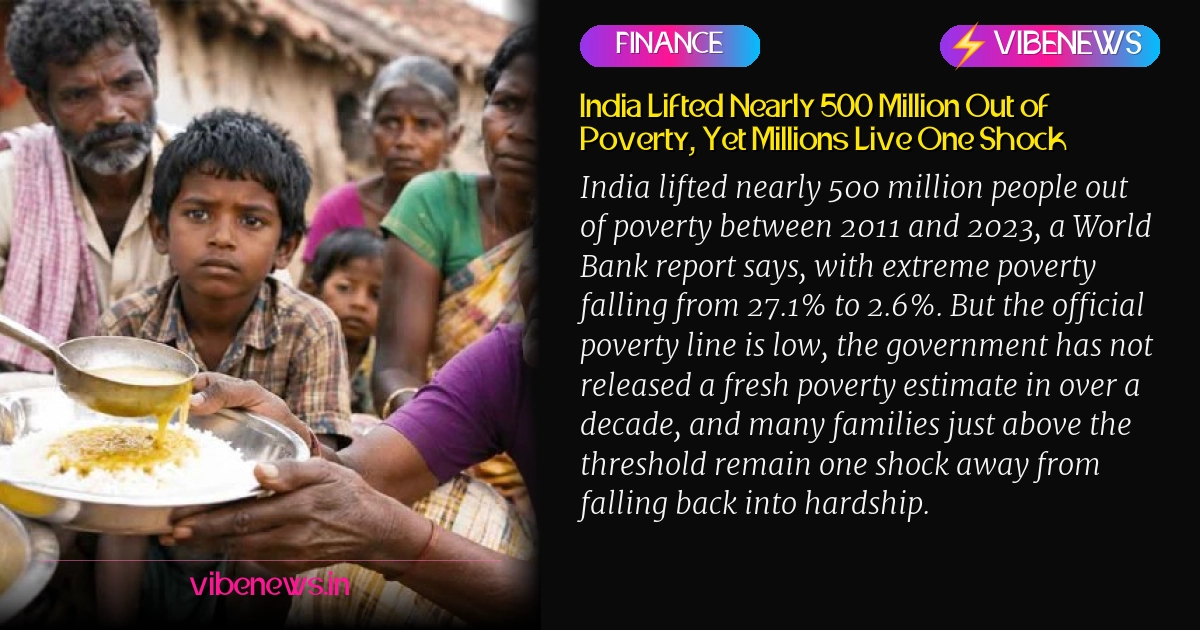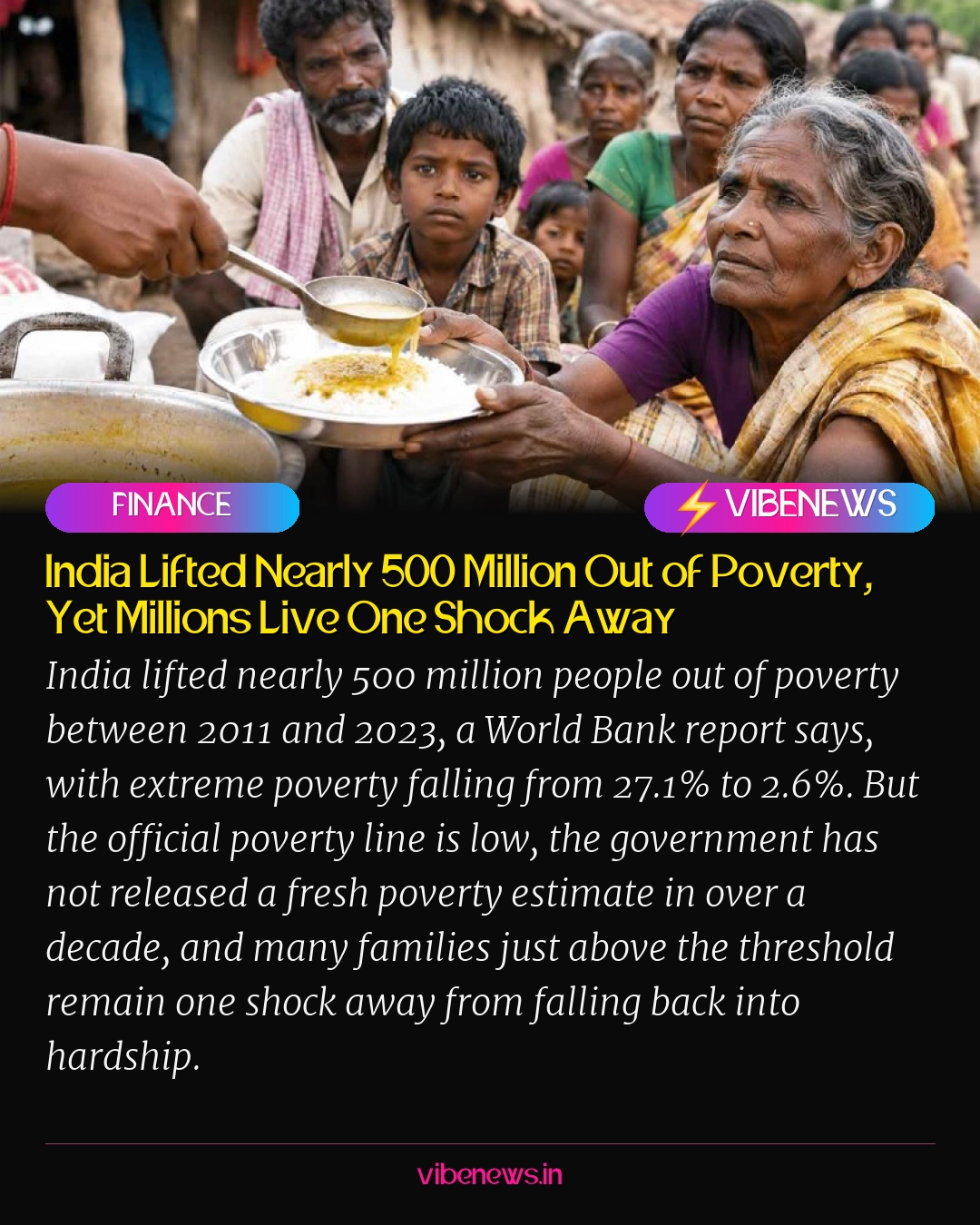
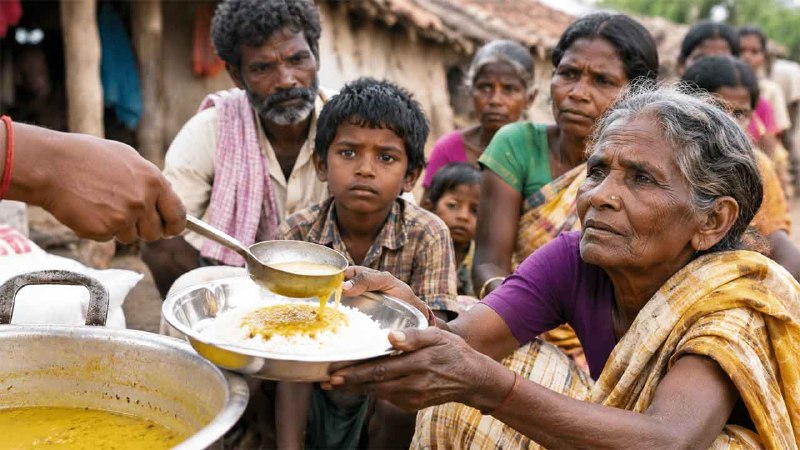
India lifted nearly 500 million people out of poverty between 2011 and 2023, according to a recent World Bank report. Over the same period, the share of people living in extreme poverty dropped from 27.1 percent to 2.6 percent. Those figures mark one of the biggest reductions in poverty anywhere in the world, but they hide a harder reality for families who are still counting every rupee.
Hema Prajapat, 25, lives in Rajsamand district of Rajasthan with her husband, Hari Prajapat, and their nine-year-old son, Divyansh. On official records, her household no longer counts as poor. She spends about Rs 11,000 a month on a family of three.
The World Bank’s poverty line for a household of that size is roughly Rs 7,380 a month in income or spending. Hema’s family spends about 49 percent more than that threshold. On paper, they have moved past poverty. At home, they have not.
By the end of each month, the shelves in Hema’s kitchen are nearly empty. Hari keeps sinking deeper into debt. Most of the food that is left goes to Divyansh. Hema works as a caretaker at a small garden, and she described the monthly squeeze in plain terms.
“Even if thorns sprout in your stomach, hunger does not hurt this much.”
Her words capture something the headline statistics struggle to show. A family can cross a line on paper and still go hungry in the second half of the month.
India does not publish its own count of poor people. The government has not released an official poverty estimate based on consumption spending for more than ten years. That gap has left a vacuum, and the World Bank has filled it with newer consumption surveys and its own poverty lines. This makes India comparable with other countries, but it also means the numbers come from an outside institution working with the data it can access.
The numbers are real, but they are contested.
Several economists say India’s progress is significant and dispute the methods the World Bank uses to make its calculations. They argue that the bank’s approach is not open to serious doubt. Even so, they stress that India still has a long way to go before it can claim to have defeated poverty.
Other economists question the bank’s broader conclusions. They also point out that India has not made its own poverty estimates under the Modi government, and they see that absence as a reason for suspicion. The disagreement is partly academic and partly political, and it leaves ordinary households in the middle of an argument about how to measure their lives.
China is the only country that has achieved a comparable result at this scale. According to the report, China lifted more than 800 million people out of extreme poverty over four decades. India’s drop in extreme poverty over a much shorter window is a remarkable record, even for critics who want more caution about the figures.
The World Bank also credits a rise in women’s participation in the workforce as one reason poverty has fallen. That shift matters, but it has not solved the central problem. Stable jobs with decent pay remain hard to find for women, and the report’s own framing leaves that challenge in place.
Life just above the line
Lakhs of Indian families now sit just above the poverty threshold. They are not safe. They are living on the edge, and a single blow could push them back under the line. Santosh Mehrotra, a development economist based in New Delhi, says India’s poverty line is very low. In his view, one shock is enough to drag a household back into poverty.
Hema has watched prices climb in recent years. She says prices have risen many times over, and her family’s earnings have not kept pace. For households that are only just above the threshold, that gap between rising costs and stagnant income is where the risk lives.
India’s economic size makes this story harder to ignore. The country has a population of about 140 crore and is one of the fastest-growing major economies in the world. By nominal GDP, it is the fourth-largest economy, and it has held that position through the COVID-19 pandemic and the crises in Ukraine and West Asia. Yet India also ranks among the most unequal countries in the world.
That combination explains why the poverty debate matters beyond India’s borders. A country can grow quickly, climb the global economic rankings, and still leave millions of households exposed to a single bad month. For investors, policymakers and readers watching global growth, the question is not only how many people have crossed the line. It is how many can stay across it.
Hema’s experience sits at the center of that question. Her family has been counted as no longer poor, yet her kitchen tells a different story every month. The gap between the official numbers and the daily arithmetic of food, debt and wages is where the real struggle sits, and it is a gap that a single shock could widen again.
TL;DR
- India lifted nearly 500 million people out of poverty between 2011 and 2023, according to a World Bank report.
- Extreme poverty in India fell from 27.1 percent to 2.6 percent over the same period.
- The government has not released an official consumption-based poverty estimate in over a decade.
- A Rajasthan family of three counted as non-poor spends about 49 percent above the World Bank line.
- Economists say millions of families just above the poverty line remain vulnerable to a single economic shock.