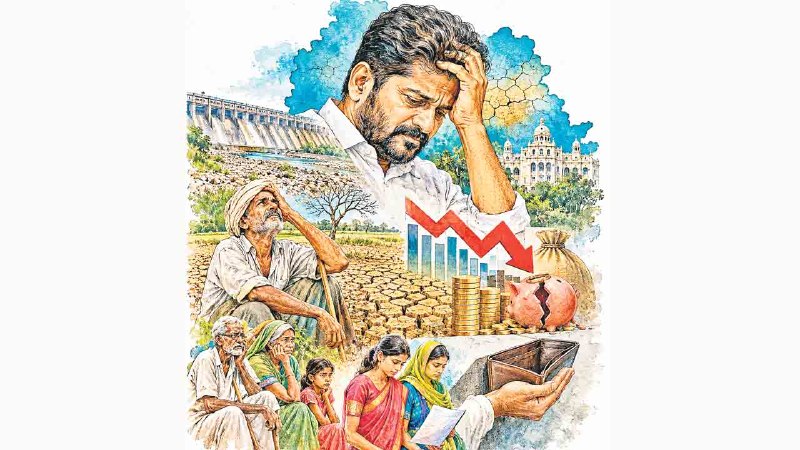
Telangana could lose at least ₹500 crore in state GST collections during November and December, a Commercial Tax department report submitted to the government has warned. The shortfall is tied directly to drought conditions that are cutting into the farm output that drives much of the state’s tax base.
According to the report, lower yields of paddy, cotton and chilli are the main problem. Slower transport and processing of those crops have compounded it. The department says the effect on tax collections begins this month, not later in the fiscal year.
That is a hard turn for the state’s finances. Between April and October of the 2026-27 fiscal year, Telangana collected ₹52,113 crore, and GST grew 17% over the period. The cushion exists on paper, but the season is not producing the goods that normally fill the tax pipeline.
Where the money usually comes from
In a normal harvest season, market yards, rice mills, cotton ginning centres and transport operators bring steady tax receipts to the state. This year, crops are not reaching those points in the volumes needed, and market movement has slowed. The sectors that depend on that flow are struggling, and the government’s revenue projections are feeling the pressure.
The report’s warning reaches beyond GST. Fertiliser, seed and pesticide dealers, rural retail, automobile sales and construction all depend on farm incomes. Agricultural labourers, loading workers and lorry drivers who earn from harvest-season work face the risk of losing jobs. The coverage describes a rural economy that could stall well before the state’s revenue figures show the full damage.
The Commercial Tax department has warned that if income from agriculture and allied sectors falls short, budget allocations will be thrown off and funding for welfare schemes will become very difficult to manage.
Welfare schemes in the firing line
The most immediate worry is for the people who receive monthly support. Lakhs of elderly residents, widows, persons with disabilities and single women rely on social security pensions. Beneficiaries fear that if funds run short, regular pension payments will be the first to slow down. Critics say the government has not delivered on a promised pension increase, and they are asking whether the revenue drop could be used as a reason to cut pensions further. The government has not responded to these claims in the coverage.
Marriage assistance schemes are already under strain. Kalyanalakshmi and Shaadi Mubarak have stalled over the past few months because funds have not been released, and thousands of applications are pending. The new revenue gap raises the risk that the government will stop processing these claims altogether, according to the report.
Scrutiny of businesses may follow
Economic experts quoted in the coverage believe the government may step up scrutiny of service, IT, real estate, manufacturing and commercial sectors to close the gap. They warn that inspections carried out in the name of checks could target traders. The coverage asks whether it is fair to recover losses from a farm failure by squeezing traders and ordinary people through tax pressure.
The political argument
The same coverage carries strong criticism of the state government, and readers should treat those claims as the view of the critics rather than established fact. The critics blame the government for not lifting water from pumphouses in the Kaleshwaram project to fill tanks and ponds. They also say the government failed to act on an El Nino warning that the weather department had issued earlier. Critics argue that the state’s farm and revenue crisis is the result of those decisions.
The figures in the report are early estimates. The final impact will depend on how long the drought lasts and how much of the expected shortfall actually materialises in tax receipts. For now, the warning is clear: a state that had been reporting solid GST growth could see its revenue cushion thin quickly, and the people most dependent on welfare payments are the ones watching closely.
TL;DR
- Telangana may lose at least ₹500 crore in GST collections in November and December, a Commercial Tax department report warns.
- Drought has reduced paddy, cotton and chilli yields, slowing transport, market yards and rice mills across the state.
- The state collected ₹52,113 crore from April to October, with GST growing 17% during that period.
- Critics warn welfare pensions and Kalyanalakshmi and Shaadi Mubarak payments could face funding delays.
- Opposition criticism blames the government for not using Kaleshwaram pumphouses to fill tanks and ponds.
- Economic experts warn of tighter tax scrutiny on service, IT, real estate and trading sectors.