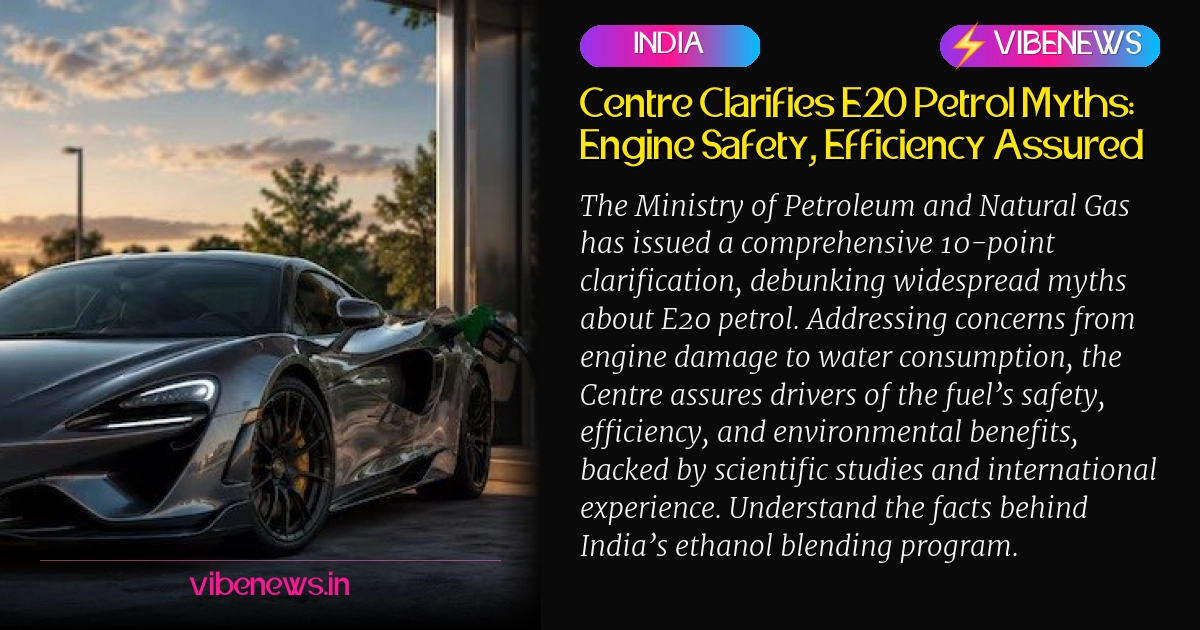
The Indian government has decisively debunked ten prevalent myths surrounding E20 petrol, assuring vehicle owners that the fuel, containing up to 20% ethanol, is safe, efficient, and environmentally beneficial. The Ministry of Petroleum and Natural Gas released a detailed 10-point clarification, directly addressing public concerns about engine damage, excessive water use in production, and fuel performance, aiming to foster greater confidence in the nation’s ambitious ethanol blending program.
This comprehensive clarification is particularly vital for millions of commuters and vehicle owners across states like Telangana, including those in bustling cities like Hyderabad. With E20 petrol becoming increasingly available at fuel stations, understanding these facts directly impacts consumer decisions, vehicle maintenance, and contributes to India’s broader energy security and environmental goals, offering reassurance to local drivers about the fuel’s reliability and long-term impact on their vehicles.
Debunking Key Concerns: Engine Damage and Fuel Efficiency
One of the most significant fears among vehicle owners has been the potential for E20 petrol to cause engine damage or corrosion. The Ministry, citing extensive studies by the Automotive Research Association of India (ARAI) in collaboration with Indian Oil Corporation, the Indian Institute of Petroleum, and the Society of Indian Automobile Manufacturers (SIAM), firmly rejected these claims. These studies found no issues related to drivability or the compatibility of metal and plastic components in modern vehicles. While certain rubber parts in older vehicles might require earlier replacement, this is a minor concern for the vast majority of the fleet.
Furthermore, ARAI-led trials, covering approximately 40,000 kilometres in passenger cars and 20,000 kilometres in two-wheelers, revealed no significant adverse impact on drivability or fuel efficiency. The trials noted only "marginal" changes in mileage, a negligible trade-off considering the broader benefits. Vehicles specifically calibrated for E20 are even poised to benefit from ethanol’s naturally higher octane rating, potentially enhancing performance.
Addressing Environmental and Production Myths
Water Consumption and Agricultural Impact
A persistent myth suggested that producing one litre of ethanol consumes an exorbitant 10,000 litres of water. The Ministry clarified that ethanol production primarily uses surplus rice, diverted only after national food security requirements are met. Moreover, ethanol distilleries typically consume only about 3-5 litres of processed water per litre of ethanol and increasingly employ Zero Liquid Discharge (ZLD) systems to recycle water, minimizing environmental footprint. Maize, now accounting for over 40% of ethanol supply, requires significantly less irrigation than paddy, further promoting sustainable agricultural practices.
E20: Not an Untested Fuel
Claims that E20 is an untested fuel were also dismissed. The government highlighted that ethanol-blended fuels have been in use internationally for decades. Countries such as the United States, Brazil, Canada, Thailand, Japan, and several European nations have successfully adopted ethanol blending at various levels, providing a robust global precedent for India’s program.
Consumer Confidence: Warranties, Insurance, and Misinformation
Warranty and Insurance Validity
Concerns about E20 fuel voiding vehicle warranties or insurance coverage were directly addressed. Automobile manufacturers and insurers have clarified that vehicles designed or approved for E20 remain fully covered under applicable warranty and insurance terms, providing crucial peace of mind for vehicle owners in Telangana and across India.
Debunking Viral Misinformation
The Ministry also tackled several viral social media posts. The notion that ants and bees are attracted to E20 fuel due to sugar content was refuted, explaining that fuel-grade ethanol undergoes distillation to remove residual sugars and contains denaturants that repel insects. Additionally, petrol’s strong hydrocarbon odour dominates the blended fuel, further deterring pests.
Claims that the government described the E20 program as an "experiment" before the Supreme Court were clarified as inaccurate. Court proceedings pertained to contractual provisions for ethanol procurement, not the merits of the blending program itself. Similarly, allegations of water entering fuel tanks in modern vehicles and fabricated videos showing sugarcane juice being mixed into petrol were dismissed, with the Ministry emphasizing industrial production processes and quality specifications.
Significant Benefits and Future Outlook
The E20 ethanol blending program has yielded substantial benefits for India. Since 2014-15, it has contributed to foreign exchange savings exceeding Rs 1.9 lakh crore and expedited payments of over Rs 1.6 lakh crore to farmers. Environmentally, the program has reduced carbon dioxide emissions by approximately 930 lakh metric tonnes and displaced over 310 lakh metric tonnes of crude oil imports.
India achieved its target of 20% ethanol blending in petrol in December 2025, ahead of schedule, with blending levels rising dramatically from about 1.5% in 2013-14. The installed ethanol production capacity has now reached approximately 2,000 crore litres, with procurement projected to exceed 1,200 crore litres during the 2025-26 ethanol supply year. This robust growth underscores the program’s success and its pivotal role in India’s sustainable energy future, directly benefiting the national economy and indirectly supporting local economies in states like Telangana through reduced import bills and agricultural support.
TL;DR
- The Ministry of Petroleum and Natural Gas clarified 10 widespread myths about E20 petrol, assuring its safety and efficiency for vehicle owners.
- ARAI trials confirmed no significant engine damage or adverse impact on drivability for E20-calibrated vehicles, with only marginal mileage changes.
- Ethanol production utilizes surplus agricultural produce like rice and maize, employing efficient water management and Zero Liquid Discharge (ZLD) systems.
- E20 blending has generated over Rs 1.9 lakh crore in foreign exchange savings and reduced CO2 emissions by approximately 930 lakh metric tonnes since 2014-15.
- Vehicle warranties and insurance remain valid for E20-approved models, debunking consumer fears about coverage.
- India achieved its 20% ethanol blending target in December 2025, ahead of schedule, with robust growth in production capacity.