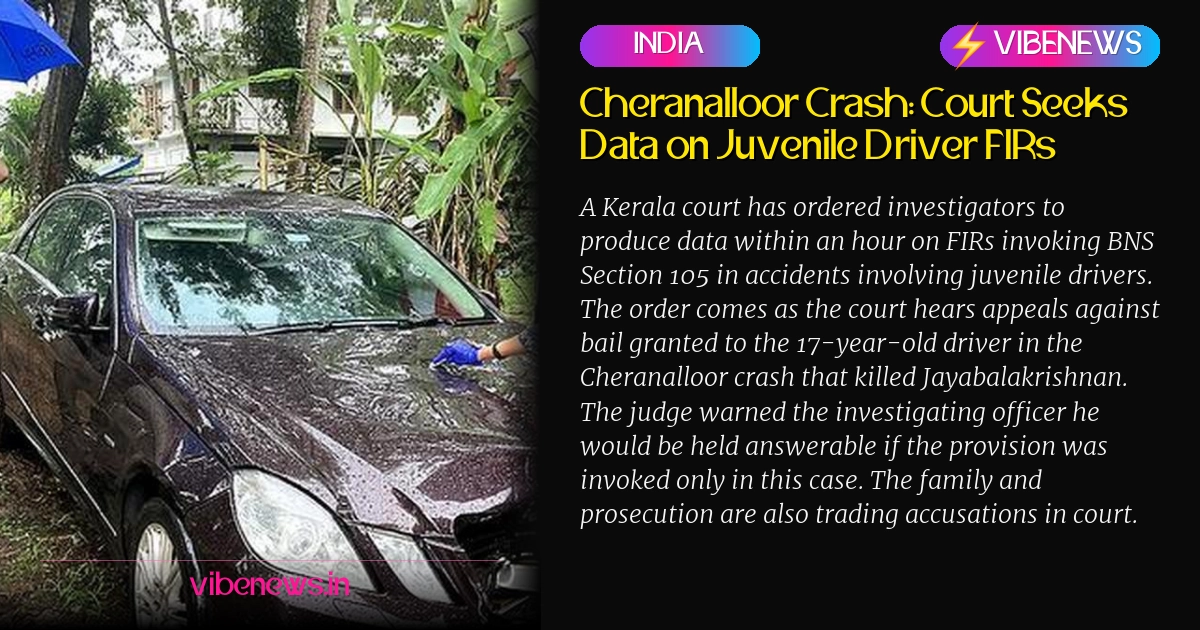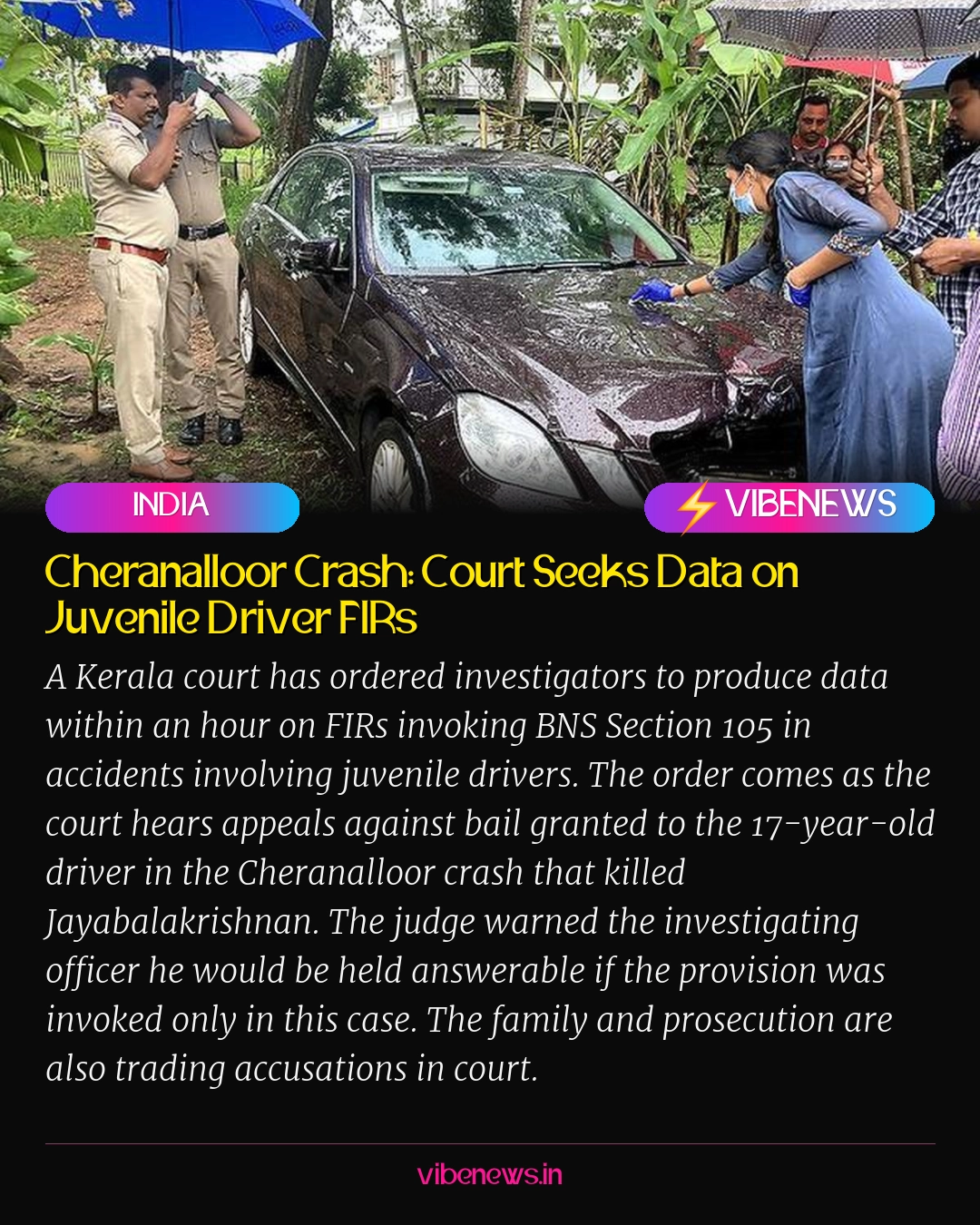
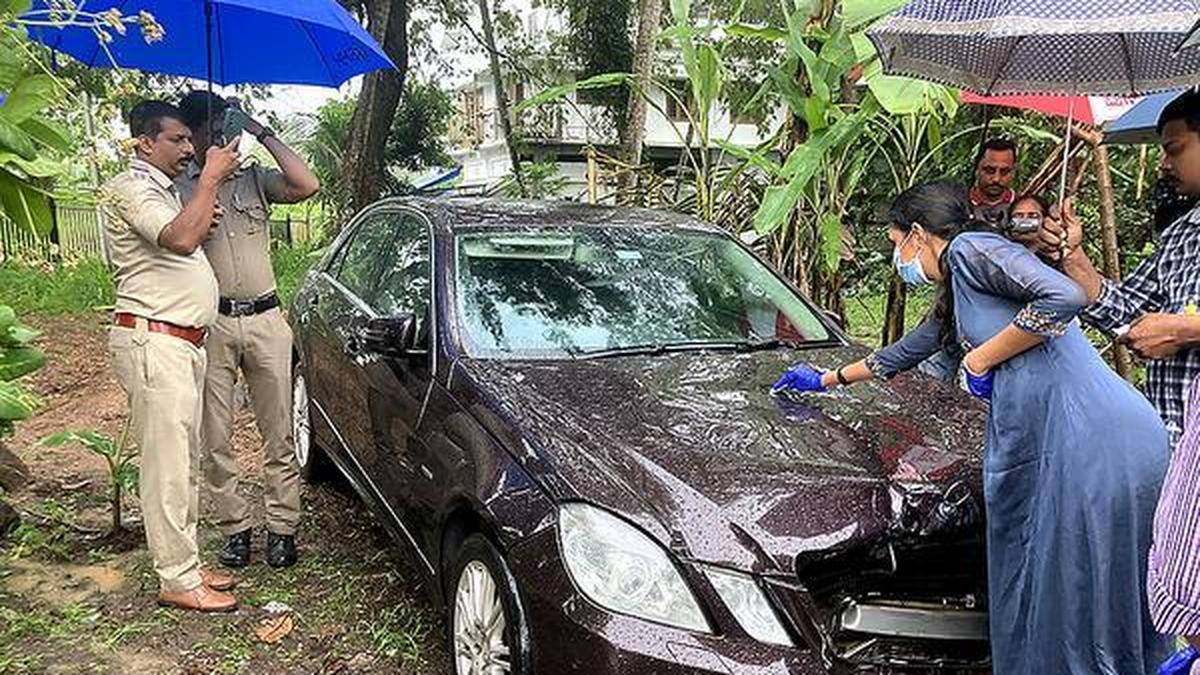
A Kerala court has ordered investigators to hand over, within one hour, data on every FIR registered in the district or elsewhere in the state where Section 105 of the Bharatiya Nyaya Sanhita (BNS) was invoked in accidents involving juvenile drivers.
The order came from the Additional District and Sessions Court in Ernakulam, the court designated to try cases involving atrocities against women and children. Judge Kavitha Gangadharan issued it while hearing appeals seeking the suspension of bail granted to the 17-year-old at the centre of the Cheranalloor crash in Kochi. That crash claimed a life.
Section 105 of the BNS prescribes punishment for culpable homicide not amounting to murder. The fact that the court is asking how often this provision has been used in juvenile driving cases is the story’s central question.
A warning to the investigating officer
The judge did not stop at requesting records. She told the investigation officer, an Assistant Commissioner in the Crime Branch, that he would be held answerable if no FIRs had been registered elsewhere invoking BNS Section 105 in similar cases, and if the provision had been invoked only in the present case.
he would be held answerable if no FIRs had been registered elsewhere invoking BNS Section 105 in similar cases and if the provision had been invoked only in the present case
That warning puts the investigating officer on the hook for the consistency of charging decisions. It also raises a simple question the court wants answered on the record: has this section been applied to young drivers anywhere else in Kerala, or is the Cheranalloor case an outlier?
Questions about where the appeal was filed
The court was also openly critical of the investigation agency. The prosecution filed its appeal against the bail order before the Principal Sessions Court, not before the court designated to try cases involving juveniles. For a court already reviewing how juvenile matters are handled, that choice of forum drew sharp attention.
The judge then asked the prosecution whether it had any doubt that the Juvenile Justice Model Rules constituted the sole framework of the State government governing matters involving children in conflict with the law. It was a pointed question. It signals that the court expects the prosecution to work within the juvenile justice system, not around it.
The bail order itself was granted by the Juvenile Justice Board. The appeals now before the Sessions Court are challenging that decision, and the prosecution and the victim’s family are both on the same side of the challenge.
A courtroom turned tense
The hearing had already become heated before the data order. On Monday, November 2, 2026, the court expressed displeasure over the prosecution and counsel for the victim’s family trading allegations. The judge directed that further proceedings for the day be held in camera, closing the courtroom.
She took that decision despite objections from the family’s counsel. The move shut the public out of arguments that the court itself deemed too sensitive for open proceedings.
The family’s frustration was already public. Bhadra Keerthy, daughter of the deceased Jayabalakrishnan, told the media that the family lacked confidence in the prosecution. The prosecution is represented by Special Public Prosecutor P.A. Bindu.
On the same day, the prosecution told the court that the victim’s family was interfering with the independent investigation through contradictory statements made to the media. The family’s counsel, M.G. Sreejith, rejected that claim. He denied that the family was hampering the investigation and accused the prosecution of non-cooperation.
The in-camera decision came after Sreejith told the court he had certain matters to place before it that could not be discussed in open proceedings. What those matters are has not been made public.
Why this case is pulling public attention
A fatal crash involving a minor who has been granted bail is the kind of case that draws anger, and this one has drawn both anger and curiosity. People want to know how a teenager can face bail in a death case, what the law allows, and whether the rules treat young drivers differently from adults.
The court’s order gives the public a direct answer to part of that question. If Section 105 is being used routinely in juvenile driving deaths, the law is being applied one way. If it is rare, the Cheranalloor case may be an exception that tests the system.
The data the investigation officer must provide will show which of those is true. Until then, the court has made clear that the charging decision in this case will be examined as closely as the crash itself.
What comes next
The bail appeals remain pending before the Ernakulam court. The judge has asked for the FIR data to be appended to her order on those appeals, which means the information will become part of the official record in the case.
For the family, the court’s questions about forum and the juvenile framework may shape how the appeals proceed. For the prosecution, the warning about accountability puts pressure on how its officers have charged juvenile drivers in similar cases.
For Kerala, the case is a test of whether Section 105 and the Juvenile Justice Model Rules are being applied consistently across the state. The answer will come from the records the court has now demanded.
TL;DR
- An Ernakulam court ordered investigators to produce FIR data within one hour on Section 105 BNS use in juvenile driver accidents.
- The order came while the court heard appeals against bail granted to a 17-year-old in the fatal Cheranalloor crash in Kochi.
- Judge Kavitha Gangadharan warned the investigating officer he would be held answerable for inconsistent charging.
- The prosecution filed its bail appeal before the Principal Sessions Court, not the juvenile-designated court, drawing criticism.
- Proceedings on November 2 were held in camera after the family and prosecution traded allegations.
- The victim’s daughter said the family lacked confidence in the prosecution.