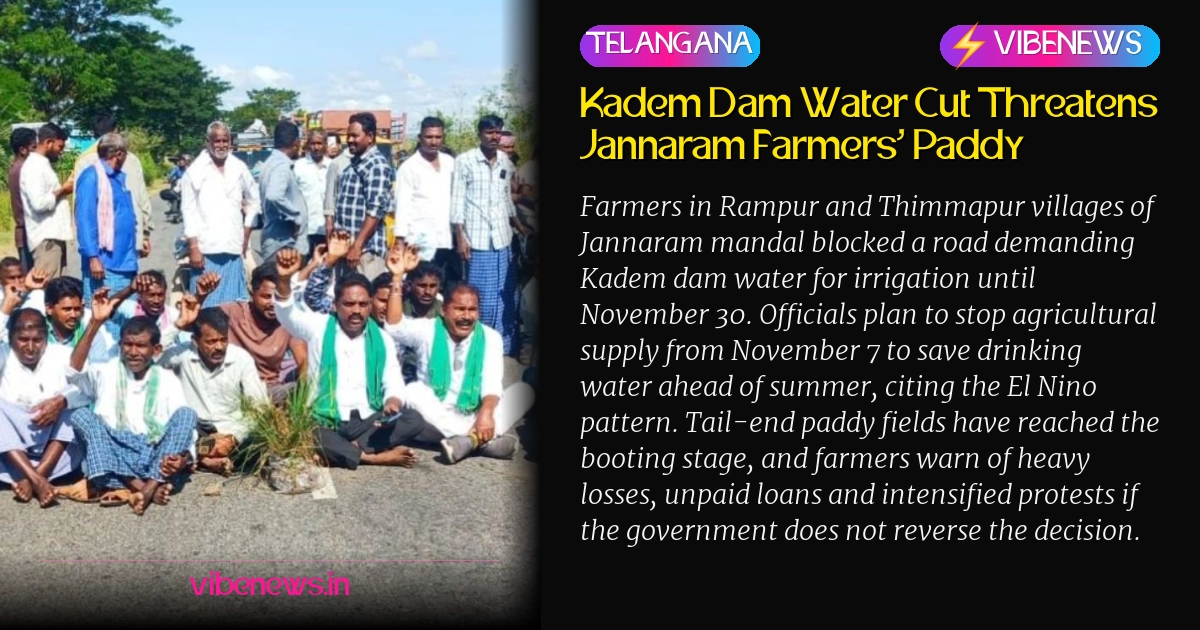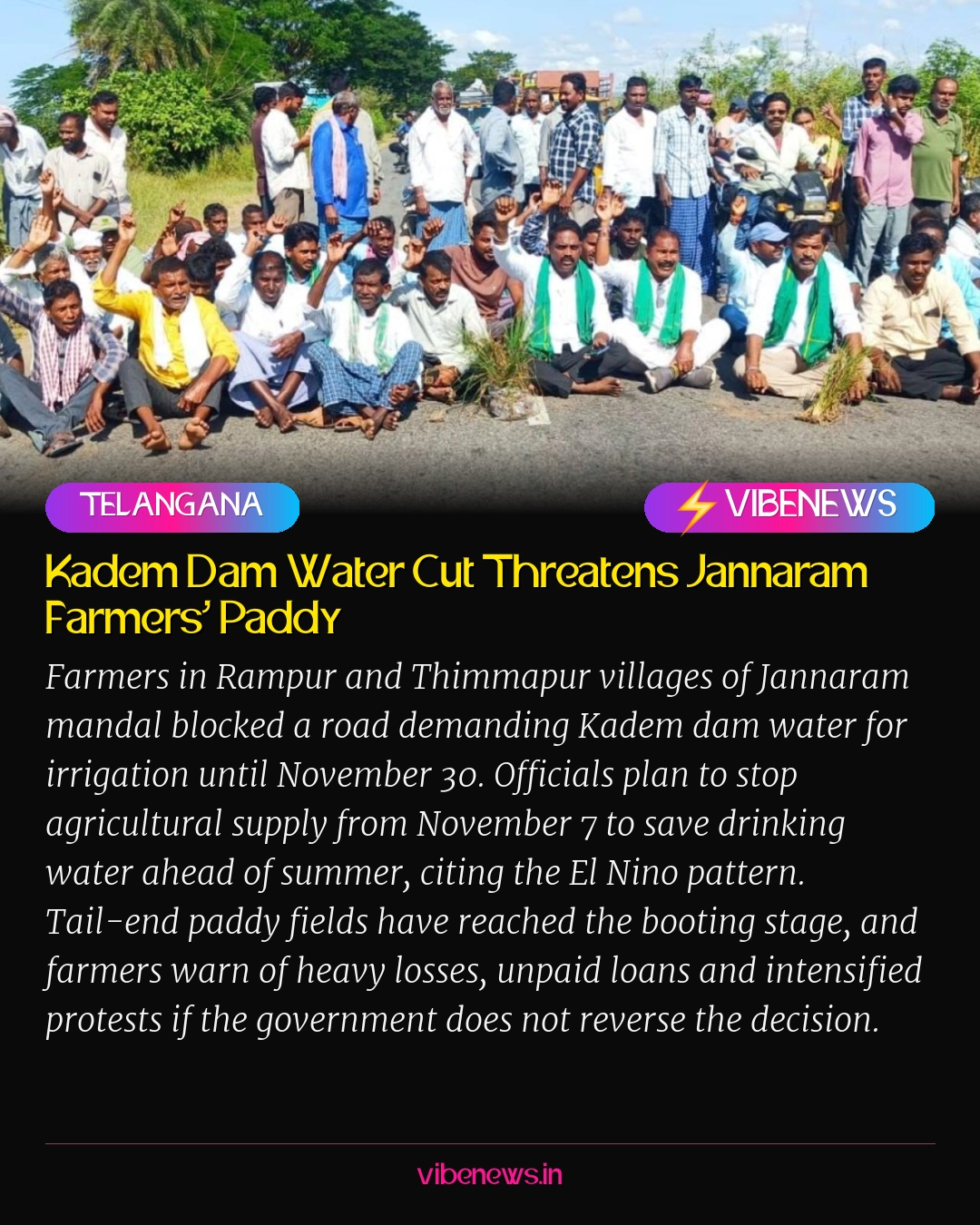
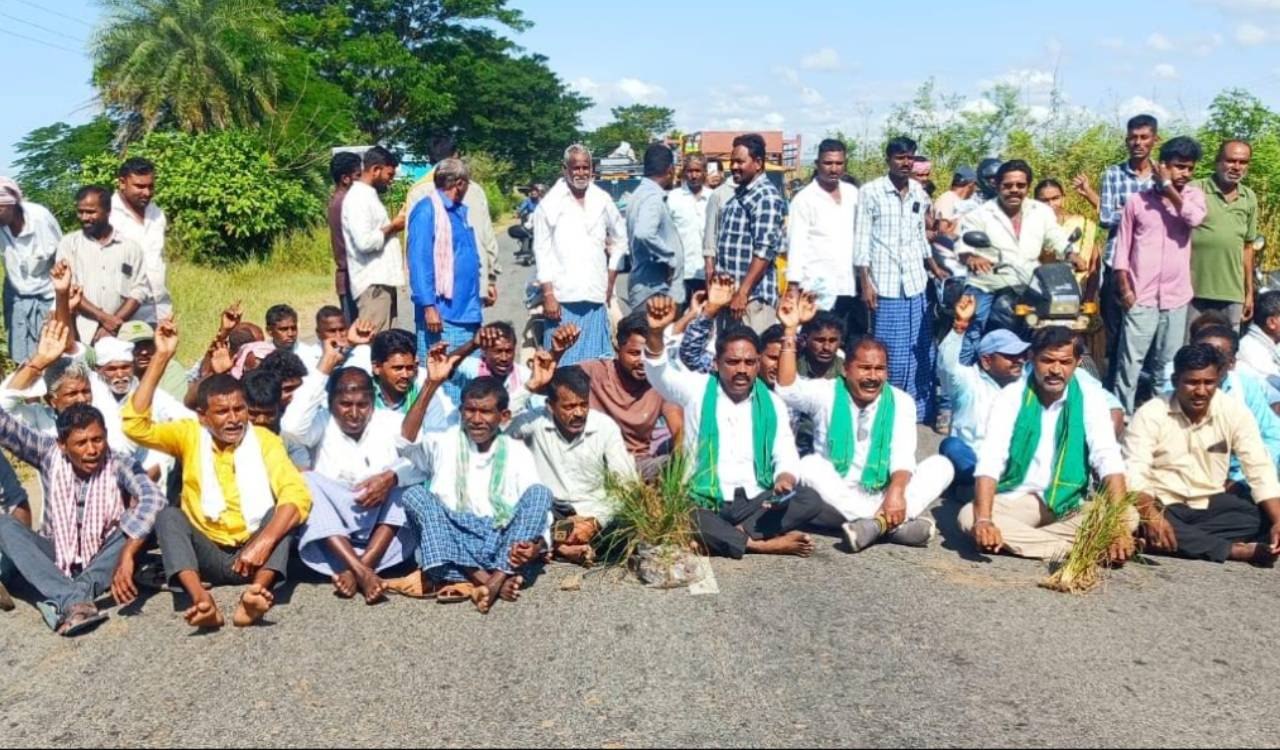
Farmers in Rampur and Thimmapur villages of Jannaram mandal blocked a road on Thursday, demanding that water from the Kadem dam keep flowing for irrigation until November 30. The protest came days before irrigation officials are set to stop agricultural supply on November 7, and the farmers say their paddy will not survive the cut.
The sit-in took place at Thimmapur village. The protesters are cultivating paddy and other crops at the tail-end of the dam, where water arrives last and runs out first. Their fields have reached the booting stage, the phase when the plant forms its grain-bearing head, and farmers say any break in water supply now could wipe out the harvest.
A deadline that leaves no room for error
On November 3, irrigation officials declared that water would not be supplied from the Kaddam Narayana Reddy project or the Kadem dam for agriculture from November 7. The reason given was the need to conserve water for drinking needs in the coming summer, in the wake of the El Nino pattern.
For the farmers, that announcement landed like a countdown. Every day without water at the booting stage is a day their crops lose ground that cannot be made up later. They are not asking for a permanent change in policy. They want the supply extended to November 30, a window that would carry the paddy through a critical stretch of growth.
The water situation, as officials have put it, is not an empty reservoir. The water level of the project is currently at 693.635 feet, or 211.3 tmcs. That figure is the core of the farmers’ frustration: they see water in the dam and cannot understand why it cannot reach the fields that need it most.
Farmers warn the protest will grow
The farmers said they would intensify their agitation against the government if their demand was not considered. That warning carries weight in a district where the dam is the lifeline for crops planted at the tail end of the canal network.
They said that they would not be able to repay loans and witness a financial crisis, driving them to die by suicide.
That statement, reported from the protest site, is the sharpest part of the story. Farmers who have borrowed to plant paddy say a failed crop would leave them unable to repay those debts. The financial pressure they describe is not abstract. It is the kind of stress that, in their words, could drive them to suicide. Their account shows how a single decision about water can quickly turn into a question of survival for entire households.
The farmers also said that they would incur huge losses if the water was not supplied. For families whose income depends on a single season, that loss would not be recovered in a year.
Chintaguda joins the demand
The anger is not confined to Rampur and Thimmapur. On Wednesday, villagers from Chintaguda staged a similar protest, seeking water from the Kadem dam for tail-end agriculture fields. They expressed concern about saving crops from withering at the booting stage, the same worry voiced by farmers a day later at Thimmapur.
The Chintaguda villagers went a step further in their request. They submitted a representation to irrigation officials asking for water until December 5, a date that would extend the supply beyond the November 30 deadline sought by the Rampur and Thimmapur farmers. Two separate villages making two separate written and physical appeals show that the problem is widespread along the tail-end fields, not isolated to one settlement.
Both groups have directed their demands at the same authority: the irrigation officials who made the decision. The farmers have asked those officials to review their decision to reserve water for drinking needs by stopping supply for agriculture from November 7. Whether that review happens before the deadline will determine how the next few weeks unfold.
What happens next
The immediate question is simple. Will the November 7 cutoff hold, or will officials revisit it before the water stops? The farmers have not said they will back down. They have said they will escalate.
There is also a larger balancing act in front of the authorities. The official rationale rests on preparing for summer drinking water needs during an El Nino pattern. The farmers, meanwhile, are pointing to crops already standing in the field and loans already taken out against them. Both concerns are real, and both are rooted in the same reservoir.
For now, the facts are clear. The Kadem dam holds water. The paddy at the tail end is at the booting stage. The supply is scheduled to stop on November 7. The farmers want it to continue until November 30, and the Chintaguda villagers want it until December 5. Every hour between now and that cutoff is an hour in which the decision could still change, and every hour the decision stands is an hour closer to losses the farmers say they cannot absorb.
TL;DR
- Farmers in Rampur and Thimmapur blocked a road in Jannaram mandal, demanding Kadem dam water until November 30.
- Irrigation officials plan to stop agricultural supply from the Kadem dam from November 7.
- The official reason is conserving water for drinking needs next summer, citing the El Nino pattern.
- Tail-end paddy and other crops have reached the booting stage, where farmers say losses would be severe.
- Farmers say failed crops would leave them unable to repay loans, warning of a financial crisis.
- Chintaguda villagers protested Wednesday and requested water from the dam until December 5.