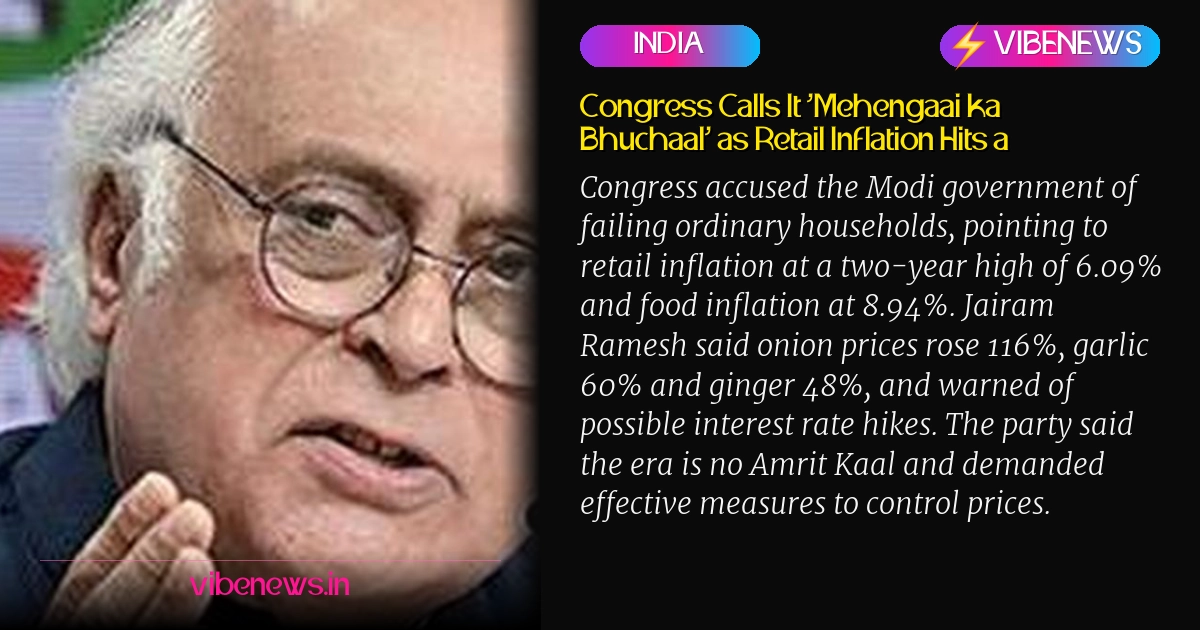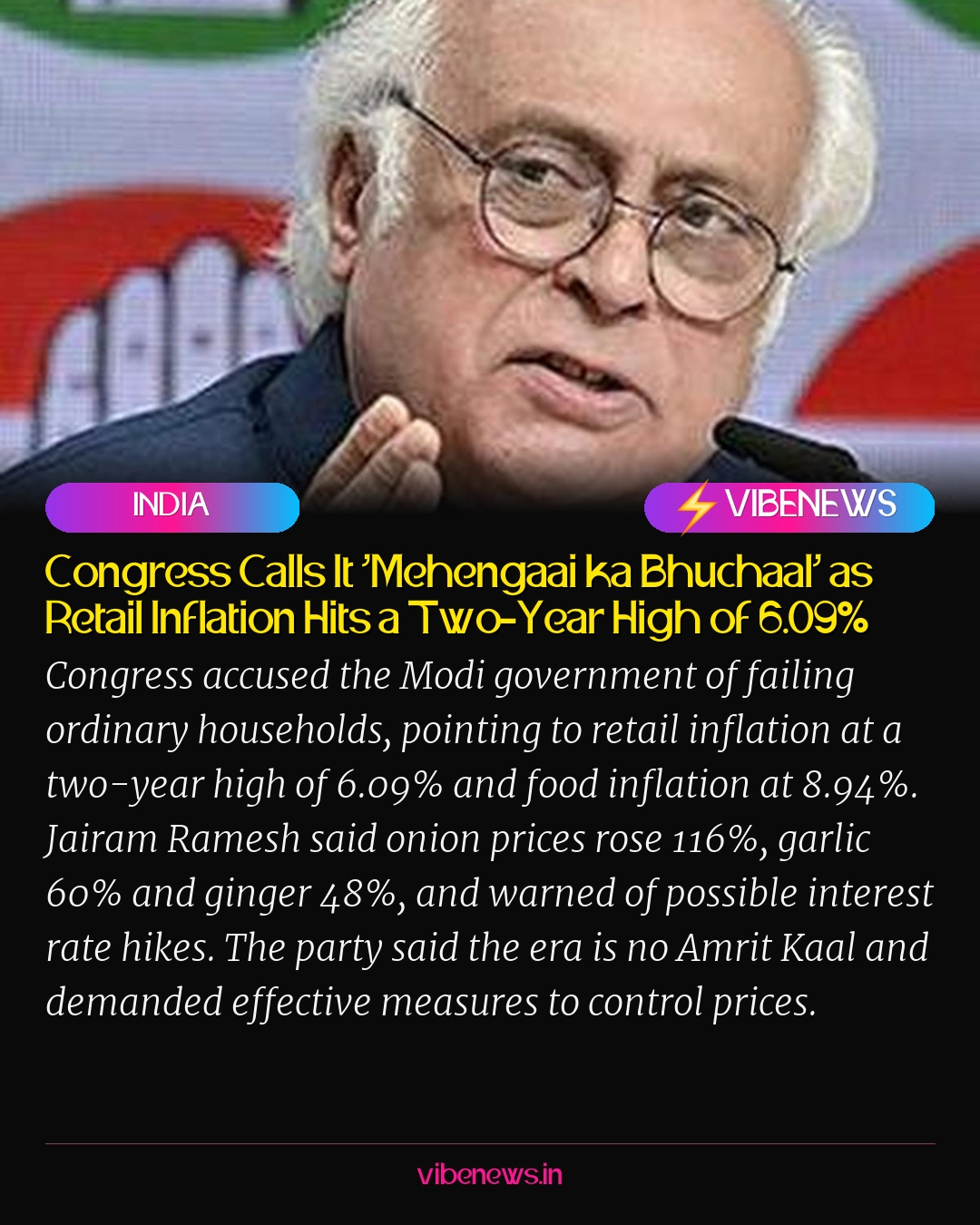
Congress on Friday accused the Modi government of pushing essential prices beyond the reach of ordinary households, and it chose a sharp phrase to make the point. Party communications chief Jairam Ramesh said the country was living through ‘mehengaai ka bhuchaal’, an earthquake of inflation, and not an ‘Amrit Kaal’.
Ramesh made the claim in a post on X, written in Hindi, after sharing media reports that people were struggling with rising inflation and a steep climb in the prices of food and beverages. He did not stop at the reports. He put his own argument at the center of the post, and it was blunt.
’Under the Modi government, inflation is no longer just a daayan; it has now become an uninvited guest, devouring every household’s budget,’ he wrote. He added that prices have spiralled out of control, from the kitchen to every other daily necessity.
The Congress leader framed the trouble as a long-running problem rather than a sudden shock. He said inflation has been rising for the past 12 years and argued that its real impact is far greater than what government statistics suggest. This year, he said, even the official figures have climbed every month.
The numbers behind the charge
Ramesh pointed to retail inflation at 6.09%, which he described as a two-year high. He said inflation rose in 11 of the 12 consumption categories tracked, and he accused Prime Minister Narendra Modi, whom he called the ‘arrogant pravachan mantri’, of staying silent about the government’s performance.
Food inflation stood at 8.94%, according to Ramesh. He listed specific items that have become costlier: onions up 116%, garlic up 60%, and ginger up 48%. He also named flour, oil, ghee, milk, lentils and soap as products where prices are running rampant.
The pressure is not limited to higher price tags. Ramesh said companies are considering reducing product quantities, a move that would leave buyers paying roughly the same for less. Consumers rarely see that change coming until the packet is already on the shelf.
Borrowing costs enter the picture
Ramesh also raised the prospect of interest rate hikes. He said such a move would make both borrowing and everyday living more expensive for ordinary people. That warning links the grocery bill to home loans, car loans and other debt that families carry.
He did not provide further detail on when or whether any rate increase would happen. The claim rests on fears he described, and the article should be read as the Congress position on that risk rather than a confirmed policy decision.
A party attack that started a day earlier
The offensive was not a one-off post. Congress had already launched an attack on Thursday, November 12, 2026, over rising prices of essential commodities. The party said households were struggling with mounting expenses and demanded effective steps to control inflation.
Friday’s statement sharpened that line of attack. Ramesh moved from a general complaint about costs to a set of specific figures, then closed with a line built for headlines and social media: ‘This is not an Amrit Kaal; it is ‘mehengaai ka bhuchaal’ (earthquake of inflation).’
The phrase is doing political work. Amrit Kaal is the government’s own language for a celebrated era of development, and Congress is turning that slogan back on the ruling party. Whether voters feel the same way at their local markets is the question the party is betting on.
The government’s response was not part of the statement, and the reporting available does not include one. For now, the case against the government comes from the opposition’s reading of the inflation data and the daily price of onions, garlic, flour and milk.
This is not an Amrit Kaal; it is ‘mehengaai ka bhuchaal’ (earthquake of inflation).
TL;DR
- Congress says rising prices mark ‘mehengaai ka bhuchaal’, not Amrit Kaal, as it attacks the Modi government.
- Retail inflation has reached a two-year high of 6.09%, according to figures Congress cited in its attack.
- Food inflation stands at 8.94%, with onions up 116%, garlic 60% and ginger 48%.
- Jairam Ramesh says inflation rose in 11 of 12 consumption categories and warns of possible interest rate hikes.
- Congress also says companies are considering reducing product quantities as prices climb.