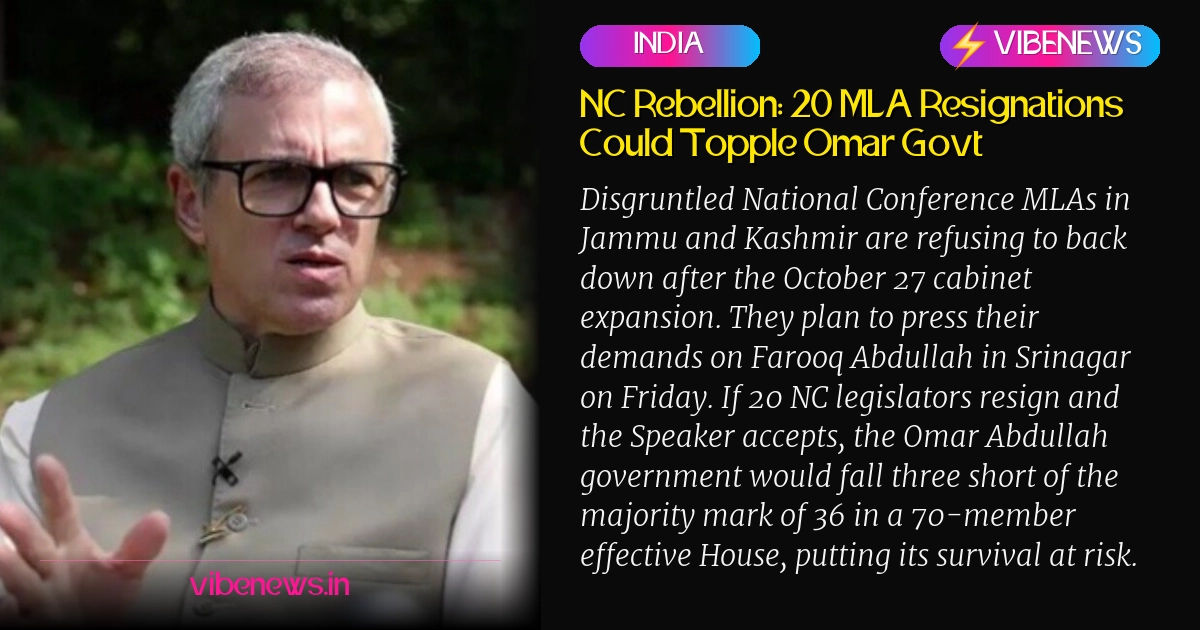
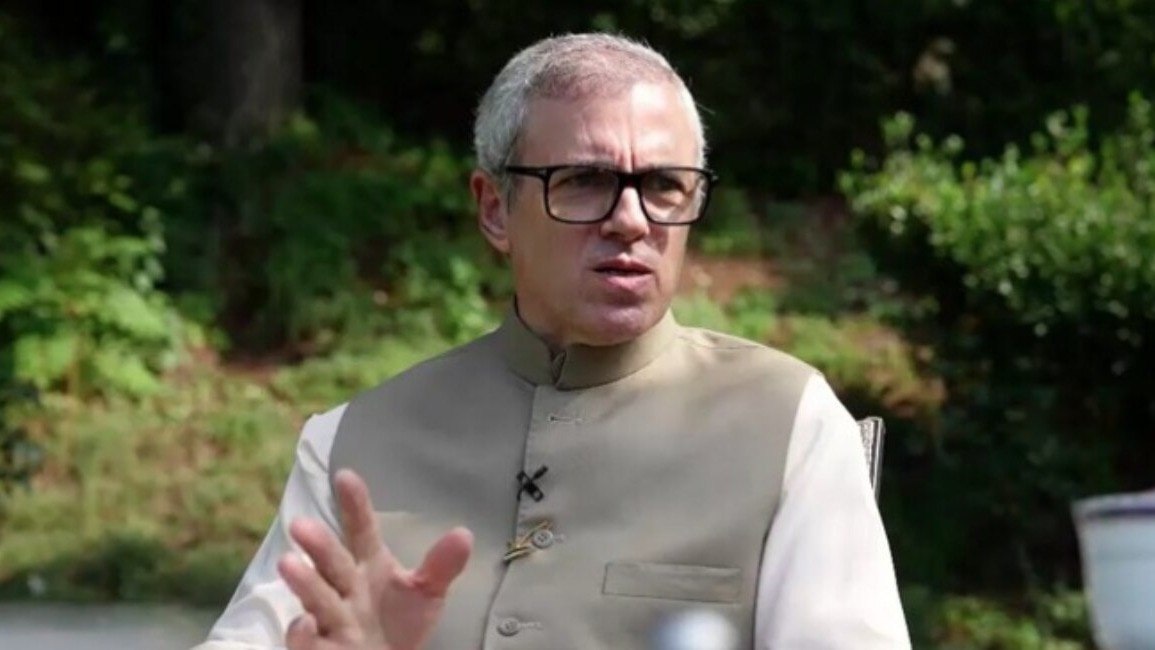
Disgruntled National Conference MLAs in Jammu and Kashmir are refusing to back down, and they are expected to put their demands directly to party patron Farooq Abdullah in Srinagar on Friday. Chief Minister Omar Abdullah is likely to be present for the discussions, which come as he tries to contain discontent inside the ruling party.
The revolt has a clear trigger. On October 27, the party expanded the cabinet, inducting four new ministers and taking the council of ministers to its maximum permissible strength of nine. Several senior leaders were left out, most notably six-time MLA Mubarak Gul, and that exclusion has triggered resentment across sections of the party.
What the dissidents want
The legislators are adamant. They want ministers who have completed two years in office removed from the council of ministers. That is the core demand they plan to formalise before Farooq Abdullah.
Before Friday, the dissidents are set to meet again on Thursday to finalise their strategy. That would be their fourth meeting since the cabinet reshuffle. Each gathering signals that the anger has not faded, despite the leadership’s efforts to play it down.
The crisis has also pushed the party’s internal equations back into focus. The bigger question is whether Omar Abdullah can keep his flock together.
The party’s response
The National Conference leadership has officially dismissed reports of a rebellion. It described the legislators’ gathering as a routine social meeting over lunch ahead of the Darbar move.
Hazratbal MLA Salman Sagar made the same point at a press conference on Wednesday. He dismissed reports of dissent and alleged that such claims were being circulated by people with vested interests.
Those denials have not closed the story. A public rebuttal can calm a room, but it does not change the arithmetic that sits behind the dissent.
The numbers that decide the government
The 90-member Jammu and Kashmir Assembly has a majority mark of 46. The ruling alliance currently commands 54 legislators. That includes 41 NC MLAs, six Congress MLAs, six Independents and one CPM member.
The Opposition holds 36 seats. It has 29 BJP MLAs, four from the PDP, one from the Jammu and Kashmir People’s Conference, one from the AAP and one Independent.
The math shifts sharply if the rebels walk. If 20 NC MLAs resign together and the Speaker accepts their resignations, the effective strength of the House falls to 70. The majority mark drops to 36. The NC’s strength falls from 41 to 21.
Now add one more blow. If one Independent MLA also withdraws support, the ruling alliance would be left with 33 legislators. That is 21 NC MLAs, five Independents, six Congress MLAs and one CPM member.
That leaves the Omar Abdullah government three short of the majority mark. At that point, its survival is in serious jeopardy.
The legal wall
Switching sides is harder than it looks. The anti-defection provisions under the Tenth Schedule of the Constitution apply to the Jammu and Kashmir Assembly under Section 28 of the Jammu and Kashmir Reorganisation Act, 2019.
An MLA who voluntarily gives up membership of the party on whose ticket they were elected can face disqualification. Legislators who defy their party whip in a vote can also face the same consequence, subject to the provisions of the law.
The one clean exit is a merger. It requires at least two-thirds of the members of the legislature party to agree. For the NC, that means at least 28 of its 41 MLAs. A group of 20 does not reach that threshold. The earlier one-third split provision was removed in 2003.
Resignation is a separate route, and it carries the real risk. Under Section 26 of the Reorganisation Act, an MLA’s seat becomes vacant once the Speaker accepts a resignation submitted in writing. That is the path that could turn internal grumbling into a direct threat to the government.
What happens next
Nothing has been formalised yet. No resignations have been reported in the available material. The dissidents have not yet put their demands on the record in the Friday meeting, and the leadership still has a window to respond.
The stakes are high for both father and son. The Chief Minister has to hold his government together, and Farooq Abdullah has to decide how to manage a revolt inside the party he leads.
For now, the immediate test for Farooq Abdullah and Omar Abdullah is whether they can persuade the disgruntled legislators to reconsider their position before the internal crisis turns into a direct threat to the government’s majority.
TL;DR
- Disgruntled NC MLAs will press their demands on Farooq Abdullah in Srinagar on Friday, after the October 27 cabinet expansion.
- The dissidents want ministers who have completed two years in office removed from the council of ministers.
- If 20 NC MLAs resign and the Speaker accepts, the Assembly majority mark falls from 46 to 36.
- The Omar Abdullah government would be left three short of the majority mark, putting its survival at risk.
- A merger needs at least 28 of the NC’s 41 MLAs, so a group of 20 cannot legally switch sides that way.
- The party has officially dismissed the rebellion reports as a routine social meeting over lunch.