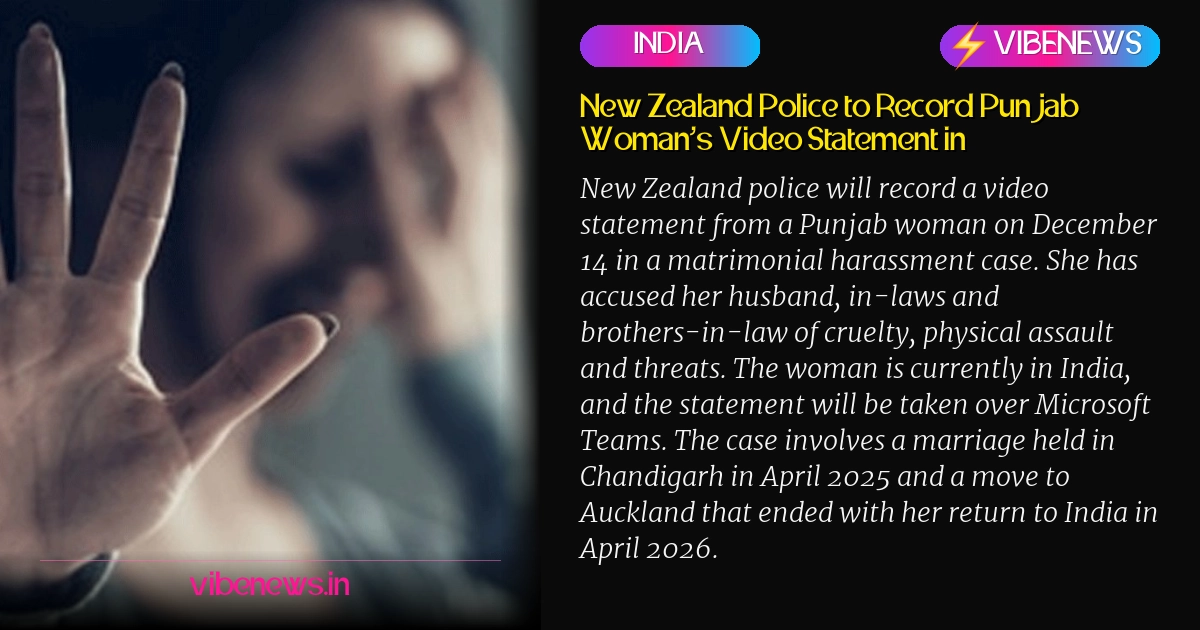

New Zealand police will record a video statement from a Punjab woman on December 14 as part of a harassment complaint against her husband and in-laws, a move her lawyer described as a first in a cross-border domestic violence case. The woman is currently living in India, and the statement will be recorded through Microsoft Teams.
According to the complaint, her husband, his parents and his brothers have subjected her to cruelty, physical attacks and threats. She has filed the case with New Zealand police, and she has also made a complaint to the Delhi Police Women’s Cell.
How the case reached New Zealand police
The woman sent a series of emails to New Zealand police before they agreed to investigate. Once the authorities accepted the matter, they set a date to take her statement by video. Police in New Zealand will question her from abroad, while she remains on Indian soil.
Her lawyer, advocate Arpit Batra, shared the details of the case. He said the decision by New Zealand authorities would help victims in international matrimonial disputes get justice, and he called the move commendable.
The decision taken by New Zealand is commendable, and victims in international matrimonial dispute cases will get justice, said advocate Arpit Batra.
The complaint says the woman married a New Zealand national on April 19, 2025. The wedding took place at Hotel Park Grand in Chandigarh and followed Hindu traditions. The woman’s family was already under financial strain, but she says her in-laws insisted that the wedding guests stay at Hotel Park Grand before the ceremony, despite those difficulties.
Timeline of the marriage and the move abroad
After the wedding, the woman travelled to Auckland on July 2, 2025. She stayed in New Zealand until she returned to India on April 21, 2026. Her complaint states that she faced physical and mental harassment after the marriage, and that the pressure continued throughout the time she lived with her husband’s family abroad.
The timeline matters for the investigation. It places the alleged harassment across both countries, from the wedding in Chandigarh to the months in Auckland and her eventual return home. Investigators will have to examine events that took place in India and New Zealand, which is one reason the case has drawn attention from legal observers following cross-border matrimonial disputes.
The report does not say whether the husband or his family have responded to the allegations, and it does not describe any charges that have been filed. Those details remain outside the public record for now.
Why cross-border cases are difficult to pursue
Matrimonial disputes that involve couples living in different countries often leave victims caught between two legal systems. A woman may be living in India while the alleged offences took place abroad, and the evidence may sit in another jurisdiction. Questions about which police force can act, and how a witness can give testimony from far away, have long complicated such cases.
In this instance, the use of a video link means the woman does not have to travel to New Zealand to give her account. Recording the statement remotely through Microsoft Teams allows police to take evidence without requiring her to make a long journey, a practical step that matters for someone who says she has been physically harmed.
The case also shows that complaints filed in one country can draw in authorities in another. The woman has approached both New Zealand police and the Delhi Police Women’s Cell, which means her allegations are being pursued on more than one front.
What happens next
The next key date is December 14, when New Zealand police are scheduled to record the woman’s video statement. That session will be the first formal step in which the investigation hears her account directly. Until then, the allegations remain the woman’s claims, and no findings have been made.
For readers following NRI matrimonial disputes, the case offers a clear example of how international legal cooperation can start with something as simple as a video call. Whether it leads to a broader outcome will depend on what the investigation finds once her statement is on record.
TL;DR
- New Zealand police will record a video statement from a Punjab woman on December 14 in a matrimonial harassment case.
- The woman alleges cruelty, physical assault and threats from her husband, in-laws and brothers-in-law.
- She is currently in India, and the statement will be taken over Microsoft Teams.
- The couple married in Chandigarh on April 19, 2025, and she moved to Auckland in July 2025.
- She returned to India on April 21, 2026, and has also complained to the Delhi Police Women’s Cell.