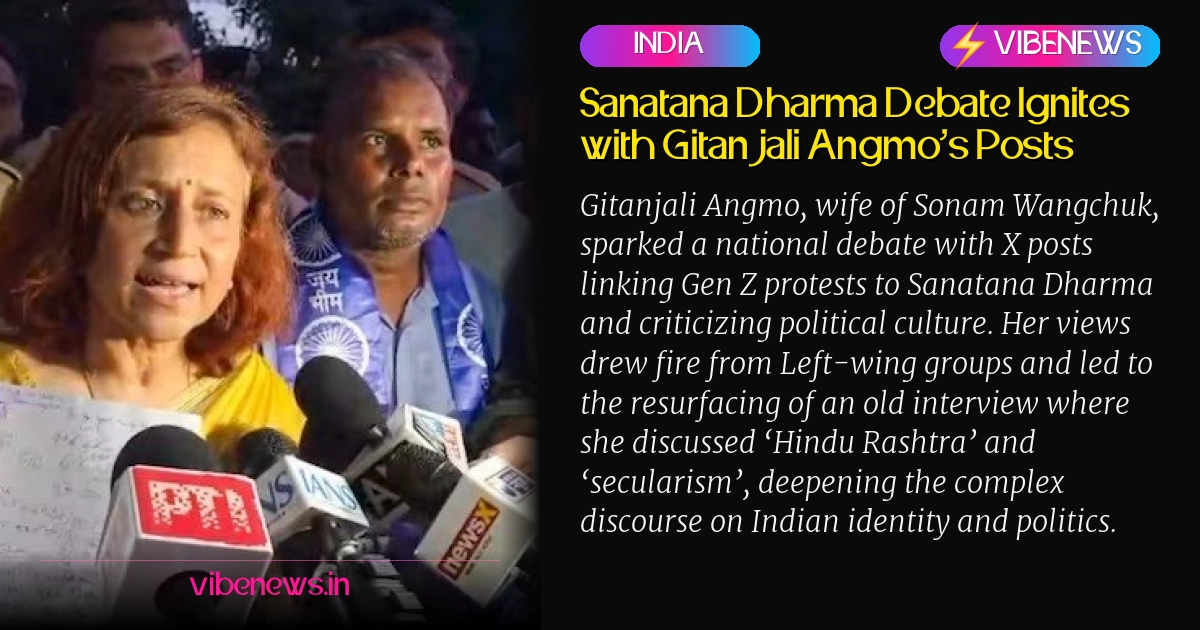
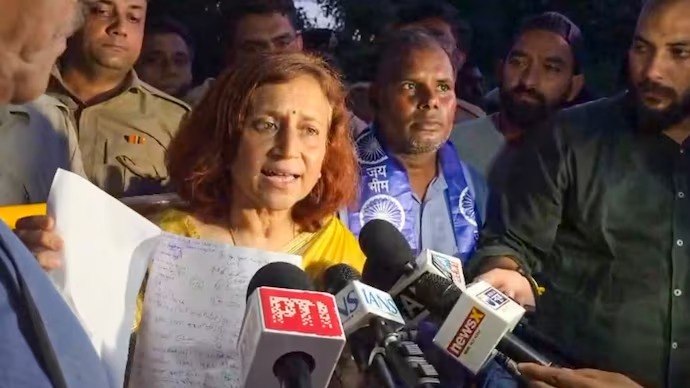
Social entrepreneur Gitanjali Angmo, wife of renowned educationist Sonam Wangchuk, has ignited a nationwide discussion through a series of posts on X. Her recent commentary, spanning July 25 to 27, delves into the intricate relationship between Sanatana Dharma, contemporary politics, and the essence of Indian nationalism. The posts have drawn significant attention, prompting reactions from various political spectrums and leading to the re-circulation of her past interviews.
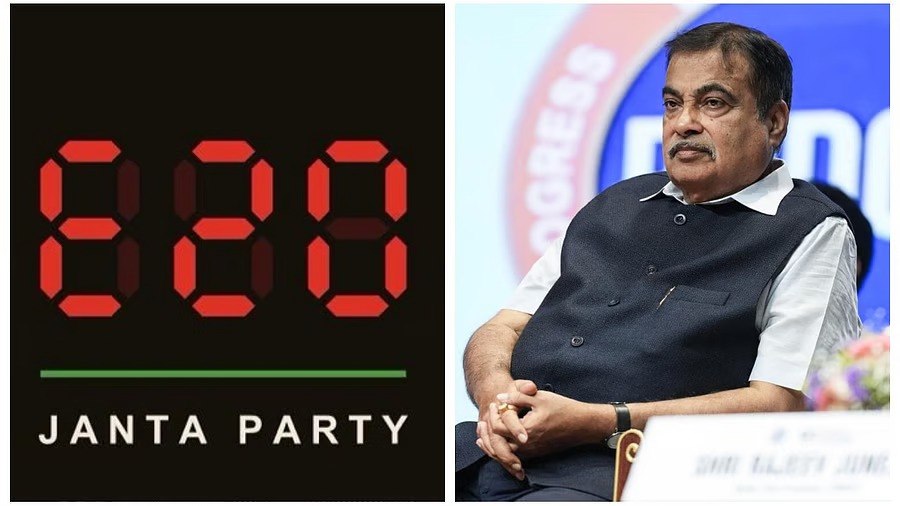
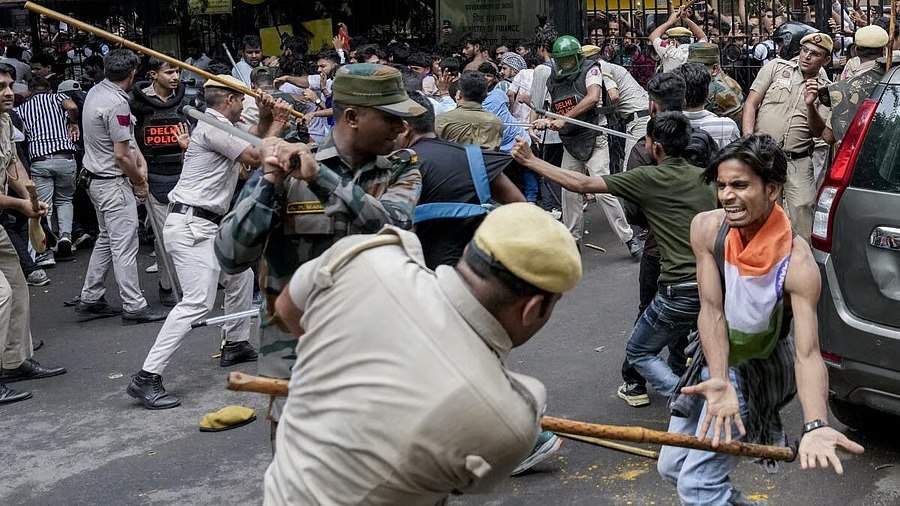
The debate originated with Angmo’s commendation of young protesters, whose activism reportedly led to the resignation of Union Education Minister Dharmendra Pradhan. On July 25, she lauded "Gen Z" for embodying Sanatana Dharma through their "courage without hate" and "patriotism without blind obedience," contrasting their actions with what she perceived as the shortcomings of the "Hindu nationalist party." Her post, tagging Prime Minister Narendra Modi and the protest-leading "Cockroach Janta Party," quickly drew criticism for allegedly communalizing a multi-faith student movement and linking it to the concept of ‘Vishwaguru’.
Responding to initial backlash, Angmo elaborated on her views on July 26, distinguishing between religion and spirituality. She asserted that while religion seeks followers and defines identity, spirituality is a personal awakening fostering transformation. Quoting nationalist freedom fighter Aurobindo Ghosh, she emphasized Sanatana Dharma as the bedrock of Indian civilisation, never intended as a narrow institutional religion, and thus beyond the monopoly of any single political entity. This clarification aimed to frame her perspective within a broader civilisational context rather than a sectarian one.
The All India Students’ Federation (AISF), a prominent Left-wing student organization, swiftly offered a critique of Angmo’s stance. On July 27, AISF argued that invoking Sanatana Dharma without acknowledging Dr. B.R. Ambedkar’s fundamental critique of caste within the Hindu social order presents an incomplete picture. They suggested that if the message truly champions equality and ‘Vasudhaiva Kutumbakam’ (the world is one family), it should celebrate Bhakti saints like Kabir, Ravidas, and Tukaram, who actively challenged caste hierarchies and social exclusion. AISF contended that India’s civilisational strength lies in its struggles for equality, not in romanticizing potentially oppressive structures.
Angmo further broadened her commentary on July 27, reflecting on the polarized reactions she has encountered. She recounted instances where the BJP IT cell labeled her and Wangchuk "anti-national" and "Chinese agents" during her husband’s detention, while Congress-aligned accounts later branded them "Sanghis" or "BJP stooges" for criticizing a Congress protest. This experience led her to conclude that "the rot has infected our entire political culture," transcending party lines. She advocated for a fundamental shift in political grammar, urging for dialogue over demonization, integrity over party affiliation, and truth over tribal loyalty, tagging both PM Modi and Rahul Gandhi in her appeal.
Amidst the ongoing debate, multiple clips from an older interview featuring Angmo on BJP leader Subramanian Swamy’s YouTube channel resurfaced. Conducted within a discussion titled "Decolonising the Indian Mind to Transform India," these clips reportedly show Angmo advocating for the removal of "secular" from the Constitution, supporting Sanskrit as a national language, endorsing the Ram Mandir, and expressing views aligned with a "Hindu Rashtra" that transcends mere political slogans. She also reportedly rejected the Aryan Invasion Theory and criticized the funding disparity for Hindu studies. These older statements have added another layer of complexity to the public’s perception of her current commentary, suggesting a consistent ideological framework.
Gitanjali Angmo and Sonam Wangchuk have long been recognized public figures, particularly for their pioneering work in alternative education and environmental advocacy in Ladakh through the Himalayan Institute of Alternatives (HIAL). Wangchuk’s detention under the National Security Act in September 2025, following protests for Ladakh’s statehood and Sixth Schedule protections, brought the couple further into the national spotlight. Angmo’s public statements during that period, including concerns over due process, underscored their commitment to public discourse. Their recent association with wider student movements, including the CJP, provides context for her engagement with the current political climate.
Editorial Context: A Shifting Cultural Landscape
The controversy surrounding Gitanjali Angmo’s statements is more than a fleeting social media storm; it reflects a deeper, ongoing re-evaluation of India’s foundational concepts. Her articulation of Sanatana Dharma, distinct from institutional religion and intertwined with a vision of national character, challenges both traditional secular narratives and certain interpretations of Hindu nationalism. The swift and varied reactions from student bodies, political factions, and social media users underscore the fluidity and contestation surrounding terms like ‘secularism,’ ‘nationalism,’ and ‘Dharma’ in contemporary India.
This debate highlights the increasing role of public intellectuals in shaping national identity and the complex interplay between ancient philosophical traditions and modern political realities. Over the long term, such discussions contribute to a dynamic redefinition of what it means to be Indian, pushing for a nuanced understanding beyond simplistic binaries and demanding a more inclusive and historically informed public discourse. The re-emergence of past statements further complicates this, forcing a consideration of consistency and evolution in public figures’ ideological positions.
TL;DR
- Gitanjali Angmo’s X posts praised Gen Z protesters, linking their actions to Sanatana Dharma and criticizing the ‘Hindu nationalist party’.
- She clarified her views by distinguishing between religion and spirituality, asserting Sanatana Dharma as a civilisational bedrock beyond political monopoly.
- The All India Students’ Federation (AISF) criticized Angmo, arguing her views ignored Dr. B.R. Ambedkar’s critique of caste and romanticized oppressive structures.
- Angmo also critiqued India’s polarized political culture, advocating for dialogue, integrity, and truth over tribal loyalties.
- Older interview clips resurfaced, showing Angmo’s past support for removing ‘secular’ from the Constitution, Sanskrit as a national language, and a ‘Hindu Rashtra’.
- Angmo and her husband, Sonam Wangchuk, are known for their work in alternative education and environmental advocacy, and Wangchuk was previously detained under the National Security Act.