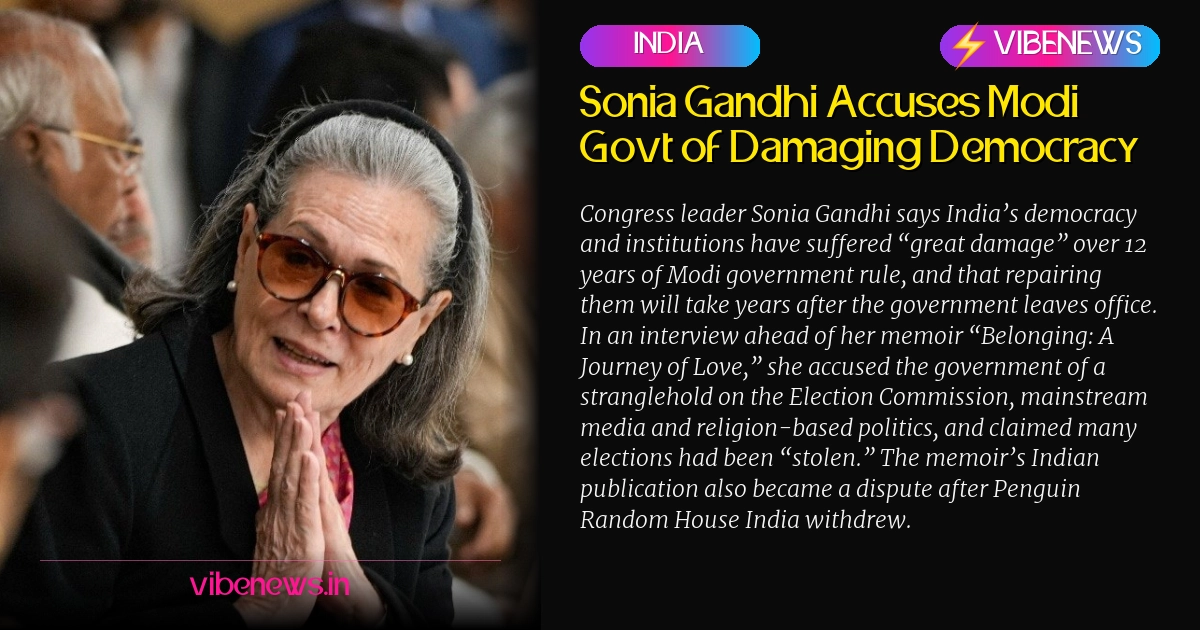
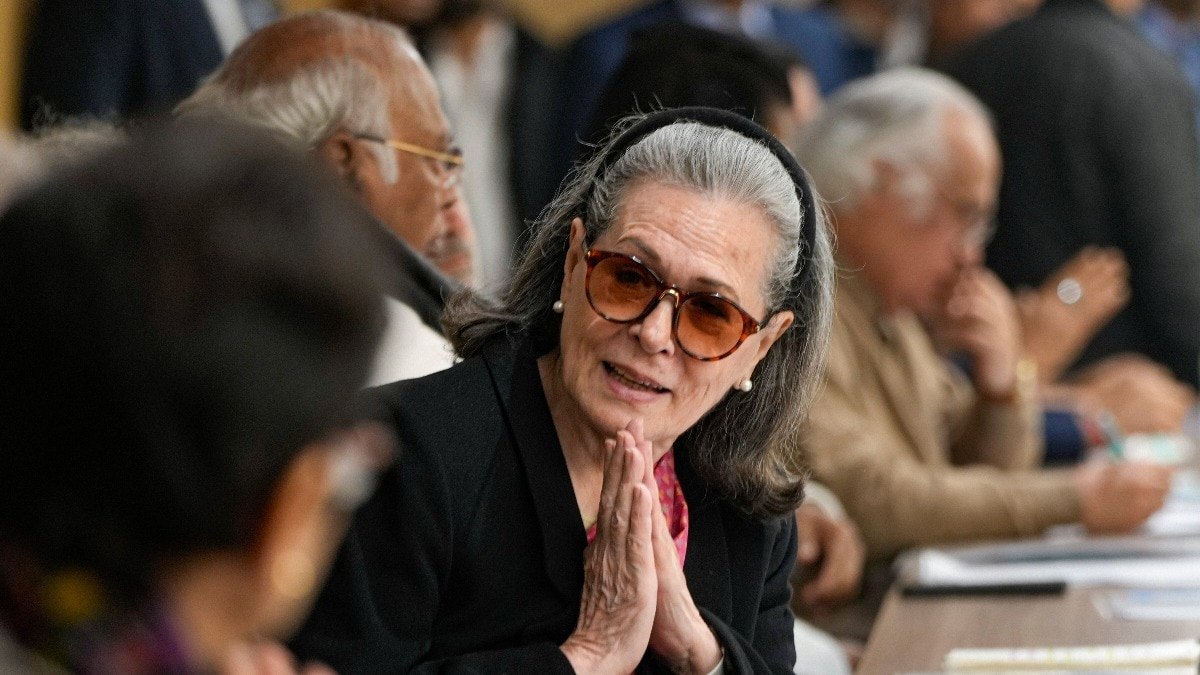
Congress Parliamentary Party Chairperson Sonia Gandhi has said India’s democratic fabric and institutions have suffered “great damage” over the past 12 years under the Narendra Modi government, and that restoring them will take time even after the government leaves office.
Her remarks, carried in an interview ahead of the launch of her memoir, Belonging: A Journey of Love, put the opposition’s grievances about governance, elections and institutional independence at the centre of her political message.
“Over the last twelve years great damage has been done to the fabric of our country, our democracy and our institutions. Even after this government goes, it will take time to restore our systems back to health and great effort from political parties.”
The former Congress president said people were becoming restless and recognising the damage being done. “But I am optimistic and I know that the people of India will welcome a return to proper governance,” she said.
A level playing field, she argues, has been missing
Asked about the Congress’s decline and its prospects, Gandhi rejected pessimism, but she was blunt about the conditions her party faces. “Consider that the Congress party and other opposition parties have not had a level playing field since this government came to power,” she said.
She went further, naming the institutions she believes are under pressure. “Take into account the complete stranglehold they have on all institutions, especially the Election Commission, their control of mainstream media, their money power and their exploitation of religion,” she added.
Gandhi also claimed that recent months had provided ample proof that many elections had been “stolen,” and that voters were growing more aware of it. These are allegations the government has not been quoted responding to in the material available, and they stand as the sharpest claims in the interview.
Congress workers, she says, have borne the cost
Gandhi said Congress workers and leaders had faced “persecution of all kinds.” Even so, she insisted the party was still fighting. “In fact, it is the only party that has had the resilience to withstand this onslaught,” she said.
“And yet, in every village and every district, Congressmen and women are still fighting for the values enshrined in our Constitution,” she said. She added that the party was working with like-minded parties and that its prospects were “improving day by day.”
Modi, the RSS and a question she sidestepped
Asked about Prime Minister Narendra Modi and the lessons Congress should draw from his rise, Gandhi acknowledged the gap in outlook. “It’s true that he comes from a very different ideological world. But there are many ways that people succeed in politics within the Congress party, take for example Dr. Manmohan Singh and Congress President Mallikarjun Kharge. I don’t think we have much to learn from the RSS.”
On whether she had considered how policy and strategy under the Congress-led United Progressive Alliance might have differed had she accepted the prime minister’s post in 2004, Gandhi said the thought had never crossed her mind. “Our experience was by and large a very positive one. We worked as a team, and our roles were distinct, with him leading the government and I leading the party,” she said, referring to former prime minister Manmohan Singh.
The memoir and the publishing fight
The memoir is a personal account in which politics provides the background, or “a kind of framework,” as Gandhi describes it. Published by HarperCollins India, the 544-page book is set to reach readers in India on November 10.
That date settles a fight that had left the book’s domestic release uncertain. An “impasse” between Gandhi’s representatives and Penguin Random House India led to the publisher stepping away. The company had initially been keen to publish the book and called it a “hard-won acquisition,” but said it would not be its Indian publisher after a “stalemate over a particular issue.”
The dispute arose amid reports of differences over changes to the manuscript. Several Congress leaders raised concerns about government pressure and freedom of expression. Some alleged that Penguin India had been pressured to remove sections relating to Modi, the Rashtriya Swayamsevak Sangh and China’s “occupation” of Indian territory during the Modi government.
Penguin Random House India denied any external pressure. It declined to disclose the nature of the impasse, citing confidentiality clauses and its agreement with the author. That silence is now part of the story, and it leaves the allegations of interference unresolved on the public record.
From Veneto to the Congress’s power years
The memoir opens with Gandhi’s childhood in post-war Veneto, Italy, and follows her journey to Cambridge, where she met Rajiv Gandhi in 1965. It recounts their marriage, her introduction to her mother-in-law and former prime minister Indira Gandhi, and her efforts to adjust to life in India, including learning Hindi, wearing saris and adapting to Indian food and culture.
The book also covers the tragedies that reshaped the Gandhi family. Sanjay Gandhi died in a plane crash, Indira Gandhi was assassinated in 1984, and Rajiv Gandhi was assassinated in 1991.
It examines the events around the Congress-led alliance’s 2004 election victory, when Sonia Gandhi declined to become prime minister and instead led the party and its alliance, which governed India for a decade. Gandhi said last month that others had spent decades telling her story and that it was now her turn, and she expected some “tamasha” when the memoir arrives.
The memoir combines her personal journey with her account of Congress’s time in government and her assessment of the country’s current political and institutional situation. Whether readers see a warning or a campaign document will depend on how the book handles the claims she has already put on the record.
TL;DR
- Sonia Gandhi says India’s democracy and institutions suffered “great damage” over 12 years of Modi government rule.
- She alleges the Election Commission, mainstream media and religion have been used to tilt the playing field against opposition parties.
- Gandhi claims many elections have been “stolen” and says Congress workers have faced “persecution of all kinds.”
- Her memoir, Belonging: A Journey of Love, releases in India on November 10 through HarperCollins India.
- A publishing impasse with Penguin Random House India led to the memoir’s domestic move, with pressure allegations still unresolved.