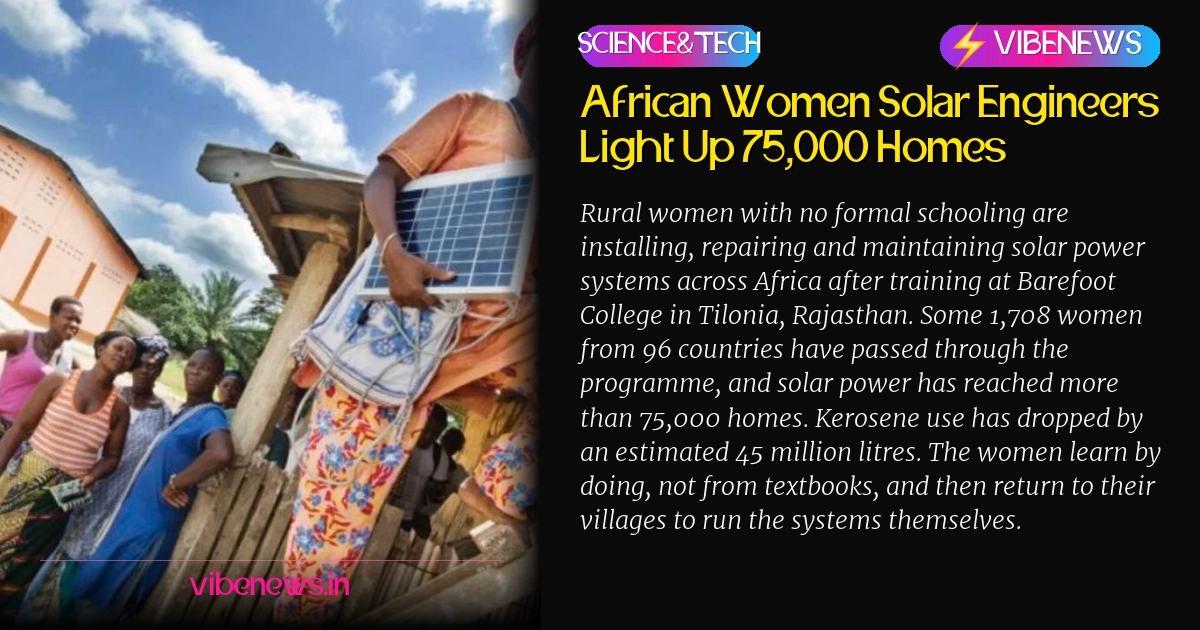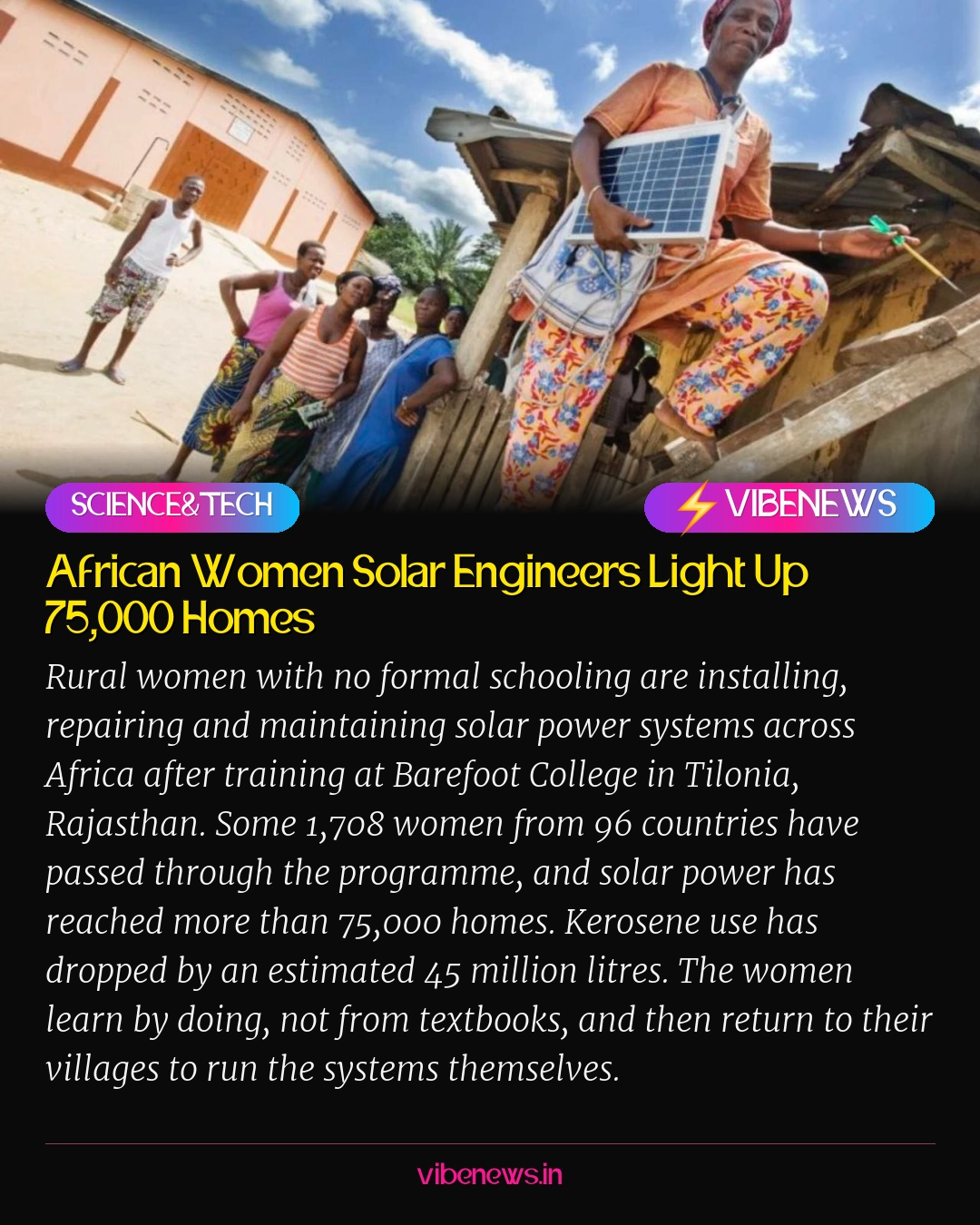
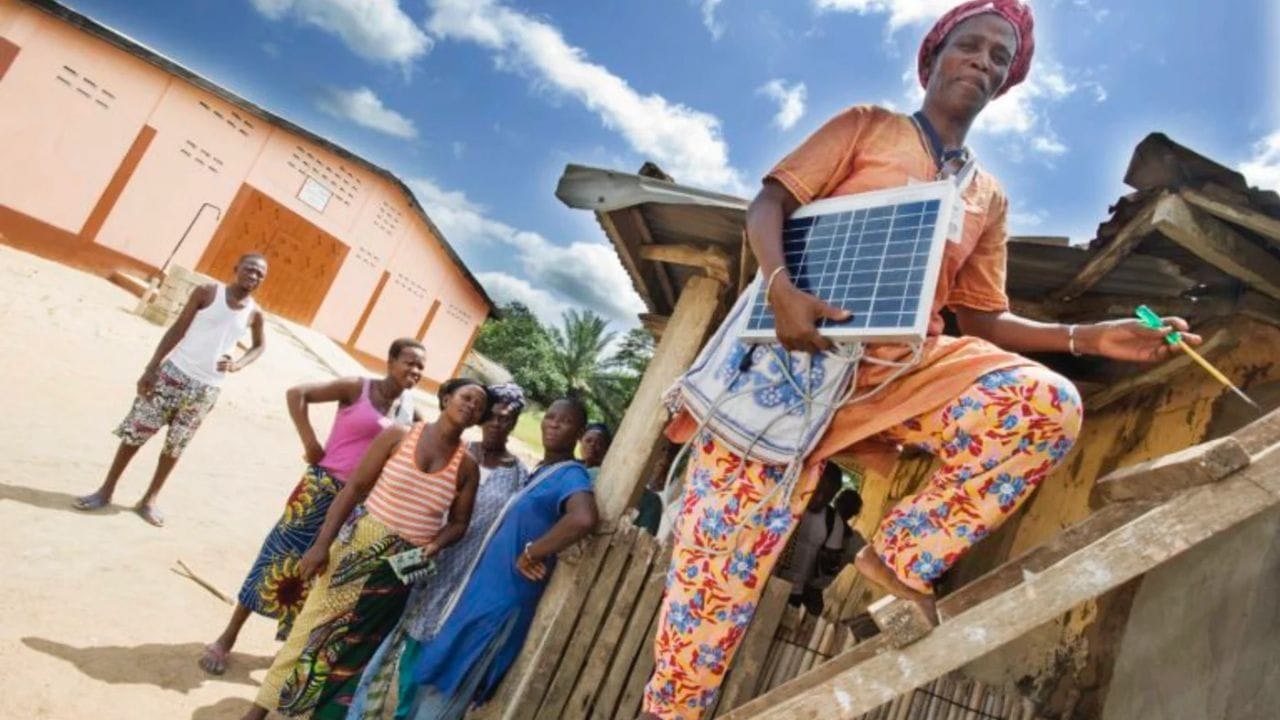
Rural women with no formal schooling are installing and repairing solar power systems across Africa, after training at the Barefoot College in Tilonia, Rajasthan, India. The programme, known as Solar Mamas, has trained 1,708 women from 96 countries, and their work has brought solar electricity to more than 75,000 homes worldwide.
The numbers behind the programme are striking. Households that once relied on kerosene lamps now have light, and the shift has cut kerosene consumption by an estimated 45 million litres. Each of those homes is a small win for families who had few options before.
No degree required, no textbooks either
Barefoot College does not screen women by educational qualifications. A woman who cannot read or write can still be admitted for training. The institution has shown that the technical skills needed to build and fix solar systems do not depend on a degree.
Engineering is usually associated with dense theory and complicated mathematics. The Tilonia approach is different. Trainees spend six months at the centre, learning through hands-on work. They fit solar panels, connect electrical circuits, set up batteries and learn how to repair lights that stop working. Every task is done by the trainees themselves, so the knowledge stays in their hands.
When the training ends, the women go home. In their villages they install solar lights in households and take on responsibility for keeping them running. If a light fails, a village no longer has to wait for an outside technician to arrive. The woman who trained down the road can fix it.
In practice, this means solar expertise is growing inside each community rather than being brought in from outside. Villages that once depended on others for technical help now solve their own problems.
From a small group in 2011 to a continent-wide network
The programme’s early results were modest but telling. In 2011, twelve women from Sierra Leone travelled to India to learn solar engineering. Many of them could not read or write. Some had spent their lives working on farms in their villages. After six months of training in India, they returned home and set up solar power systems in about 1,500 homes.
Tanzania followed a similar path. Six women from remote villages in the Mtwara and Lindi regions trained for six months at Barefoot College. Their training was part of the Rural Women Light Up Africa initiative, supported by UN Women. After returning to their villages, they installed solar systems in their communities.
How the systems reach families who cannot pay upfront
The model is built to work for families with very little cash. Each home receives a solar panel, a battery, a charger and three lights. Families can pay for the equipment in instalments over five years, which removes the need for a large upfront payment.
Villages also set up their own savings systems. These pooled funds pay the women’s wages and cover maintenance costs for the equipment. The community, in other words, funds the upkeep of the system that serves it. That local ownership is a big part of why the system lasts.
The women are responsible for more than installation. They also keep the lights working, which makes them the first point of contact when something goes wrong.
Nancy Kanu and the rise of a chief solar engineer
Nancy Kanu, from Sierra Leone, is one of the most visible results of the programme. After training at Barefoot College, she rose to become chief solar engineer. She now trains other women in solar technology.
Her day-to-day work covers the practical needs of village life. She repairs broken solar lights, replaces bulbs and provides mobile phone charging. For villages that once depended on outside help for basic technical problems, her work has changed how they handle everyday needs.
Her career shows how quickly a trained woman can become a teacher for others. What started as a personal training path has turned into a role that spreads skills across her community.
What researchers found about resistance and change
The programme has also been studied in depth. A study published in the journal Nature Energy in May 2024 looked at the Solar Mamas programme in Zanzibar. The researchers said the initiative challenged an old assumption: that engineering and electricity are work for men only.
The study also found that change has not come easily. In some areas, traditions and patriarchal attitudes made it difficult for women to take part in training. Those barriers are real, and they slow down the work of bringing women into technical fields.
Even so, women who finish the training gain a new kind of standing in their villages. They are no longer seen only as household managers. They are technicians who fix problems, and teachers who pass on what they know. That shift in how a community sees its women may matter as much as the electricity itself.
Where the programme goes next
Barefoot College is working to take the model to more parts of Africa. Plans are in place to set up training centres in Senegal, Burkina Faso, Liberia and Tanzania.
The expansion would carry the same core idea: teach women who may have no formal education, give them real equipment to work with, and let them become the people their villages depend on. Each new centre adds another group of women who can light up homes and keep the lights on.
The light that lasts
Women who once lived in the dark now bring electricity to thousands of homes. They are challenging the idea that you need a diploma to master advanced technology. Their work shows that curiosity, a chance to learn and persistence can change a life.
Curiosity, opportunity and determination can change a life, and these women have proved it one village at a time.
The most powerful part of this story may be what the programme does beyond electricity. It builds confidence, independence and a determination to achieve something that once seemed out of reach. The solar panels provide the light, but the women provide the spark.
TL;DR
- Women with no formal schooling are now installing and repairing solar systems across Africa.
- Barefoot College in Rajasthan has trained 1,708 women from 96 countries under the Solar Mamas programme.
- Solar power has reached more than 75,000 homes, cutting kerosene use by an estimated 45 million litres.
- Trainees learn through hands-on work over six months, with no degree needed to join.
- After training, the women return to their villages to install, maintain and repair solar lights.
- Plans are underway to expand training centres to Senegal, Burkina Faso, Liberia and Tanzania.