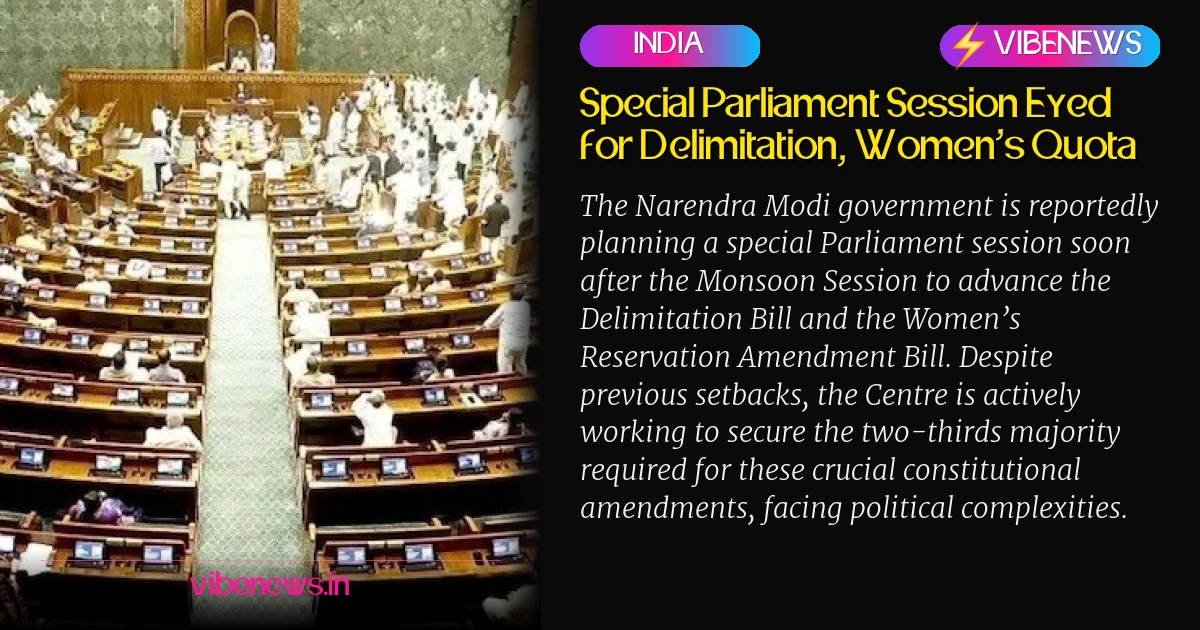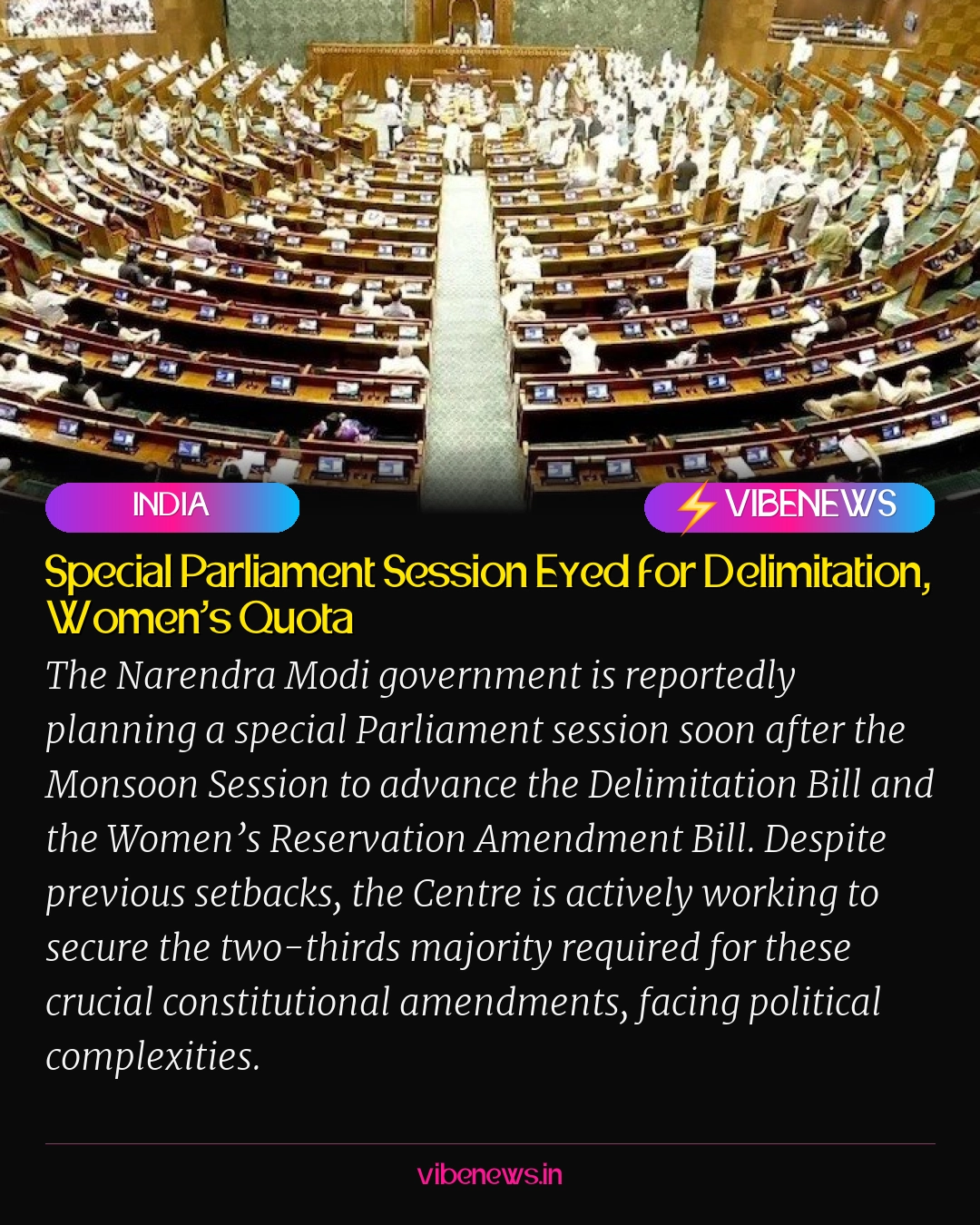
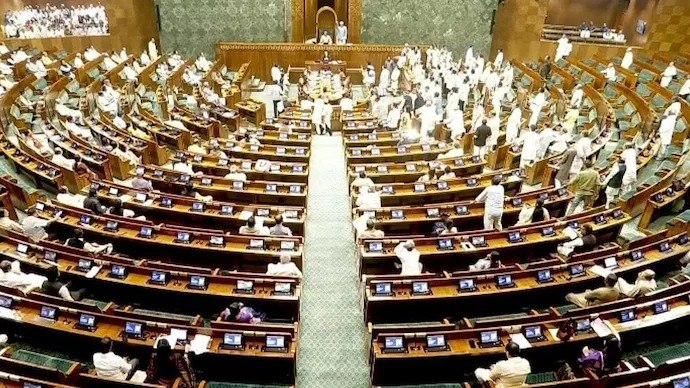
The Narendra Modi government is reportedly preparing to convene a special session of Parliament shortly after the conclusion of the Monsoon Session. This extraordinary sitting is anticipated to address two pivotal legislative proposals: the Delimitation Bill and the Women’s Reservation Amendment Bill, both of which are constitutional amendments.
Sources indicate that the Centre is meticulously working to secure the requisite two-thirds majority in both Houses of Parliament. This supermajority is crucial for the passage of any Constitutional Amendment Bill, a legislative hurdle that proved insurmountable during a previous attempt earlier this year.
The Legislative Imperative
The Delimitation Bill, formally introduced as part of the 131st Constitutional Amendment Bill alongside the Women’s Reservation Bill, previously failed to garner the necessary support in the Lok Sabha during a three-day special session held in April. At that time, the BJP-led National Democratic Alliance (NDA) lacked the numerical strength required for such a significant constitutional change.
However, the political landscape has since undergone notable shifts. The BJP’s parliamentary position has seen an enhancement, particularly following the results of the West Bengal Assembly elections in May. This electoral outcome has demonstrably narrowed the gap to the special majority threshold needed in both the Lok Sabha and the Rajya Sabha.
Shifting Political Tides and Numerical Realities
The special majority threshold mandates the support of 360 Members of Parliament in the Lok Sabha and 164 in the Rajya Sabha. The recent political developments have brought the government closer to these critical numbers, fueling speculation about the renewed push for these bills.
Beyond the gains from state elections, the BJP has also reportedly explored avenues for support from other regional parties. Following a perceived fallout between the Dravida Munnetra Kazhagam (DMK) and its INDIA bloc ally, the Congress, the BJP has reportedly eyed the support of the DMK’s 22 Lok Sabha MPs. Such an alliance could significantly bolster the government’s chances of passing constitutional amendments.
However, the issue of delimitation remains a contentious political flashpoint, particularly in states like Tamil Nadu. The DMK itself has historically campaigned vigorously against delimitation, fearing a potential reduction in the state’s parliamentary representation due to its successful population control measures. This historical stance casts uncertainty over whether the DMK would ultimately lend its support to the 131st Constitutional Amendment Bill.
Delimitation: A Historical Overview and Future Implications
Delimitation, the process of redrawing boundaries of Lok Sabha and state assembly constituencies to reflect population changes, is a constitutionally mandated exercise. Its primary objective is to ensure that each constituency has roughly the same number of voters, thereby maintaining the principle of "one person, one vote."
India has undergone several delimitation exercises since independence, with the last major one completed in 2008. However, a constitutional amendment in 2002 froze the delimitation of Lok Sabha and assembly constituencies until the first census after 2026. This freeze was primarily to allow southern states, which had effectively controlled population growth, to avoid a reduction in their parliamentary seats.
The current push for a Delimitation Bill, therefore, signals a potential acceleration of this process or a modification of its parameters. Any new delimitation exercise before 2026 would be a significant policy shift, potentially altering the political map of India and reigniting debates about federal representation and the demographic dividend.
The Enduring Quest for Women’s Representation
Parallel to the delimitation efforts, the Women’s Reservation Amendment Bill seeks to reserve one-third of all seats for women in the Lok Sabha and state legislative assemblies. This bill has a long and often frustrating history in Indian politics, having been introduced multiple times since the mid-1990s but consistently failing to pass.
Proponents argue that the bill is essential for enhancing gender equality in political decision-making and ensuring that women’s voices are adequately represented in legislative bodies. India, despite being a vibrant democracy, lags behind many nations in terms of female representation in its Parliament.
The repeated failures to pass this bill have often been attributed to a lack of political consensus, with various parties raising concerns about the methodology of reservation, such as rotation of reserved constituencies, and the potential impact on existing political dynamics. Its reintroduction now underscores a renewed political will to address this long-standing demand for gender parity.
Strategic Timing and Broader Ramifications
The government’s decision to push these two significant bills concurrently, especially after a turbulent Monsoon Session, suggests a calculated political strategy. Passing such landmark legislation could be framed as a major achievement, potentially ahead of upcoming state elections or even the next general elections.
The successful passage of these bills would not only reshape India’s electoral geography but also fundamentally alter the composition of its legislative bodies. Delimitation could lead to a redistribution of political power among states and regions, while women’s reservation would bring a much-needed demographic shift to parliamentary representation.
However, the path to enactment is fraught with challenges, requiring not just numerical strength but also deft political negotiation to overcome historical opposition and regional sensitivities. The coming special session, if convened, will be a critical test of the government’s legislative prowess and its ability to forge consensus on issues of national importance.
Editorial Context
The potential convening of a special Parliament session to pass the Delimitation and Women’s Reservation Bills represents a watershed moment for Indian democracy. These are not merely procedural amendments; they are foundational shifts that will redefine the very architecture of political representation in the country for decades to come.
The Delimitation Bill, if enacted, will redraw electoral boundaries based on updated population figures, potentially altering the balance of power between states. This has profound implications for federalism, as states that have successfully controlled population growth fear a reduction in their political voice, while others may gain. The debate around this bill touches upon the core principles of equitable representation versus rewarding demographic management.
Similarly, the Women’s Reservation Bill, a legislative proposal that has languished for decades, aims to correct a historical imbalance in gender representation. Its passage would be a monumental step towards greater inclusivity and could significantly impact policy-making by bringing diverse perspectives to the legislative process. The long-term impact on women’s empowerment and political participation across all levels of governance cannot be overstated.
Together, these bills signify a bold move to address long-standing structural issues within India’s democratic framework. Their passage would not only mark a significant legislative victory but also set the stage for a new era of political dynamics, potentially reshaping electoral strategies, party alignments, and the very fabric of Indian governance for generations.
TL;DR
- The Narendra Modi government is reportedly planning a special Parliament session to pass the Delimitation Bill and the Women’s Reservation Amendment Bill.
- Both bills are Constitutional Amendments, requiring a two-thirds special majority in both the Lok Sabha and Rajya Sabha for passage.
- The BJP’s parliamentary strength has increased following recent state elections, narrowing the gap to the required majority.
- Delimitation faces significant political challenges, particularly from regional parties like the DMK in Tamil Nadu, due to concerns over representation.
- The Women’s Reservation Bill, seeking to reserve one-third of seats for women, has a long history of failed attempts in Indian Parliament.
- The move signifies a major legislative push with long-term implications for India’s electoral geography, federal structure, and gender representation in politics.