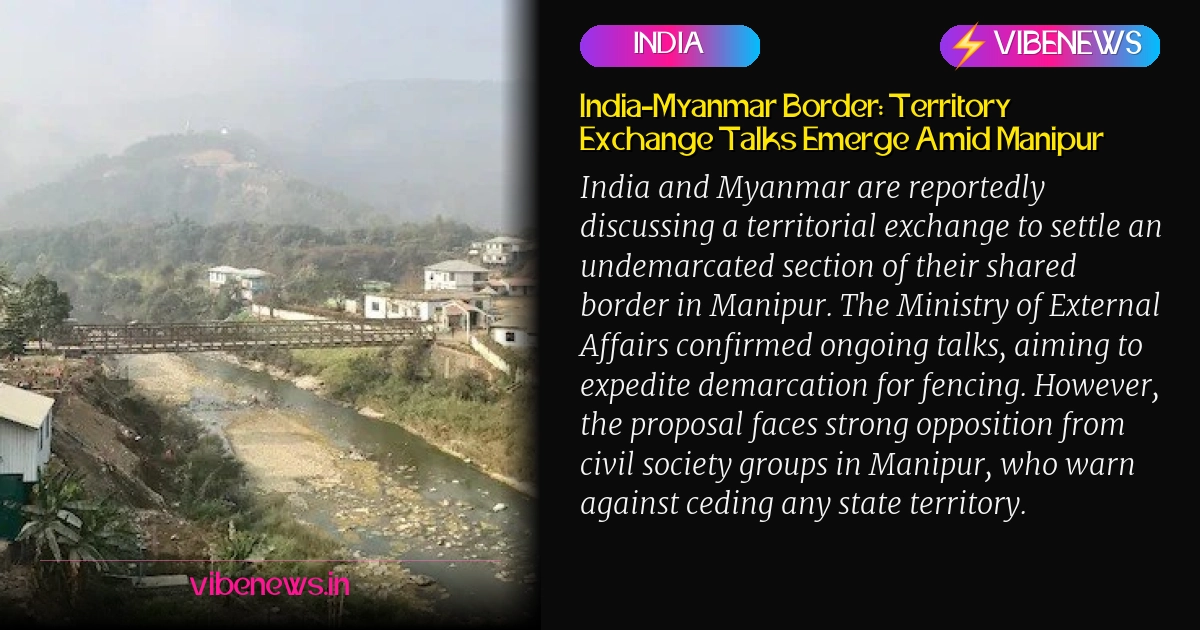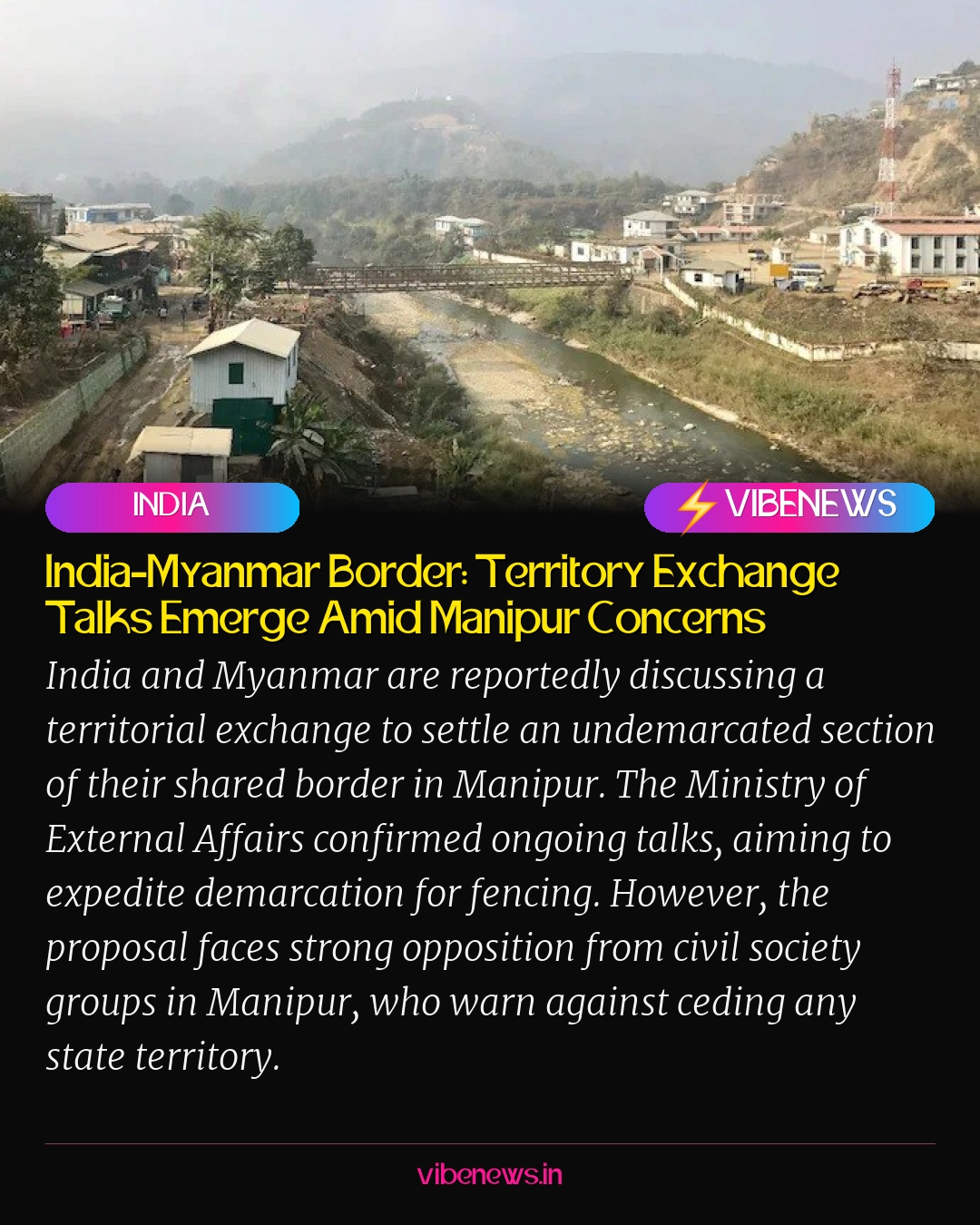
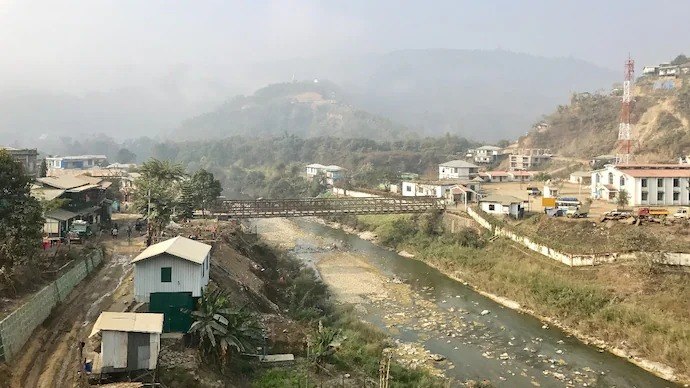
India and Myanmar are reportedly engaged in discussions concerning a potential territorial exchange aimed at resolving a long-standing, undemarcated section of their shared border, particularly along Manipur. The Ministry of External Affairs (MEA) spokesperson, Randhir Jaiswal, confirmed on Tuesday that "certain areas on the border which are yet to be settled" are currently under discussion.
Jaiswal’s statement came in response to media inquiries regarding reports of a proposed land swap with Myanmar in the Manipur sector. While not explicitly confirming the land swap, his acknowledgment underscored ongoing diplomatic efforts to finalize the boundary demarcation.
The Proposed Boundary Adjustment
Weeks prior to the MEA’s statement, a report by US-based magazine The Diplomat, published on July 17, cited an "official document" detailing India’s active consideration of such a proposal. This document reportedly outlined a plan to complete the demarcation between border pillars 65 and 68 along Manipur’s frontier with Myanmar.
The proposed exchange involves approximately 1.4 square miles of territory. This specific stretch, roughly 2.8 km in length, is located in Manipur’s Chandel district, adjacent to Myanmar’s Kabaw Valley in the Sagaing Region. The official document, dated May 26, 2026, projected the completion of this demarcation exercise within three months, suggesting an August timeline.
The primary motivation behind this potential territorial exchange is to accelerate the demarcation of unresolved border segments. This move is seen as crucial for New Delhi’s broader strategy to fence the entire 1,643-km international boundary. Such fencing aims to curb illegal immigration, insurgent movements, and other cross-border criminal activities that have long plagued the region.
A Shared, Complex Frontier
The India-Myanmar international boundary spans 1,643 kilometers, traversing Arunachal Pradesh, Nagaland, Manipur, and Mizoram in India, before extending into Myanmar’s Sagaing Region and Chin State. Much of this frontier is characterized by rugged mountainous terrain, dense forests, and a porous nature, often bisecting ethnic communities that have historically resided on both sides.
According to data from the Ministry of Home Affairs, approximately 1,472 km of this extensive border has already been demarcated through the placement of boundary pillars. However, a significant stretch of nearly 171 km remains unresolved, with key areas including Arunachal Pradesh’s Lohit sector and Manipur’s Kabaw Valley.
The current India-Myanmar boundary was formally defined under a bilateral agreement signed in 1967. Despite this, certain sections have remained unsettled. In 2018, the Indian government informed Parliament that the remaining unresolved stretches would be addressed through a dedicated bilateral boundary mechanism, which includes the identification and erection of nine specific boundary pillars.
Sensitive stretches within Manipur include the Molcham sector (between border pillars 64 and 68), the Moreh sector (between pillars 75 and 79), and the Choro Khunou sector (between pillars 88 and 95). India has consistently maintained that there is no overarching border dispute with Myanmar, but rather specific, localized issues concerning these nine unresolved boundary pillars, which are being managed through bilateral channels.
Broader Border Management Initiatives
The discussions around a territorial exchange are part of a larger strategic shift in India’s border management policy. In 2024, India announced ambitious plans to fence the entire 1,643-km-long international boundary with Myanmar. This decision was accompanied by the controversial scrapping of the India-Myanmar border Free Movement Regime (FMR).
The FMR, in place since 2018, allowed tribal communities residing near the border to travel up to 16 km into each other’s territory without a visa, using a special border pass. The abrogation of this regime, while aimed at enhancing security and curbing illegal activities, has generated considerable debate and concern among the affected communities who share deep cultural and familial ties across the border.
The Diplomat report further indicated that the issue of border demarcation was discussed during Myanmar leader Min Aung Hlaing’s visit to India last month. The report, citing an unnamed government official, suggested that both sides considered erecting auxiliary and new boundary pillars in the Molcham sector, specifically between border pillars 65 and 68. They also reportedly reviewed a 2017 Ministry of External Affairs proposal concerning the border’s alignment in that particular area.
Precedents and Local Resistance
Territorial exchanges with neighboring countries are not without precedent in India’s diplomatic history. A notable example is the 2015 Land Boundary Agreement (LBA) with Bangladesh. Under this landmark agreement, New Delhi transferred 111 enclaves within its territory to Dhaka and received 51 Bangladeshi enclaves in return. This resolved a complex, 41-year-old boundary dispute, demonstrating a willingness to use land swaps for definitive border resolution.
However, the current reported proposal for a land swap with Myanmar has already ignited significant opposition within Manipur. Following The Diplomat’s report, The Imphal Times highlighted warnings from the Coordinating Committee on Manipur Integrity (COCOMI). This influential joint body of Meitei civil society organizations, formed in 2019, has strongly cautioned the Government of India against ceding any portion of the state’s territory to Myanmar.
On July 27, ten days after The Diplomat’s report, COCOMI issued a stern statement, declaring that if the proposal were to be implemented, the organization "will not remain a silent spectator." They emphasized that Manipur’s territorial integrity is "non-negotiable," asserting that the state’s existing boundaries are a legacy from previous generations, defended through history.
COCOMI further argued that Manipur has already experienced a reduction in its historical territory since its merger with the Indian Union in 1949. They warned that any further diminution of the state’s geographical boundaries would be deemed unacceptable. The organization also cautioned New Delhi against making decisions affecting Manipur’s territorial integrity without the explicit consent of its people, urging the government not to "play with fire."
Editorial Context
The ongoing discussions between India and Myanmar regarding a territorial exchange represent a critical juncture in bilateral relations and border management. While the stated aim of expediting demarcation and enhancing border security is strategically sound for India, the deep-seated concerns of local communities, particularly in Manipur, cannot be overlooked. The historical and cultural ties that transcend the physical border, coupled with a strong sense of territorial identity among the Meitei population, introduce significant complexities.
In the long term, a successful resolution would not only solidify India’s eastern frontier but also potentially streamline efforts to combat cross-border challenges like drug trafficking and insurgency. However, any perceived unilateral decision or lack of adequate consultation with stakeholders in Manipur could exacerbate existing ethnic tensions and fuel public discontent. The precedent of the India-Bangladesh LBA offers a model for resolution, but the unique socio-political landscape of Manipur demands a nuanced approach that balances national security imperatives with regional sensitivities and the aspirations of its people. The outcome of these talks will significantly influence regional stability and the future of India’s Act East policy.
TL;DR
- India and Myanmar are discussing a territorial exchange to settle an undemarcated border section along Manipur.
- The proposal involves exchanging approximately 1.4 square miles of territory between border pillars 65 and 68 in Manipur’s Chandel district.
- The primary goal is to expedite border demarcation, enabling India to fence the entire 1,643-km frontier to curb illegal immigration and insurgent activities.
- India recently announced plans to fence the entire border and scrapped the India-Myanmar Free Movement Regime (FMR).
- The Coordinating Committee on Manipur Integrity (COCOMI) has strongly opposed any land cession, asserting Manipur’s non-negotiable territorial integrity.
- India has a precedent for territorial exchanges, notably the 2015 Land Boundary Agreement with Bangladesh.