The Bharatiya Kisan Sangh (BKS), a farmers’ organisation affiliated with the Rashtriya Swayamsevak Sangh, on Wednesday urged state governments to stop penalising farmers for stubble burning. The group was reacting to observations made by the Supreme Court on stubble burning and air pollution in Delhi-NCR.
A Bench comprising Chief Justice of India Surya Kant and Justice Joymalya Bagchi made the remarks during a recent hearing. The judges said stubble burning was one of several contributors to the capital region’s air pollution, and that vehicular emissions and industrial pollution also play a significant role.
To make the point, the Bench pointed to the clear skies Delhi recorded during the COVID-19 lockdown. Those skies came despite instances of stubble burning, the Bench noted, which suggests that other major sources of pollution deserve a closer look.
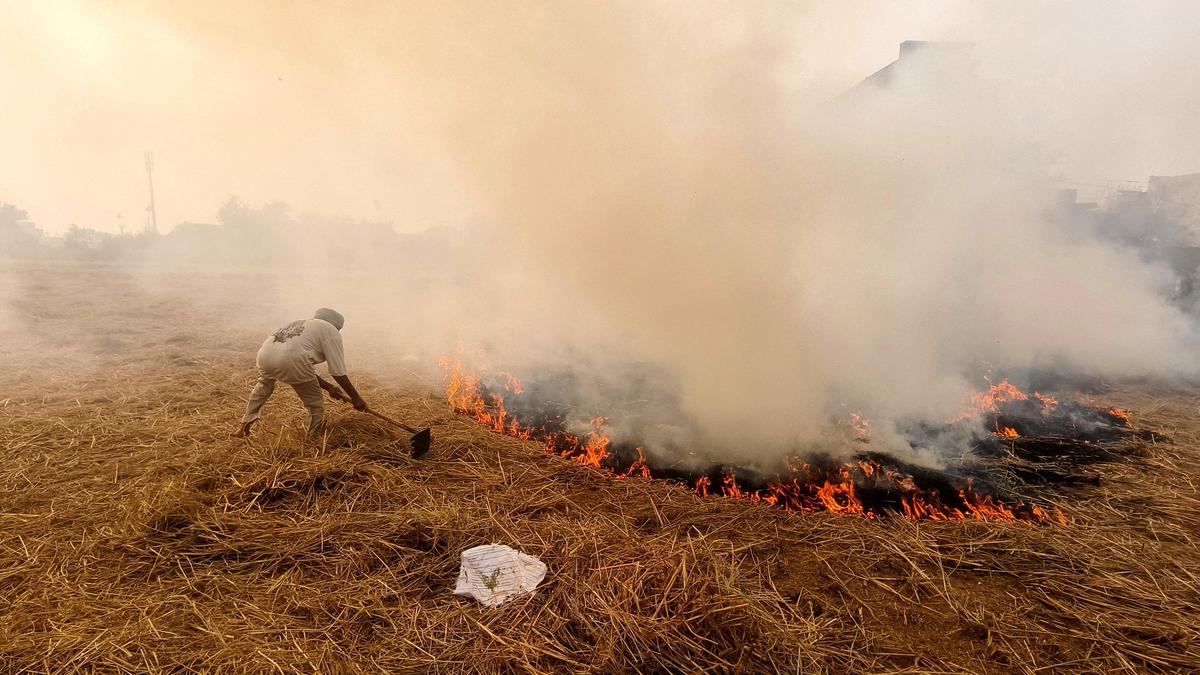
The gap between that argument and what happens in the fields is easy to see. A farmer burns paddy stubble in a field in Sangrur district, Punjab, in a photograph dated November 11, 2026. For many farmers, burning remains the fastest and cheapest way to clear a field before sowing the next crop, and that reality sits at the centre of the dispute.
A question of who gets blamed
The BKS framed the Supreme Court’s remarks as a call for a broader investigation. Its All India General Secretary, Mohini Mohan Mishra, said the court had underlined the need to look beyond stubble burning and identify the other major sources of pollution.
"State governments should move beyond paperwork and take concrete steps to identify the actual causes of pollution rather than repeatedly blaming farmers for the deteriorating air quality in the national capital and surrounding regions," he said.
That criticism goes to the heart of the issue. Farmers in northern states have often faced fines, and FIRs have been registered against them, while the pollution crisis in the national capital has many contributors. The BKS argues that focusing enforcement on rural households and fields shifts attention away from traffic, factories and other sources that the court itself mentioned.
A procurement idea with a price tag
The more concrete proposal in the BKS statement concerns money. Welcoming the Supreme Court’s suggestion of a procurement mechanism for crop residue, Mishra said the government should introduce a system modelled on the Minimum Support Price framework for agricultural produce.
His logic is straightforward. If the government buys stubble, farmers gain an extra source of income, and they have a reason to sell residue instead of setting it alight. Mishra presented that as an incentive rather than a punishment, which is a different approach from the penalty-led enforcement the group wants to end.
The organisation also made three specific demands. It asked for the immediate withdrawal of all fines imposed on farmers over stubble burning and all FIRs registered against them. It urged governments either to bear the full cost of crop residue management, or to give farmers the equipment and resources needed to handle stubble without burning it.
Those demands raise questions that the statement does not answer. It does not say how much a residue procurement scheme would cost, who would pay for it at the state level, or how the equipment would reach small and medium farmers. Those details will decide whether the proposal changes anything in the field.
The environmental stakes
Stubble burning is a real concern for air quality, and the Supreme Court’s remarks did not dismiss it. The court’s point was narrower: that it is one factor among several, and that the response should match the full set of causes. That is why the debate has become so contentious. Environmental regulators and farm groups both have a stake in cleaner air, but they disagree on who should carry the burden of change.
For farmers, the choice is often between cost and compliance. Clearing paddy residue quickly with machinery takes time and money, and many smaller holdings lack access to shared equipment. A penalty does not solve that problem on its own, which is the core of the BKS argument.
The statement also raises a broader question about farmers’ rights. When enforcement lands mainly on rural landholders, critics argue it treats them as the default culprits in an urban pollution problem. Supporters of strict action argue that clean air is a public good and that burning cannot continue unchecked. The BKS wants both goals met, but through support rather than fines.
What happens next
The statement does not say whether state governments have responded to the Supreme Court’s observations or whether they plan to change how they enforce rules on stubble burning. What it does show is that the farm lobby is now pressing the Centre and the states to turn the court’s language into policy. Whether that happens will depend on how governments balance pollution control against the financial pressure on farmers.
For now, the central message from the BKS is simple. Farmers should not be the first and only target of anti-pollution action, and any serious plan has to address the full range of sources that the Supreme Court pointed to.
TL;DR
- The RSS-affiliated Bharatiya Kisan Sangh urged state governments to stop penalising farmers for stubble burning.
- The group welcomed Supreme Court observations that stubble burning is one of several causes of Delhi-NCR air pollution.
- The bench also named vehicular emissions and industrial pollution as significant contributors.
- BKS wants a procurement mechanism for crop residue, modelled on the MSP framework.
- The group demanded withdrawal of all fines and FIRs registered against farmers over stubble burning.
- It also urged governments to bear crop residue management costs or provide equipment.