Agricultural drones and app-based machinery rentals could reshape Indian farming by cutting input costs, raising output and opening new income streams, industry leaders and experts said at the Bharat Agriculture Conference 2026.
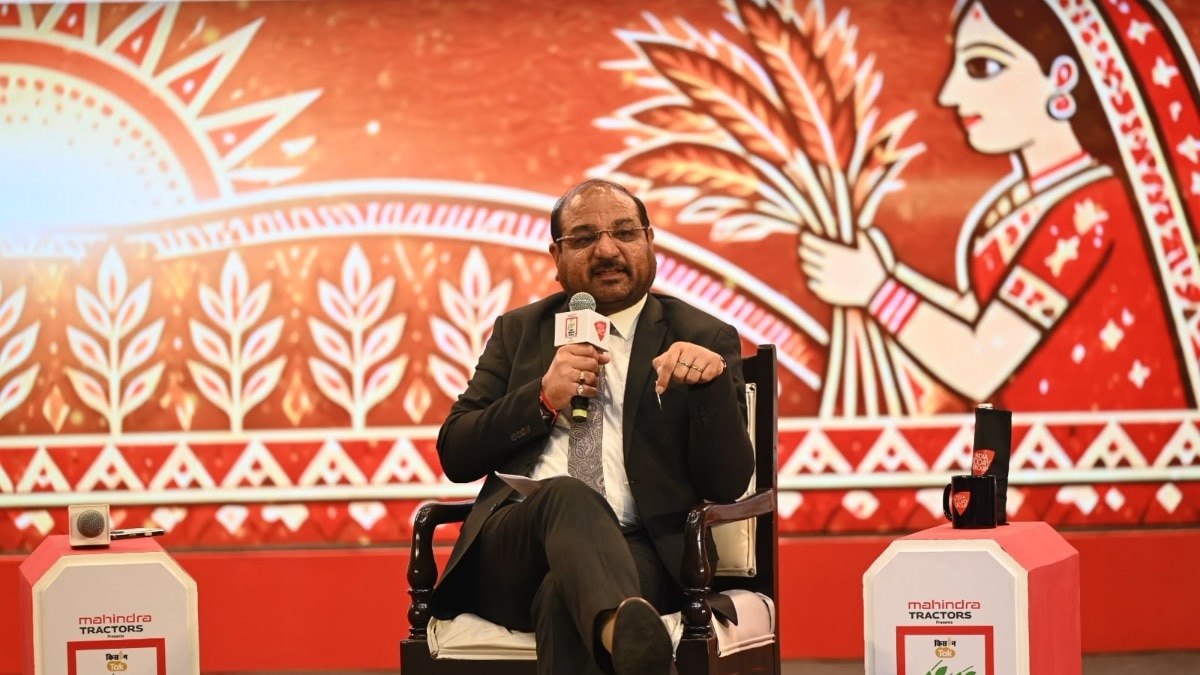
The message came from a session titled ‘Agricultural Revolution: New Tools’, where representatives from the Mahindra Group, the drone industry and NITI Aayog discussed how farmers could move past conventional tractor-based mechanisation. The panel did not treat machines as the goal. The bigger question was how to make modern tools useful to a farmer with a few acres of land.
One idea stood out. Speakers proposed an app-based platform where farmers could book agricultural equipment on demand, much like ordering food or booking a cab. The logic is simple. Many farmers cannot justify spending large sums on machinery they will use only a few times a year.
Drones are changing the spraying job
Anoop Kumar Upadhyay, Co-Founder and Director of IoTech World, made the case that drones have become an important farm tool, especially for spraying pesticides and other agrochemicals. He used sugarcane as an example. Once the crop grows five to six feet tall, spraying by hand or conventional means becomes difficult. Drones can get into those fields and do the job faster.
He put the change in terms of water and time. Speaking in Hindi, he said that where 200 litres of water was being used for spraying, the drone method uses 10 litres. He also said an acre that once took two to three hours to spray could now be finished in around seven minutes.
“Drone se spray karne se hamare jo kheti mein jo lagat hoti hai, jahan 200 liter pani use ho raha tha, ab 10 liter pani use hota hai spray karne ke liye.”
Safety was another point. Operators control drones remotely, so they do not have to walk through fields while spraying chemicals. That reduces their direct exposure to pesticides.
Upadhyay also described GPS-based technology and sensors that can identify patches of unhealthy crops. The machine can then spray only those areas instead of treating the whole field. He said scientific assessments conducted with agrochemical scientists have shown that drone-based spraying can increase agricultural output by 10 to 15 per cent. He added that his company had sold around 4,000 agricultural drones in India, and that women own 40 to 45 per cent of them.
A bigger role for women in farm mechanisation
The discussion kept coming back to women. Speakers pointed to the Centre’s Namo Drone Didi programme, which intends to provide 15,000 drones to women-led self-help groups, along with training.
Upadhyay said drone operation gives women a way to earn extra money without doing physically demanding field work. He explained that a woman operating a drone could spray around 10 acres in two hours and earn Rs 300 per acre. Depending on the available work, that could add up to Rs 2,000 to 3,000 a day.
Harsh K Rai, CEO of the Farm Division and Growmax at Mahindra Group, said the industry also needs machines that suit women farmers. Companies have started looking at whether tractors, tillers and other implements need different designs or variants to be more comfortable for women users. Rai called “female-friendly products” an important area for research and development.
KV Raju, Member (Agriculture) at NITI Aayog, stressed training. He said women need to learn to operate equipment and take on tasks such as planting, transplantation, grading, sorting and storage.
Why renting may beat buying
Raju said farmers often spend lakhs of rupees on tractors and other equipment but use them only for part of the year. A rental model could improve how much each machine gets used and ease the financial strain on small farmers. He proposed an online platform where farmers could book tractors, harvesters, transplanters, weeders and other implements whenever they need them.
The drone industry representative backed the idea and called it “drone as a service”, or DaaS. He said an agricultural drone could spray around 30 acres in a day. The problem is that most individual farmers have small plots and would need the machine for only a short period.
A drone can cost Rs 7 to 8 lakh, not counting training and insurance. For many farmers, that price does not make economic sense. Trained agri-entrepreneurs could instead offer spraying services to several farmers and earn money through rentals. Speakers also discussed extending the model beyond drones to a wider ‘farming as a service’ approach covering different types of farm machines.
Where Telangana and Andhra Pradesh fit in
The two Telugu-speaking states feature in the adoption story. Upadhyay said Maharashtra, Uttar Pradesh, Telangana, Andhra Pradesh and Haryana have reported encouraging uptake of agricultural drones. For farmers and rural entrepreneurs in those states, the rental model could matter as much as the technology, since it lets a farmer use a drone without buying one outright. The session did not give state-level figures, so the scale of adoption in either state remains unclear from the discussion.
Productivity, not just more machines
Rai argued that mechanisation should be judged by how much each acre produces, not by how many machines are on a farm. He said Mahindra is investing in research on electric tractors, hybrid tractors and alternative-fuel technologies to make farming more sustainable. Fuel efficiency will still matter during the shift toward electric machinery, he added.
Raju said private companies will play an essential role in the mechanisation push by building new equipment and showing farmers what it can do. He also laid out a longer-term goal tied to 2047. The primary sector, which includes agriculture, horticulture, livestock, fisheries and forestry, has been assigned a target of contributing $6 trillion to a proposed $30 trillion Indian economy.
Planning is underway to study the mechanisation needs of different states and crops. Officials are also looking at where drones and harvesters should be deployed and what training farmers will need to adopt them.
The session ended with calls for stronger public-private collaboration and wider access to farm machinery through digital platforms. Whether an app can match a farmer with the right tractor or drone at the right time will depend on the details that the panel left open, including pricing, availability and who trains the operators.
TL;DR
- Agricultural drones and app-based machinery rentals could reshape Indian farming, experts said at the Bharat Agriculture Conference 2026.
- Drone spraying can cut water use from 200 litres to 10 litres per spraying operation, according to IoTech World’s Anoop Kumar Upadhyay.
- Speakers proposed an app-based platform letting farmers book tractors and implements on demand, instead of buying machines they use rarely.
- The Namo Drone Didi programme plans to provide 15,000 drones to women-led self-help groups, with training.
- A drone can spray around 30 acres in a day, but a single small farmer may need it only briefly.
- Agriculture, horticulture, livestock, fisheries and forestry have a target of contributing $6 trillion to a proposed $30 trillion economy by 2047.