For generations, the narrative of human civilization has placed Mesopotamia at its genesis, followed by Egypt, Greece, and Rome. India, in this conventional account, often appears as a later chapter, a recipient of ideas and innovations from elsewhere. However, a compelling new perspective from maritime historian Nick Collins is challenging this entrenched view, positing that ancient India was not merely a participant but the very opening page of civilization’s story.
Collins, who spent four decades immersed in international shipping, approached historical research without academic preconceptions. His extensive work tracing ancient trade routes, goods, and commercial networks consistently led him to one conclusion: the Indian subcontinent was the true cradle of civilization, flourishing long before Western historians typically acknowledge its scale and influence.
Revisiting Ancient Narratives
The historian’s central argument, expanded in a detailed Substack column and shared on platforms like X, directly refutes the Mesopotamia-first narrative. He contends that India’s cities, sophisticated mathematics, advanced manufacturing, and extensive maritime networks were well-established and thriving at a time when other regions were still in nascent stages of development.
Collins suggests that the conventional historical timeline, which places Mesopotamia at the forefront, is partly a product of early European archaeological priorities. The dry climate of Mesopotamia preserved artifacts like clay tablets, bricks, and bones, while biblical and classical texts directed scholars to the region. Ottoman authorities also facilitated European excavations, further cementing its perceived primacy.
In contrast, India received comparatively less attention. While sites like Harappa were identified in the 19th century, serious exploration only began decades later. Mohenjo-daro, a monumental discovery, came to light in 1922. By then, Collins argues, the Mesopotamia-first narrative had already solidified into an accepted historical fact, overshadowing the true scale of the Indus-Sarasvati civilization.
The Indus-Sarasvati Legacy
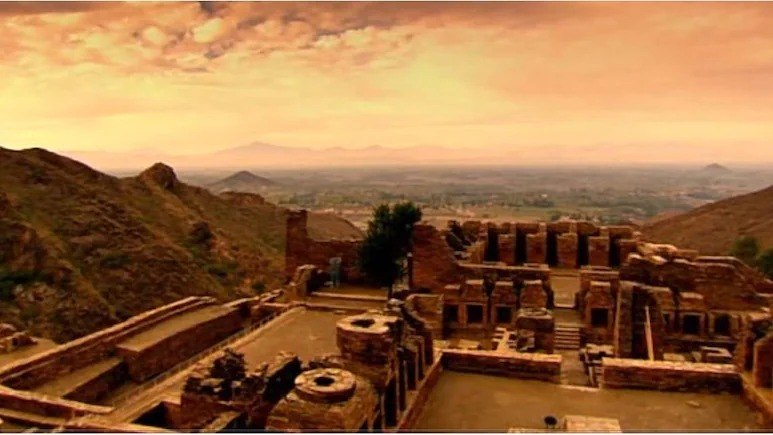
The evidence supporting India’s ancient prominence is substantial. The Indus-Sarasvati civilization, spanning hundreds of settlements, showcased remarkable urban planning with standardized bricks, uniform weights, grid-patterned streets, advanced sanitation systems including bathrooms and covered drains, and extensive manufacturing and trading networks.
Lothal, located in Gujarat, serves as a cornerstone of Collins’s argument. Its enormous brick basin, often misidentified in early interpretations as a bathing pool or water tank, is presented by Collins as an advanced dockyard. He asserts it was capable of handling dozens of trading vessels, a level of maritime sophistication that Europe would not achieve for another four millennia. This misinterpretation, he believes, highlights a deeper prejudice against recognizing such advanced capabilities in ancient India.
Debunking the Aryan Theory
Collins also delves into one of the most contentious theories in Indian history: the Aryan invasion. Developed by European scholars in the 19th century, this theory proposed that light-skinned Indo-European groups entered India around 1500 BC, bringing with them Sanskrit, the Vedas, and the foundations of Vedic civilization. Collins dismisses this, stating that the theory was constructed because an Indian civilization independent of Caucasian influence was unpalatable to the late 19th-century European mindset.
Modern scholarship has largely moved beyond the idea of a violent invasion, favoring more complex migration models. While genetic research indicates steppe ancestry entering South Asia, Collins emphasizes that the builders of the Indus cities were indigenous populations who had already forged an advanced civilization long before these migrations. He further points to the Rig Veda’s descriptions of the Sarasvati River, which had diminished or disappeared before the conventional dating of later migrations, arguing that the Vedas themselves do not describe an invasion.
Eastward Flow of Innovation
A fundamental flaw, according to Collins, lies in the compartmentalized way history is often studied, with Mesopotamian scholars focusing solely on Mesopotamia, Egyptologists on Egypt, and Indologists on India. He argues that ancient trade, however, respected no such academic boundaries.
Once these artificial divisions are removed, the direction of cultural and commercial flow appears strikingly different. Carnelian beads, cotton, and timber discovered in Mesopotamia have been traced back to Meluhha, the Sumerian name for the Indus civilization, arriving aboard ships. An Akkadian seal even identifies its owner as an "interpreter of the Meluhhan language," suggesting that trade with India was regular and significant enough to necessitate professional linguistic intermediaries.
Merchant seals, stone anchors, and the remains of a warehouse at Lothal further bolster Collins’s maritime argument. Beads manufactured in Lothal traveled as far as the royal tombs of Ur, indicating a robust East-to-West cultural and commercial exchange. For Collins, this evidence strongly suggests that the cultural flow was from east to west, rather than the other way around, as traditionally taught.
Editorial Context
Nick Collins’s re-evaluation of ancient history carries profound implications, extending far beyond academic circles. By challenging the long-standing Western-centric narrative of civilization’s origins, his work contributes to a broader global movement to decolonize history and acknowledge the independent and pioneering contributions of non-Western cultures. This perspective not only enriches our understanding of humanity’s past but also fosters a more inclusive and accurate appreciation of diverse historical trajectories.
Over the long term, this shift in historical understanding could influence educational curricula, archaeological funding, and even national identity. It encourages a deeper exploration of indigenous innovations and achievements, potentially uncovering further evidence that reshapes our collective memory of how human societies developed. The debate sparked by Collins underscores the dynamic nature of historical inquiry, reminding us that established narratives are always subject to re-examination in light of new evidence and perspectives.
TL;DR
- Maritime historian Nick Collins challenges the conventional view that Mesopotamia was the cradle of civilization, asserting India’s Indus-Sarasvati civilization predates and influenced it.
- Collins’s research, based on ancient shipping and trade networks, suggests India’s cities, mathematics, manufacturing, and maritime capabilities flourished earlier than recognized.
- He argues the Mesopotamia-first narrative gained traction due to early European archaeological focus, climate preservation, and biblical texts, while India’s vast sites like Mohenjo-daro were explored later.
- Lothal, with its advanced brick basin, is highlighted as a sophisticated dockyard, demonstrating India’s unparalleled maritime technology for its time.
- Collins refutes the 19th-century Aryan invasion theory, emphasizing the indigenous development of the Indus cities and an East-to-West cultural flow, evidenced by trade goods and linguistic needs in Mesopotamia.
- The re-evaluation calls for a holistic study of history, moving beyond compartmentalized academic boundaries to reveal a more accurate and interconnected ancient world.