A Glimpse into the Late Cretaceous
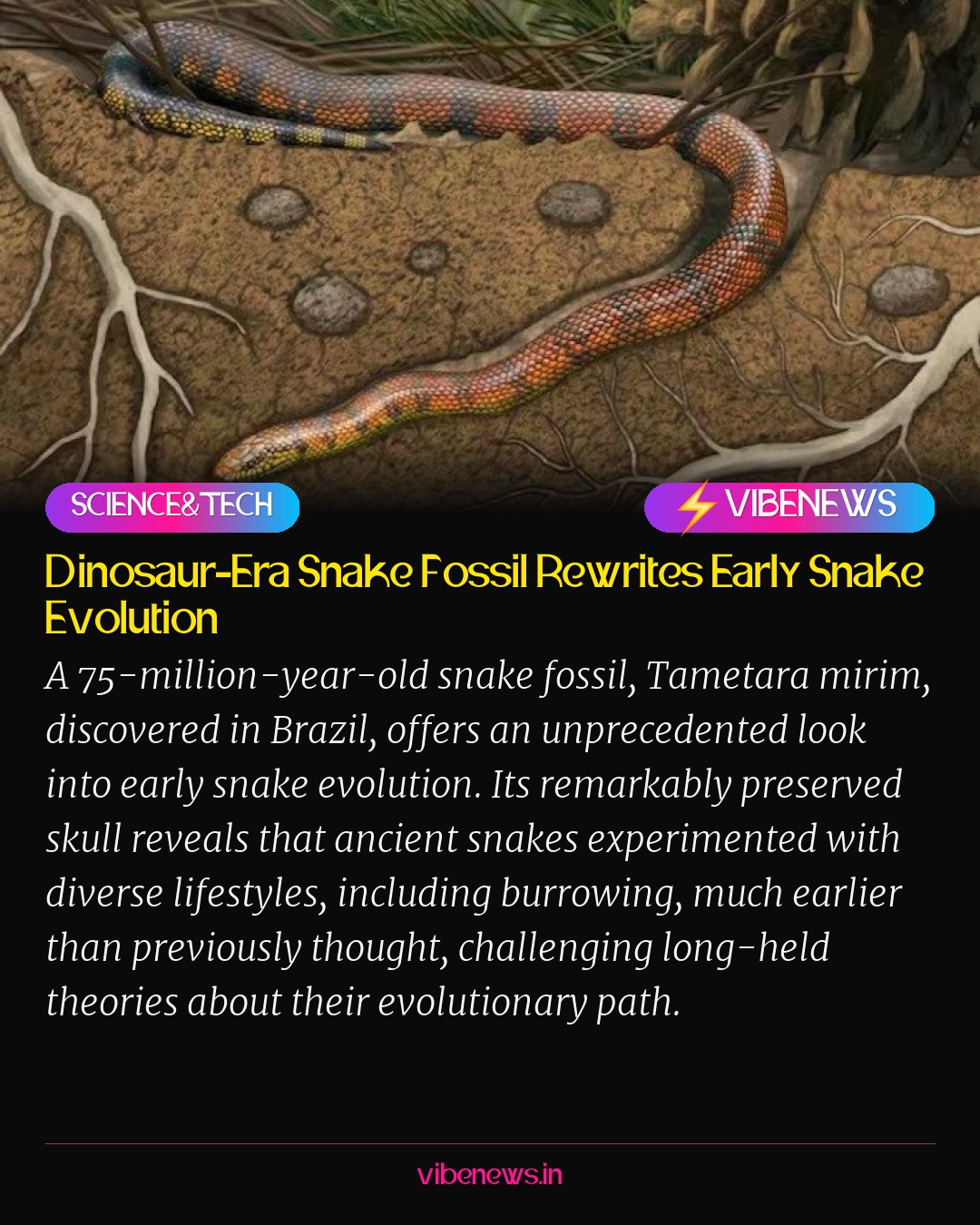
A remarkably well-preserved snake fossil, dating back 75 to 85 million years, has provided scientists with an unparalleled window into the early evolutionary journey of snakes. This discovery suggests that these ancient reptiles explored a variety of lifestyles and habitats far earlier than previously understood, fundamentally altering long-standing theories.
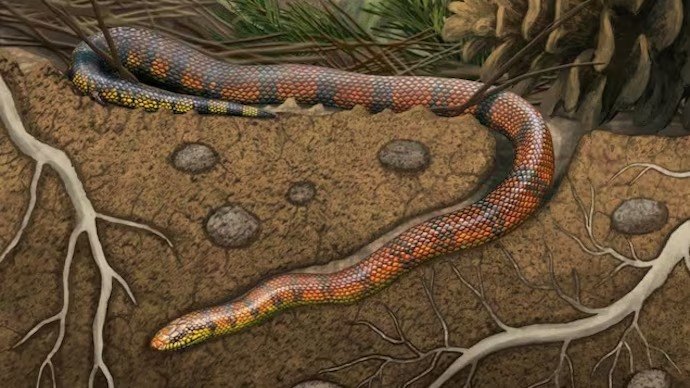
The fossil, unearthed in the rich paleontological grounds of southeastern Brazil, represents a newly identified species named Tametara mirim. This creature thrived during the Late Cretaceous Period, an epoch when colossal dinosaurs still dominated the Earth’s ecosystems.
Unearthing Tametara mirim: A Unique Preservation
Measuring approximately 42 centimetres in length, Tametara mirim coexisted with formidable long-necked dinosaurs, formidable crocodiles, and early avian species within what was then a vibrant, lush landscape. The findings, which shed significant light on a previously obscure chapter of life, were meticulously documented and published in the esteemed scientific journal Nature.
Fossils of snakes from the dinosaur era are exceedingly rare, and most specimens are too fragmented to offer substantial insights into their evolutionary trajectory. What distinguishes Tametara mirim is the extraordinary preservation of its skull, a feature seldom found in such ancient remains.
Researchers successfully recovered about 60% of the snake’s skull and 70% of its vertebral column. This remarkable completeness allowed them to reconstruct the snake’s brain anatomy with unprecedented detail, utilizing advanced high-resolution CT scans.
Challenging the Linear Path of Evolution
The detailed analysis of Tametara mirim’s anatomy revealed a surprising adaptation: the species was well-suited for a fossorial, or burrowing, lifestyle. This mode of existence is strikingly similar to that of modern coral snakes, indicating a specialized adaptation much earlier in snake history.
Even more unexpectedly, the fossil evidence suggests that early snakes did not follow a simple, linear evolutionary progression from one habitat to another. Instead, they appear to have repeatedly adapted to diverse environments, including subterranean, terrestrial, and even marine settings, over vast stretches of geological time.
This dynamic pattern challenges the conventional wisdom that early snakes shared a singular way of life before diversifying. The research indicates that different lineages independently evolved their specialized lifestyles over millions of years, showcasing a far more complex and adaptable evolutionary history than previously imagined.
Life in an Ancient Brazilian Landscape
Snakes are generally believed to have originated from lizard ancestors approximately 170 million years ago, during the Jurassic Period. However, the fossil record from this remote era is exceptionally sparse, making it difficult for scientists to fully comprehend the mechanisms by which this group lost its limbs and developed its characteristic elongated bodies.
While the new Tametara mirim fossil does not preserve its teeth or hip region, researchers hypothesize that it likely retained robust hind limbs. This characteristic would align it with other ancient snakes, such as Najash rionegrina, which famously possessed functional back legs, offering further clues into the transitional forms of early snakes.
The study further posits that the ancestral snake may not have been fully committed to a single habitat. Instead, it likely occupied a transitional lifestyle, navigating between burrowing underground and moving across the ground. This versatile existence would have preceded the later diversification of snake lineages into the vast array of habitats observed in the modern world.
The Scientific Lens: Unlocking Ancient Secrets
The discovery and subsequent study of Tametara mirim represent a monumental achievement in paleontology. The advanced imaging techniques, particularly the high-resolution CT scans, were instrumental in reconstructing the intricate brain anatomy, providing insights that would be impossible with traditional methods.
The publication in Nature underscores the global significance of this find, positioning it as a cornerstone in understanding reptile evolution. It offers one of the most complete and detailed windows yet into the earliest chapters of snake evolution, helping to elucidate how one of Earth’s most successful and diverse groups of reptiles first emerged during the age of dinosaurs.
Editorial Context: A Deeper Understanding of Life’s Tapestry
The unearthing of Tametara mirim is more than just the discovery of another ancient creature; it is a profound re-evaluation of evolutionary principles. For Vibe News readers, this development matters because it illustrates the dynamic and often unpredictable nature of life’s history on Earth. It reminds us that scientific understanding is constantly evolving, with each new fossil potentially overturning decades of established theory.
Over the long term, this research contributes significantly to our understanding of biodiversity and adaptation. It highlights how early life forms were not necessarily simple or linear in their development but engaged in complex evolutionary experiments. This insight has implications for fields ranging from conservation biology, by providing a deeper historical context for modern species, to astrobiology, by informing our understanding of how life might adapt and diversify on other planets.
The story of Tametara mirim underscores the critical role of paleontological research in piecing together the grand narrative of life. It reinforces the idea that the past holds crucial keys to understanding the present and anticipating the future of biological evolution.
TL;DR
- A 75-million-year-old snake fossil, Tametara mirim, was discovered in southeastern Brazil.
- The fossil’s remarkably preserved skull provides the clearest insight yet into early snake evolution.
- Tametara mirim was adapted for a fossorial (burrowing) lifestyle, similar to modern coral snakes.
- The discovery suggests early snakes diversified into various habitats independently and much earlier than previously believed.
- This challenges the idea of a simple, linear evolutionary path for snakes, indicating a more dynamic process.
- The findings, published in Nature, offer a crucial window into the origins of one of Earth’s most successful reptile groups.