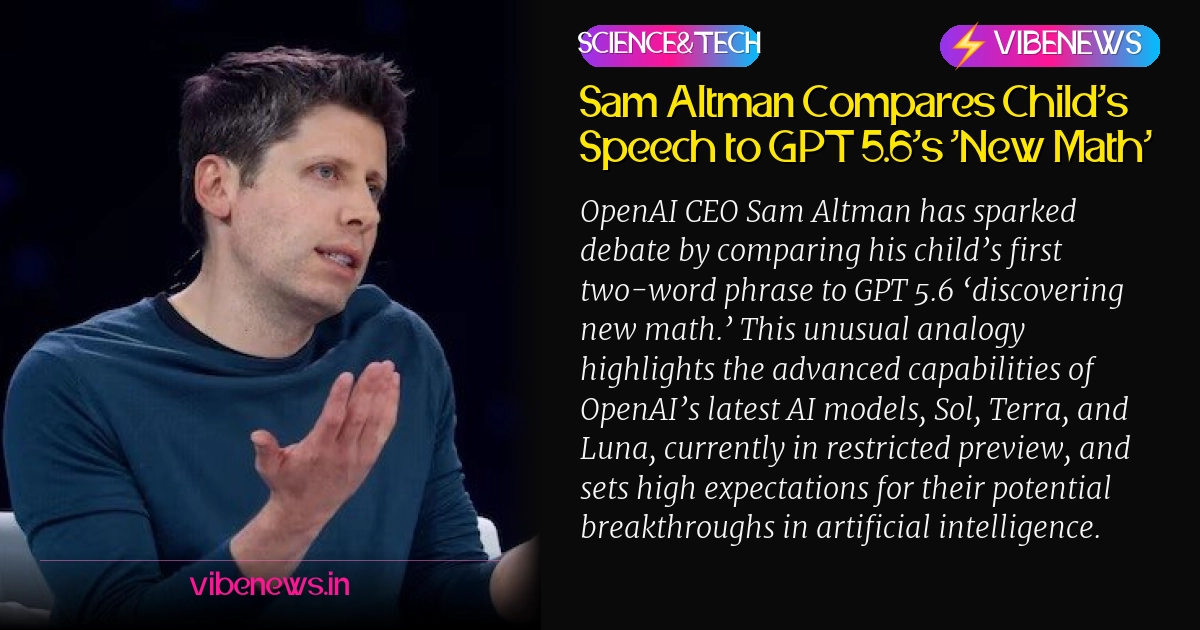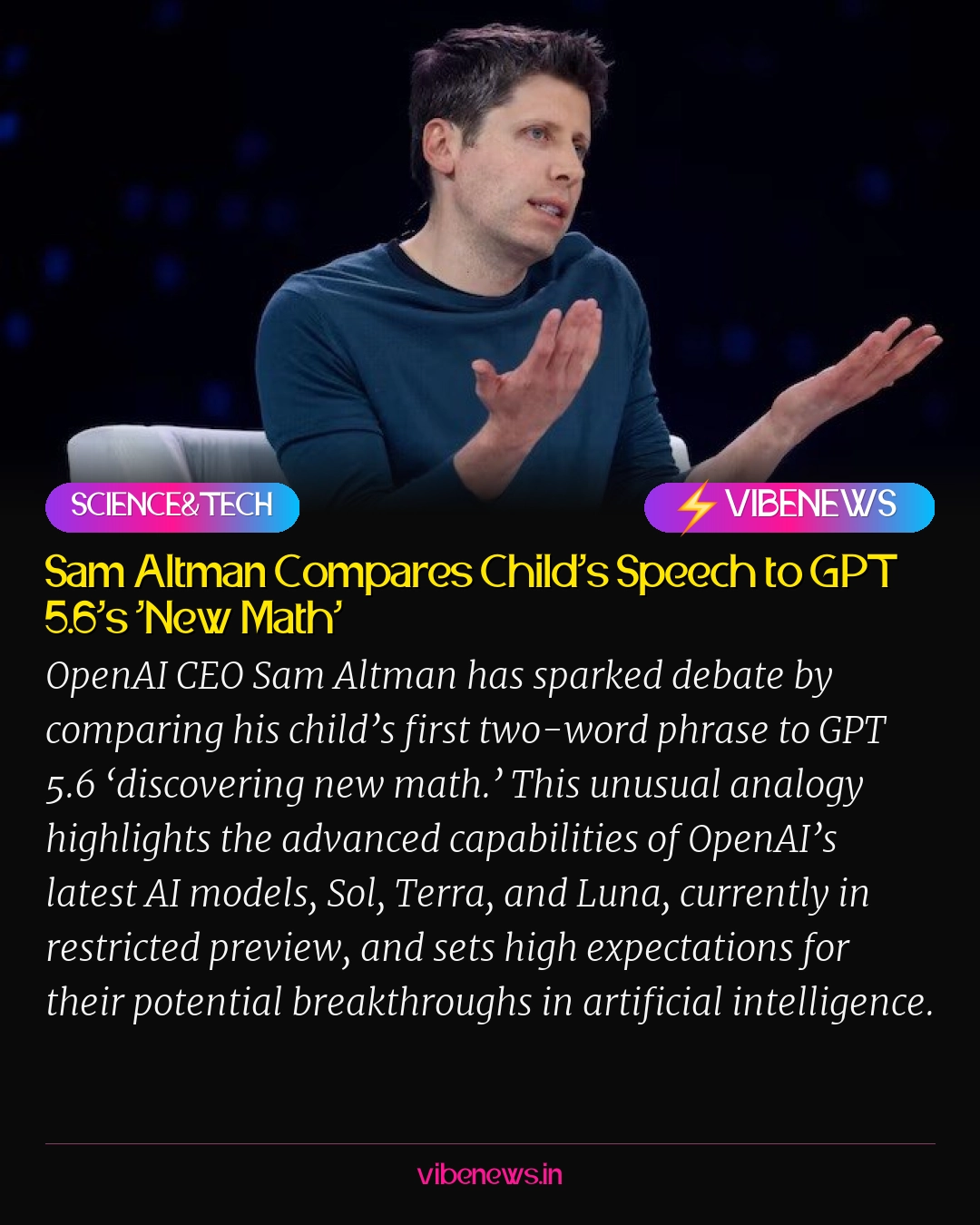
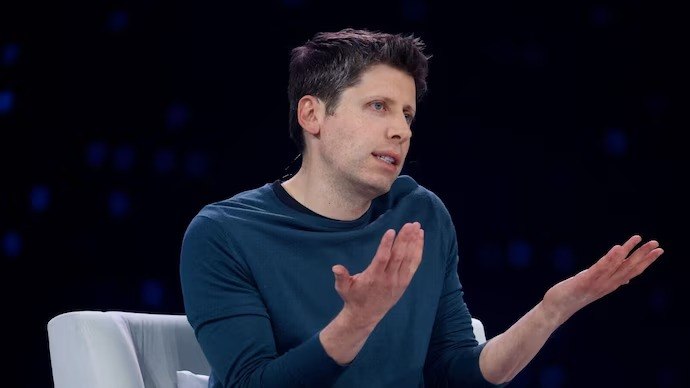
OpenAI CEO Sam Altman recently drew an unprecedented comparison, stating that his child’s first two-word phrase evoked the same amazement as GPT 5.6 "discovering new math." This statement, shared on X (formerly Twitter), has ignited discussions about the advanced capabilities of OpenAI’s latest large language models and the lofty expectations now placed upon them.
The comparison, made on July 6, 2026, suggests a significant leap in artificial intelligence, particularly with the new GPT 5.6 models — Sol, Terra, and Luna — which are currently available only through a restricted preview following a request from the US government. While the specifics of GPT 5.6’s mathematical discoveries remain undisclosed, Altman’s analogy underscores a perceived cognitive breakthrough in AI on par with fundamental human development.
What Did Sam Altman Say About GPT 5.6?
Sam Altman took to X to share his personal and professional marvel. He wrote, "Our older kid put two words together for the first time and I am approximately as amazed by this cognitive feat as I am by GPT-5.6 discovering new math." This direct comparison between a child’s developmental milestone and an AI’s advanced capability immediately captured public attention.
The statement implies that GPT 5.6 has achieved something genuinely novel and complex in the realm of mathematics, moving beyond mere computation to potentially generate new theoretical frameworks or solutions. Such a development would represent a profound advancement in generative AI.
The Significance of "New Math" in AI Development
The phrase "discovering new math" is particularly potent in the context of artificial intelligence. It suggests that GPT 5.6 is not merely processing existing data or solving known problems, but rather engaging in creative, abstract reasoning to formulate entirely new mathematical concepts or proofs. This capability would push the boundaries of what large language models are currently understood to achieve.
For AI, discovering new math could mean breakthroughs in areas like cryptography, theoretical physics, or even optimizing complex algorithms in ways previously unimagined by human researchers. It points towards a future where AI could actively contribute to fundamental scientific knowledge.
OpenAI’s New Models: Sol, Terra, and Luna
The GPT 5.6 models, named Sol, Terra, and Luna, were introduced last month as part of a restricted preview. Altman has previously characterized these models as a major step forward in both capability and pricing efficiency, indicating a significant upgrade from previous iterations.
The limited release to a select group of companies, mandated by the US government, suggests that these models possess capabilities that warrant careful oversight and controlled deployment. This adds another layer of intrigue to Altman’s bold claims about their performance.
Public Reaction to Altman’s Comparison
Altman’s comparison was met with a divided response online. Many users expressed heightened anticipation for GPT 5.6’s full release, interpreting his words as a strong indicator of groundbreaking performance. One user commented, "Sam Altman just compared his child putting two words together for the first time to GPT-5.6 discovering new math. Expectations for what’s next couldn’t be any higher now."
However, others voiced concern and even discomfort with the analogy. Some found the comparison between human cognitive development and machine learning to be unsettling or even "horrifying." Another user humorously, yet critically, remarked, "Baby spoke for the first time, Sam: ‘here’s the benchmark on the XYZ scale of Baby vs GPT-5.6.’" These reactions highlight the ongoing ethical and philosophical debates surrounding the rapid advancement of AI and its place in human society.
Broader Implications for AI and Human Cognition
This isn’t the first time Sam Altman has drawn parallels between human and artificial intelligence. In February, he addressed concerns about AI’s energy consumption by comparing it to the energy required to raise and educate a human. He stated, "People talk about how much energy it takes to train an AI model. But it also takes a lot of energy to train a human. It takes like 20 years of life and all of the food you eat during that time before you get smart."
Such statements from the OpenAI CEO consistently challenge conventional thinking about AI, framing it not just as a tool, but as an evolving intelligence with its own developmental trajectory. This perspective encourages a deeper consideration of AI’s potential and its integration into the fabric of human experience.
The Future of GPT 5.6 and General Availability
While GPT 5.6 is currently restricted, rumors suggest that OpenAI may release it for wider public use later this week. A general release would allow a broader audience to experience and evaluate the capabilities that have prompted such an extraordinary comparison from Sam Altman.
The potential for GPT 5.6 to genuinely discover new mathematical principles could revolutionize various scientific and technological fields, making its eventual widespread availability a highly anticipated event for researchers, developers, and the general public alike.
TL;DR
- Sam Altman compared his child’s first two-word phrase to GPT 5.6 "discovering new math," highlighting significant AI advancements.
- OpenAI’s latest models, GPT 5.6 (Sol, Terra, Luna), are currently in a restricted preview following a US government request.
- The comparison has generated considerable online discussion, with some users expressing excitement and others concern over the analogy.
- This statement sets high expectations for GPT 5.6’s capabilities, particularly its potential for novel mathematical breakthroughs.
- Altman previously drew parallels between human and AI energy consumption for learning, underscoring his unique perspective on AI development.