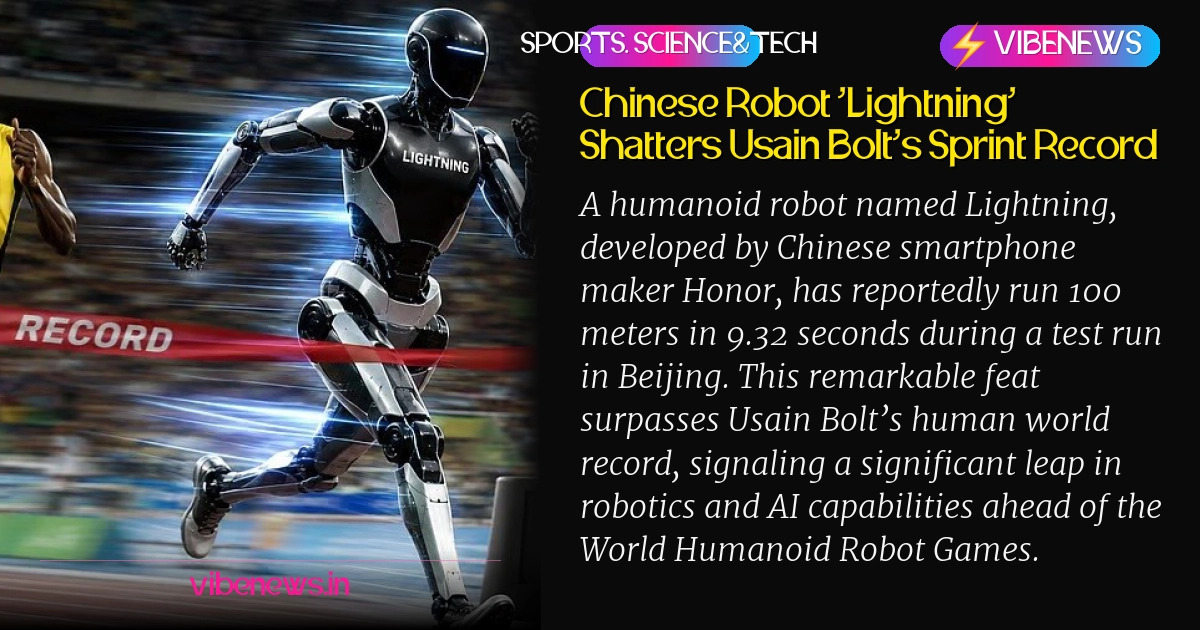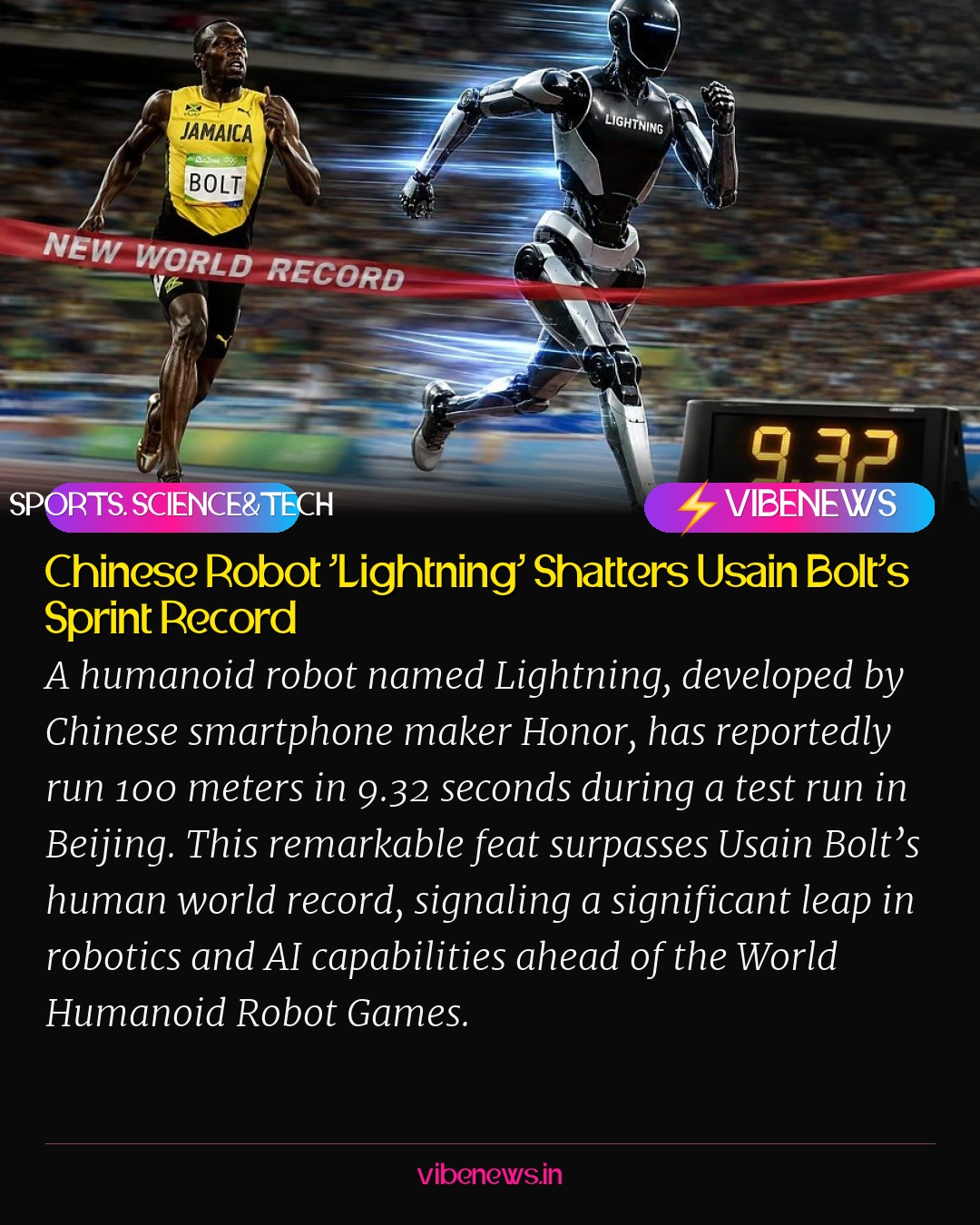
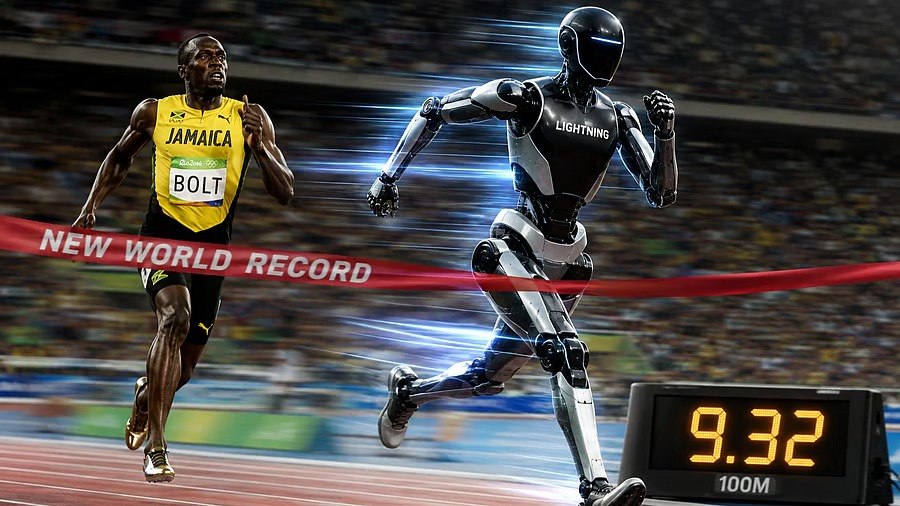
A humanoid robot developed by Chinese smartphone maker Honor has reportedly achieved a groundbreaking feat, completing a 100-meter sprint in an astonishing 9.32 seconds during a preparatory test event in Beijing. This performance by the robot, dubbed ‘Lightning’, significantly surpasses the long-standing human world record of 9.58 seconds set by Jamaican sprinting legend Usain Bolt at the 2009 World Athletics Championships.
The test run was conducted ahead of the second World Humanoid Robot Games, which commenced in Beijing on Saturday. During its sprint, Lightning reached an impressive peak speed of 14.5 meters per second, showcasing the rapid advancements in robotic locomotion and artificial intelligence.
The Robotic Athlete’s Prowess
Lightning’s recent sprint record is not its only notable achievement. The robot previously demonstrated its endurance by winning the 21-kilometer Beijing half marathon in April, completing the race in 50 minutes and 26 seconds. This time was faster than the elite men’s human world-record pace for the same distance, underscoring its versatile athletic capabilities.
Initially, the robot stood 169 cm tall and featured 95-cm legs during its half-marathon victory. However, researchers at Honor have since made modifications, lengthening its legs by an additional 10 cm to 1.05 meters. These adjustments were implemented specifically to optimize its performance for the upcoming World Humanoid Robot Games, as reported by China Central Television.
China’s Strategic Vision for Robotics
This remarkable achievement by Honor’s Lightning robot is set against a backdrop of China’s aggressive promotion of humanoid robots as a strategic emerging industry. Policymakers and leading technology companies within the nation are heavily investing in this sector, driven by the belief that significant advancements in AI and hardware will accelerate their widespread deployment.
The vision extends beyond mere athletic demonstrations. China anticipates that humanoid robots will play a pivotal role across various sectors, including advanced manufacturing, complex logistics operations, and diverse consumer applications. This national strategy aims to position China at the forefront of the global robotics revolution, leveraging AI to enhance productivity and innovation.
The Engineering Behind the Speed
Achieving such high speeds and agility in a bipedal robot presents immense engineering challenges. Unlike wheeled robots, humanoid robots must constantly manage balance, mimic complex human gait patterns, and dynamically adjust to terrain variations. The development involves sophisticated algorithms for motion planning, advanced sensor integration for real-time feedback, and powerful actuators capable of generating rapid, precise movements.
The ability of Lightning to not only sprint at record-breaking speeds but also maintain endurance over a half-marathon distance speaks volumes about the integration of robust mechanical design with highly intelligent control systems. It represents a convergence of biomechanics, materials science, and cutting-edge artificial intelligence, pushing the boundaries of what autonomous systems can achieve.
A New Era of Human-Robot Interaction
The emergence of robots capable of outperforming humans in physical feats like sprinting and long-distance running signals a new era in human-robot interaction. While these initial applications might seem confined to competitive events, the underlying technologies have profound implications for practical, real-world scenarios. Robots with superior speed, strength, and endurance could revolutionize fields requiring rapid response, heavy lifting, or continuous operation in challenging environments.
From disaster relief efforts where speed is critical to advanced manufacturing lines demanding precision and stamina, the capabilities demonstrated by Lightning could pave the way for more efficient and safer robotic assistants. This development challenges traditional notions of human physical supremacy and opens up new avenues for collaboration and augmentation.
Editorial Context
The achievement of Honor’s ‘Lightning’ robot is more than just a sports headline; it is a potent symbol of the accelerating pace of technological advancement and China’s determined push for leadership in artificial intelligence and robotics. Over the long term, this development underscores a fundamental shift in the capabilities of autonomous systems, moving them from mere tools to potential partners and even competitors in domains once exclusively human.
The implications extend to the future of labor, as robots become increasingly capable of performing tasks requiring high levels of physical dexterity and endurance. It also raises questions about the evolving definition of ‘athleticism’ and ‘performance’ in a world where biological limits are increasingly challenged by engineered solutions. As humanoid robots become more sophisticated, their integration into society will necessitate careful consideration of ethical frameworks, economic impacts, and the very nature of human identity in an increasingly automated world. This milestone serves as a powerful indicator of the transformative changes that lie ahead, driven by relentless innovation in AI and robotics.
TL;DR
- Honor’s humanoid robot, ‘Lightning’, ran 100 meters in 9.32 seconds during a test event in Beijing.
- This time surpasses Usain Bolt’s 100m human world record of 9.58 seconds.
- Lightning also won the 21-km Beijing half marathon in 50 minutes and 26 seconds, faster than the human world-record pace.
- The robot’s legs were lengthened from 95 cm to 1.05 meters for the World Humanoid Robot Games.
- The achievement highlights China’s strategic focus on promoting humanoid robots as a key emerging industry.
- The technology aims for deployment in manufacturing, logistics, and consumer applications.