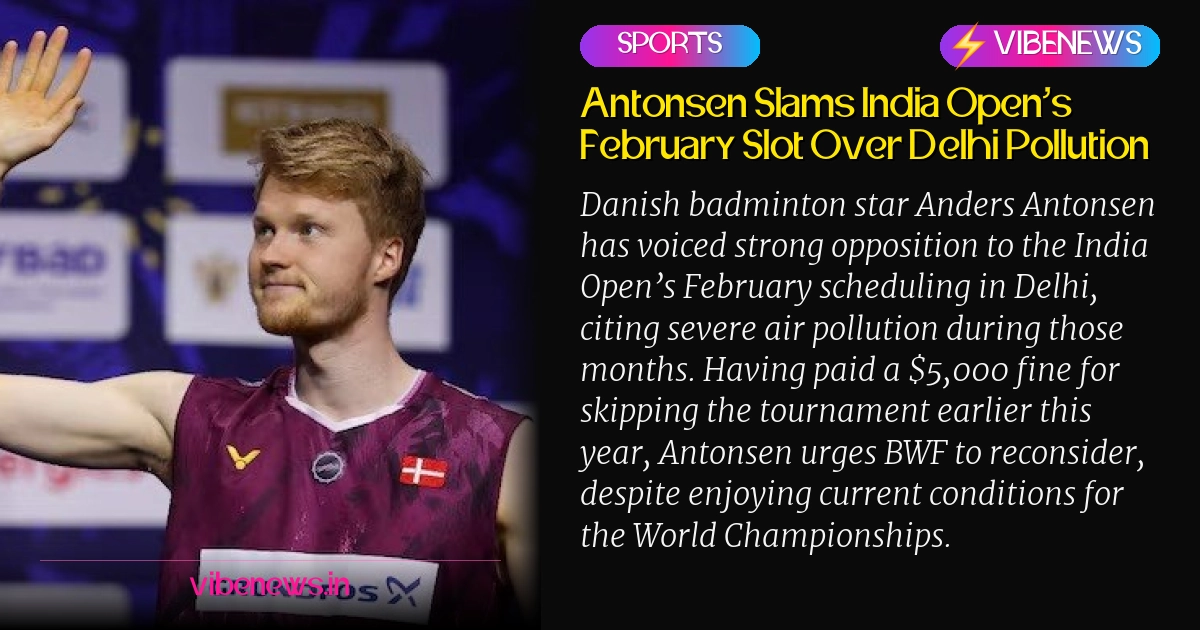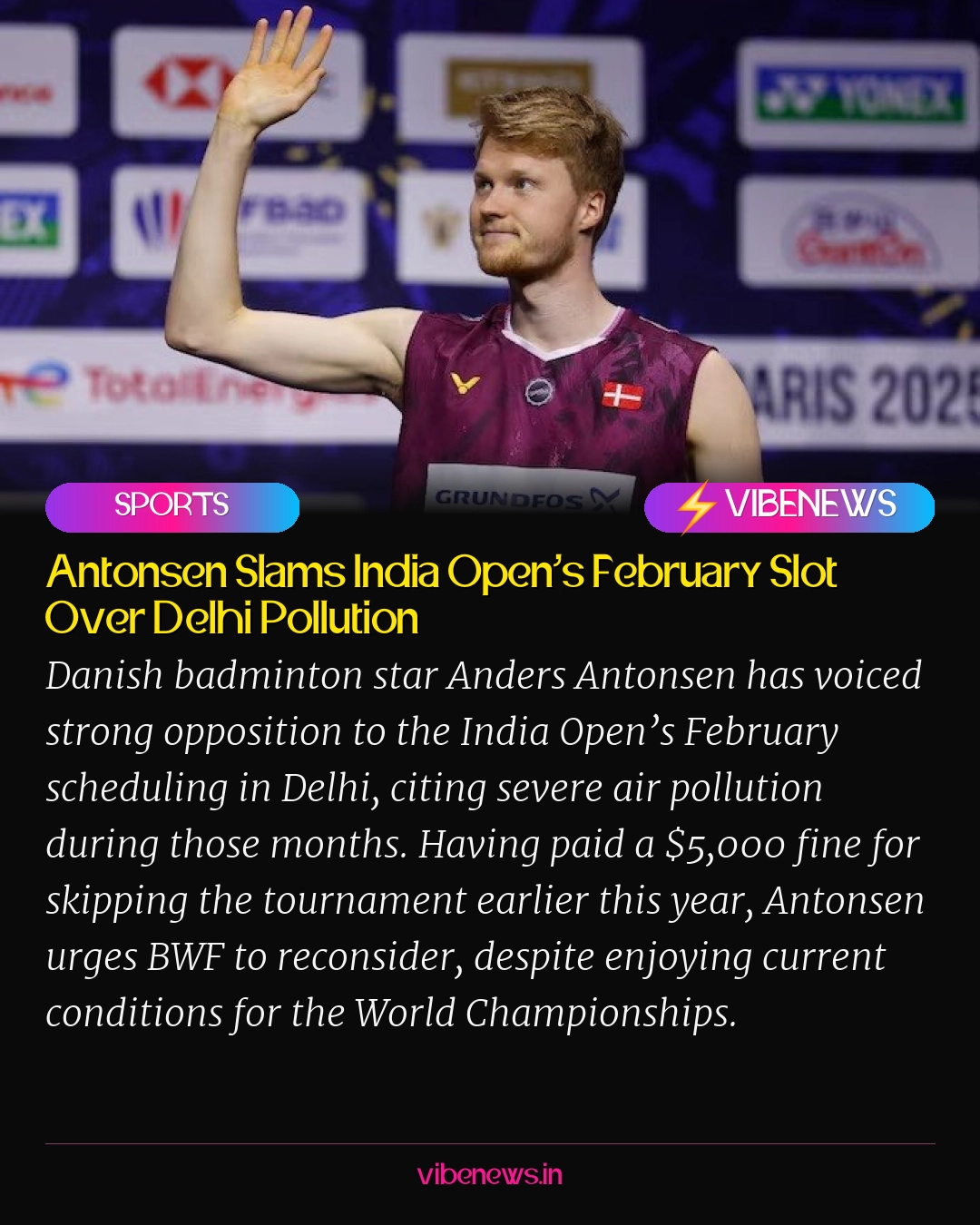

Danish badminton star Anders Antonsen has openly voiced his strong disapproval of the India Open’s recurring schedule in Delhi during the peak winter months. Currently in the national capital for the BWF World Championships, Antonsen noted a stark contrast in air quality compared to earlier this year when he opted to skip the India Open Super 750, incurring a mandatory $5,000 fine from the Badminton World Federation (BWF).
His return to Delhi for the global event has been met with satisfaction regarding the current atmospheric conditions and the facilities at the Indira Gandhi Indoor Stadium. However, this positive experience does not sway his firm stance against the tournament’s traditional January or February slot, a period notorious for severe air pollution in the region.
The Persistent Scheduling Conundrum
Antonsen’s frustration stems from the BWF’s new calendar, which continues to slate the India Open for February. He articulated his dismay during a pre-tournament interaction, highlighting the financial penalty players face for prioritizing their health over participation in mandatory Super 750 events or higher. "Every year, when I see the calendar, I’m like, okay, they are just instantly giving me a $5,000 fine," Antonsen remarked, indicating a potential repeat of his decision next year.
The core of his argument revolves around the environmental conditions. He explicitly stated that the pollution during the winter season is "pretty insane" and questioned the BWF’s judgment in hosting a major tournament in Delhi at that specific time. His observations underscore a critical concern for athlete welfare, particularly in a sport demanding high physical exertion and respiratory health.
Delhi’s Seasonal Air Quality Dynamics
Delhi’s air quality is a well-documented issue, experiencing significant seasonal fluctuations. The winter months, typically from November to February, see a dramatic deterioration in air quality due to a combination of factors including stubble burning in neighboring states, vehicular emissions, industrial pollution, and unfavorable meteorological conditions that trap pollutants close to the ground. This period often registers ‘severe’ or ‘hazardous’ levels on air quality indices, posing serious health risks to residents and visitors alike.
Conversely, the post-monsoon period, around August and September, generally offers much clearer skies and better air quality, as noted by Antonsen. This seasonal variation presents a dilemma for international sports bodies like the BWF, which must balance tournament prestige and logistical considerations with the health and safety of participating athletes. The city has hosted numerous international sporting events, and while infrastructure is often praised, the environmental context remains a recurring point of contention for athletes from regions with stricter environmental standards.
BWF’s Responsibility and Player Welfare
The BWF’s mandate includes ensuring fair play and promoting the sport globally, but it also carries an implicit responsibility for player welfare. Mandatory participation in high-tier tournaments, coupled with fines for non-attendance, places athletes in a difficult position when environmental or health concerns arise. Antonsen’s willingness to pay a substantial fine rather than compete in what he perceives as unhealthy conditions highlights a gap in the current policy framework.
This isn’t an isolated incident; other athletes across various sports have previously raised concerns about air quality in host cities, particularly in regions prone to seasonal pollution. The debate extends beyond individual player choices to the broader ethical considerations for sports federations: should they prioritize calendar consistency and commercial interests over the documented health risks to their athletes? The BWF’s response to such criticisms could set a precedent for how international sports bodies address environmental challenges in their host city selections and scheduling.
Antonsen’s Focus on World Championships
With the atmospheric concerns temporarily alleviated for the current BWF World Championships, Antonsen has shifted his complete attention to the competition. As one of Denmark’s leading medal contenders in men’s singles, especially in the absence of former world champion Viktor Axelsen, significant expectations rest on his shoulders. Despite this, Antonsen maintains that he feels no external pressure, emphasizing that his drive comes from within and his personal ambition to secure major titles.
His current performance in Delhi will be closely watched, not just for his athletic prowess but also as a testament to how environmental factors can influence player comfort and potentially, performance. His outspokenness on the India Open schedule serves as a reminder that while athletes are expected to perform at their peak, their health and the conditions under which they compete are paramount.
Editorial Context
Anders Antonsen’s pointed criticism of the India Open’s scheduling is more than just a player’s complaint; it signals a growing tension between global sports federations and the realities of environmental conditions in host cities. Over the long term, this development could force the BWF, and indeed other international sports bodies, to fundamentally re-evaluate their tournament calendars and selection criteria for venues. The recurring issue of Delhi’s winter pollution, coupled with a top player’s willingness to incur a significant financial penalty, underscores a critical need for greater flexibility and responsiveness in sports governance.
This situation highlights the increasing importance of athlete welfare in an era of heightened environmental awareness. If federations continue to disregard such concerns, they risk not only alienating top talent but also diminishing the credibility and appeal of their marquee events. The India Open, a prestigious Super 750 tournament, could face challenges in attracting the world’s best if its schedule remains fixed during periods of poor air quality. This could impact its standing in the global badminton circuit and potentially lead to calls for alternative host cities or a permanent shift in its annual timing.
Ultimately, Antonsen’s stance serves as a powerful advocate for player health and environmental responsibility. It pushes the conversation towards a future where major sporting events are not just judged on their organizational efficiency or prize money, but also on their commitment to providing a safe and healthy environment for all participants. The BWF’s eventual decision on the India Open’s future scheduling will be a crucial indicator of its evolving priorities in a rapidly changing world.
TL;DR
- Danish badminton star Anders Antonsen paid a mandatory $5,000 fine for skipping the India Open Super 750 earlier this year due to severe air pollution in Delhi.
- Antonsen strongly criticizes the BWF’s decision to schedule the India Open in January or February, citing "insane" pollution levels during those months.
- He noted a significant improvement in Delhi’s air quality during his current visit for the BWF World Championships (August-September) compared to the winter.
- Despite his concerns about the India Open, Antonsen expressed satisfaction with the facilities at the Indira Gandhi Indoor Stadium for the ongoing World Championships.
- The shuttler feels no additional external pressure for the World Championships, stating his drive comes from within and his ambition to win major titles.
- Antonsen urges the BWF to reconsider its scheduling choices for the India Open in Delhi to prioritize player health and safety.