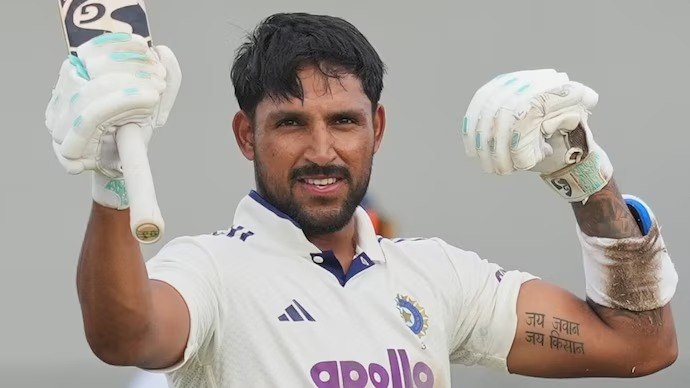
Indian wicketkeeper-batter Dhruv Jurel etched his name into the annals of Test cricket with a magnificent second century in Colombo, a performance capped by a poignant gesture. After navigating a dramatic run-out scare to reach his milestone, Jurel pulled up his left sleeve, revealing a "Jai Jawan, Jai Kisaan" tattoo, a powerful tribute that resonated far beyond the cricket pitch.
This unbeaten knock of 115 runs off 177 balls was instrumental in propelling India past the 500-run mark, allowing the team to declare their innings at 503 for 9. Jurel’s composure and resilience under pressure were evident throughout his innings, particularly in the crucial moments leading up to his hundred.
The Dramatic Milestone
The journey to his century was not without its heart-stopping moments. On 99, Jurel drove a full delivery towards mid-off and called for a quick single. A swift throw from the fielder threatened a direct hit, forcing Jurel into a full-length dive to make his ground. The ball narrowly missed the stumps, granting him the reprieve needed to complete his second Test hundred, a moment met with a relieved punch of the air and applause from the dressing room.
Mohammed Siraj, his partner at the other end, rushed to embrace him, a testament to the camaraderie and the significance of the milestone achieved under pressure. Siraj had diligently blocked and defended, allowing Jurel to inch closer to the landmark, highlighting the collective effort in building India’s formidable total.
Anchoring the Indian Innings
Jurel walked to the crease late on the opening day with India in a precarious position at 296/5. He saw off the remaining deliveries and returned on Day 2 to settle into an innings marked by assurance and maturity. His only moment of genuine anxiety came when Prabath Jayasuriya’s arm ball beat his bat, leading to an unsuccessful LBW appeal.
A pivotal 112-run partnership with fellow wicketkeeper Rishabh Pant, who contributed 63 runs, steered India beyond the 400-run mark. After Pant’s dismissal, Jurel continued to shepherd the lower order, meticulously adding crucial runs and pushing the team’s total past 460 before eventually crossing 500.
A Symbol of National Pride
The "Jai Jawan, Jai Kisaan" (Hail the Soldier, Hail the Farmer) slogan, prominently displayed on Jurel’s bicep, carries deep historical and emotional resonance in India. Coined by former Prime Minister Lal Bahadur Shastri during the 1965 Indo-Pak War, it became a powerful rallying cry, uniting the nation by honouring both its defence forces and its agricultural backbone. Jurel’s decision to reveal this tattoo at such a significant personal moment underscores a profound connection to national pride and the values of sacrifice and hard work embodied by soldiers and farmers.
This gesture transcends mere sporting achievement, transforming a personal milestone into a public declaration of respect for the foundational pillars of Indian society. It adds a layer of cultural significance to his cricketing prowess, resonating deeply with fans across the country.
Consistent Contributions and Historical Context
This century is not an isolated flash of brilliance but a continuation of Jurel’s impressive form in the series. He had previously played a match-winning knock of 51 runs off 68 balls in India’s victory in the first Test. His back-to-back 50-plus scores in away Tests highlight his growing confidence and ability to perform on foreign soil.
With this hundred, Jurel entered an exclusive club, becoming only the second Indian batter to score a Test century from No. 7 or lower in Sri Lanka. The only other Indian to achieve this feat was Hardik Pandya, who scored 108 at Pallekele in 2017. This statistic underscores the rarity and significance of Jurel’s achievement, particularly from a lower-order position.
Jurel’s Evolving Test Career
At just 24 years old, Jurel’s Test career is rapidly gaining momentum. This second century takes his total Test runs beyond 600 from 12 matches, maintaining an average of over 35. His maiden Test hundred came against West Indies last year, and he also boasts two half-centuries. His ability to convert starts into substantial scores, especially when the team needs it most, marks him as a valuable asset for the Indian Test side.
His performance in Colombo not only solidified India’s commanding position in the match but also sent a clear message about his capabilities as a resilient and impactful lower-order batsman, capable of turning the tide of an innings.
Editorial Context: The Ascendance of a New Anchor
Dhruv Jurel’s recent century in Colombo is more than just a statistical entry; it signifies a crucial development for Indian Test cricket. For years, the lower middle order has been a point of vulnerability for many teams, often failing to capitalize on strong starts or rescue collapses. Jurel’s consistent performances, culminating in this century, suggest the emergence of a reliable anchor at number seven, a position vital for building imposing totals or staging crucial fightbacks.
His ability to bat with both established batsmen like Rishabh Pant and the tail-enders demonstrates a maturity beyond his years and limited Test experience. This resilience and tactical acumen are invaluable, providing the team with much-needed depth and flexibility. Furthermore, his public display of the "Jai Jawan, Jai Kisaan" slogan adds a layer of cultural resonance, potentially endearing him further to a nation that values such expressions of patriotism from its sporting heroes.
Looking ahead, Jurel’s form presents a compelling case for his long-term inclusion in the Test squad, particularly in overseas conditions where lower-order contributions can often be the difference between victory and defeat. His development as a wicketkeeper-batsman who can consistently deliver under pressure strengthens India’s overall team balance and offers a promising outlook for future Test campaigns, ensuring that the team possesses multiple avenues for scoring runs when the top order falters.
TL;DR
- Dhruv Jurel scored his second Test century in Colombo, remaining unbeaten on 115 runs off 177 balls.
- He dramatically reached his hundred after surviving a close run-out chance while on 99.
- Jurel revealed a ‘Jai Jawan, Jai Kisaan’ tattoo on his left bicep after reaching his milestone, a tribute to India’s soldiers and farmers.
- His century helped India declare their innings at 503 for 9, significantly contributing to the team’s commanding total.
- Jurel formed a crucial 112-run partnership with Rishabh Pant and later guided the lower order.
- He became only the second Indian batter to score a Test century from No. 7 or lower in Sri Lanka, joining Hardik Pandya.