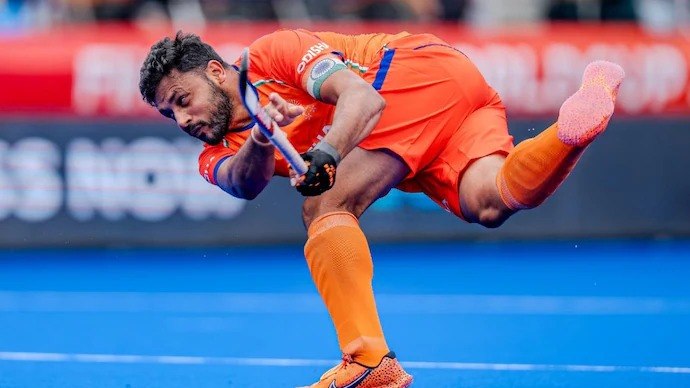
India’s aspirations for a coveted semi-final berth in the Men’s Hockey World Cup were decisively crushed following a 3-5 defeat against Argentina in Amstelveen. This outcome not only ended India’s campaign but also extended their agonizing 51-year wait to reach the tournament’s final four, a period marked by fluctuating fortunes and persistent challenges on the global stage.
The loss to Argentina, a team that has now secured five consecutive victories against India, underscored critical vulnerabilities within the Indian squad. Despite a spirited effort in the latter stages with goals from Sukhjeet Singh and a penalty stroke converted by Hardik Singh, Argentina’s early dominance proved insurmountable, leaving India to contend for a 7th-8th place finish against Belgium.
The Decisive Encounter in Amstelveen
Entering the match, the equation for India was clear: a victory by at least two goals was imperative, coupled with a favorable result in the England vs. Netherlands clash. This high-stakes scenario demanded an aggressive, goal-oriented approach from Craig Fulton’s side. However, the team’s performance from the whistle painted a starkly different picture.
Within the first minute, Argentina capitalized on defensive disarray, with Joaquin Toscani netting an early opener. This initial setback seemed to unravel India’s composure, as Argentina swiftly added a second goal from a penalty corner through Nicolas del Torre. The ease with which India’s defense was breached raised immediate concerns, especially given their strong defensive showing against the Netherlands in previous matches.
The first quarter saw India struggling to establish any rhythm, frequently pinned back in their own half. This early pressure culminated in a significant deficit that the team found challenging to overcome. While Sukhjeet Singh managed to pull one back in the 10th minute, briefly reigniting hopes, the fundamental issues persisted.
Strategic Missteps and Defensive Lapses
Coach Craig Fulton had emphasized learning from past games, particularly the need to avoid conceding early goals. Yet, the defensive structure appeared to disintegrate under pressure. The shift in pressing strategy, moving to a man-to-man attack and zonal defense, reportedly created confusion at the back. Captain Harmanpreet Singh, often positioned further up the field, left the defense exposed to Argentina’s quick forwards.
This defensive fragility was not an isolated incident. India had conceded 12 goals against Argentina in the Pro League first leg and eight goals in the group phase of the current tournament before this decisive encounter. Such statistics highlight a recurring pattern of vulnerability against top-tier opposition, a critical area for immediate introspection.
Compounding these issues were perplexing selection choices. Key midfielders like Vivek Sagar Prasad, instrumental in controlling tempo, and drag-flicking specialist Jugraj Singh were notably absent from the team sheet for this do-or-die fixture. Jugraj’s absence, despite his recent form, left India reliant on Sanjay as the primary alternative drag-flicker after Harmanpreet, a decision that drew scrutiny given the importance of penalty corner conversions.
Offensive Struggles and Missed Opportunities
Despite gaining more possession in the second quarter, India struggled to translate this into meaningful attacking opportunities. The lack of an "end product" was evident, with key forwards like Abhishek, who had started the tournament strongly, and Mandeep Singh, seemingly past his prime, failing to make a significant impact. The team’s inability to penetrate the circle effectively or convert chances became a recurring theme.
By halftime, India held 54.5% possession but lagged significantly in crucial metrics such as circle entries (6-10) and shots on target (1-5). The third quarter mirrored the first, with Argentina maintaining high intensity and delivering a "death blow" through Tomas Domene, who added two goals to his tournament tally, including one from a penalty stroke after a defensive error.
India’s repeated penalty corner opportunities in the third quarter went unconverted, further highlighting the absence of a reliable alternative drag-flicker and the effectiveness of Argentina’s defense against Harmanpreet Singh’s attempts. The late goals by Sukhjeet and Hardik in the final quarter served more as consolation than a genuine comeback.
A Legacy of Unfulfilled Potential
The Indian men’s hockey team, once a dominant force with eight Olympic gold medals, has consistently struggled to replicate that success in the World Cup format since their solitary triumph in 1975. The 51-year drought for a semi-final appearance weighs heavily on the team and its passionate fanbase. Each World Cup brings renewed hope, often followed by the familiar sting of early exits and unfulfilled potential.
This latest setback in Amstelveen adds another chapter to this narrative. It underscores the persistent gap between India’s potential and its performance at the highest level, particularly when facing teams known for their tactical discipline and clinical finishing. The pressure to perform on the global stage often appears to overwhelm the squad, leading to errors and a breakdown in strategy.
Looking Ahead: The Road to Redemption
With the Asian Games looming in just a month, the Indian team faces an immediate opportunity for redemption. However, the questions raised by this World Cup campaign are profound. Coach Fulton’s defensive philosophy, which was meant to be a cornerstone of the team’s strategy, has been severely tested and found wanting. The team’s ability to handle high-pressure situations, a critical attribute for success in international tournaments, also appears to be a significant concern.
The upcoming Asian Games will be a crucial test, not only for the players but also for the coaching staff to demonstrate adaptability and address the systemic issues exposed in Amstelveen. Success there is vital for Olympic qualification and to restore confidence within the squad and among supporters.
Editorial Context
The Indian men’s hockey team’s exit from the World Cup semi-final race carries significant long-term implications for the sport in the country. Hockey, despite the rise of cricket, remains deeply embedded in India’s national identity and sporting heritage. Consistent underperformance at major global events like the World Cup can impact public interest, grassroots development, and crucial funding for the sport.
This result necessitates a comprehensive review of player development pathways, coaching methodologies, and strategic planning. The reliance on a few key players, the struggle to convert penalty corners consistently, and the defensive vulnerabilities against top-ranked teams are not new issues. Addressing these requires a sustained, long-term vision that extends beyond immediate tournament cycles.
For Hockey India and the national sports federations, this outcome serves as a critical reminder of the continuous effort required to bridge the gap with global powerhouses. Investing in sports science, mental conditioning, and robust domestic leagues that provide a strong talent pipeline will be essential. The dream of reclaiming past glory at the World Cup will remain elusive without fundamental structural changes and a renewed commitment to excellence at every level of the sport.
TL;DR
- India lost 3-5 to Argentina, ending their Men’s Hockey World Cup semi-final hopes in Amstelveen.
- This defeat extends India’s 51-year wait for a World Cup semi-final appearance, a drought since their 1975 triumph.
- Early defensive lapses and strategic confusion under coach Craig Fulton, including a shift in pressing, were key factors in the loss.
- Questionable player selections, notably the absence of key midfielders Vivek Sagar Prasad and drag-flicking specialist Jugraj Singh, drew criticism.
- India struggled with offensive conversion and penalty corner efficiency, failing to capitalize on possession and set-piece opportunities.
- The team now faces an immediate challenge at the upcoming Asian Games to regain form, address systemic issues, and secure Olympic qualification.