
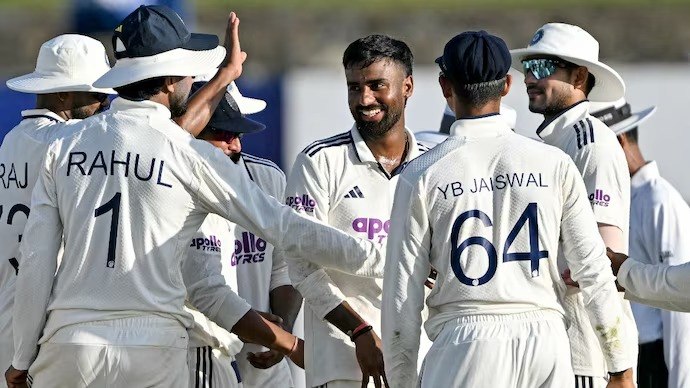
India’s Dominant Start in Galle
The Indian cricket team commenced its World Test Championship (WTC) campaign with a resounding 165-run victory over Sri Lanka in the opening Test at the Galle International Stadium. This crucial win not only provides a significant boost to India’s aspirations for the WTC final but also emphatically addresses lingering questions about their proficiency on challenging spin-friendly surfaces, particularly away from home. The match was defined by exceptional individual performances, strategic acumen, and a dramatic final-day finish that saw India snatch victory just as rain threatened to force a draw.
The victory was a testament to India’s all-round strength, with significant contributions from both bat and ball. The team’s ability to adapt to the conditions and execute their plans under pressure underscored their determination to establish dominance early in the series.
Padikkal’s Century Anchors First Innings
India’s foundation was laid by a magnificent century from Devdutt Padikkal in the first innings. Stepping in due to an injury to Sai Sudharsan, Padikkal seized the opportunity with a superb 167 runs, demonstrating composure and skill on a pitch that offered considerable turn from the outset. His partnership of 162 runs with KL Rahul was instrumental in navigating the early challenges and posting a formidable total of 462.
This substantial first-innings score provided India with a significant psychological advantage. Mohammed Siraj further amplified this lead with a sensational spell on the second and third days, notably dismissing opener Nishan Madushka for a duck. Despite resilient efforts from Sri Lanka’s Sonal Dinusha, who scored a century, and Niroshan Dickwella, who contributed 80, the hosts were eventually bowled out for 284, conceding a massive first-innings lead.
Strategic Declaration Sets Imposing Target
With a commanding lead in hand, India opted for an aggressive approach in their second innings, prioritizing rapid scoring to allow ample time for their bowlers to secure the remaining wickets. Rishabh Pant led this charge with a blistering 66 runs off just 69 balls, accelerating India’s scoring rate. The team declared at 193, setting Sri Lanka an imposing target of 372 runs to win.
While a victory chase of this magnitude was improbable, Sri Lanka’s primary objective shifted to batting out time, especially with adverse weather forecasts looming for the final day. India’s strategic declaration reflected their confidence in their bowling attack and their intent to push for a result.
Final Day Drama and Sri Lankan Resilience
The final day began under a cloud of uncertainty, both literally and figuratively, as rain predictions threatened to wash out play and deny India a deserved victory. Sri Lanka’s captain Dhananjaya de Silva and young all-rounder Sonal Dinusha mounted a determined resistance in the morning session, frustrating the Indian bowlers with a 95-run partnership. De Silva displayed solid defence, while Dinusha effectively swept the spinners, keeping India at bay.
The tension was palpable as the clock ticked down and wickets proved elusive. India’s head coach Gautam Gambhir intervened, engaging in a crucial discussion with Ravindra Jadeja, leading to a change in his bowling end and angles. This tactical adjustment proved pivotal, as de Silva soon top-edged a paddle sweep off Jadeja, breaking the stubborn partnership and providing India with a much-needed breakthrough.
Manav Suthar’s Decisive Spell
Following de Silva’s dismissal, India doubled down on their efforts. Niroshan Dickwella, who had been part of a significant partnership in the first innings, fell victim to a short-pitched delivery from Prasidh Krishna after being provoked by Yashasvi Jaiswal. However, the true turning point came with the exceptional performance of left-arm spinner Manav Suthar.
Suthar, who had already impressed in the first innings, delivered a decisive spell after lunch. He broke Dinusha’s terrific resistance, dismissing the well-set batter for 84 with a soft dismissal that induced an inside edge. Once Suthar broke through, Sri Lanka’s lower order crumbled rapidly. He picked up Prabath Jayasuriya and Lahiru Kumara in the same over, completing his second five-wicket haul in just his second Test match, and his first 10-wicket haul in two Tests. His dramatic four wickets in his last ten balls sealed the victory just minutes before heavy rain descended upon the stadium, underscoring the urgency and precision of his spell.
Reaffirming India’s Spin Credentials
This victory holds particular significance for India, as it comes after recent home losses to New Zealand and South Africa, which had raised questions about their ability to handle and bowl spin effectively. The dominant performance in Galle, a venue historically known for its turning tracks, serves as a powerful reaffirmation of India’s capabilities in these conditions. Shubman Gill’s captaincy, coupled with the emergence of talents like Manav Suthar and Devdutt Padikkal, signals a promising future for the team.
Editorial Context: A Long-Term Vision
The Galle Test victory is more than just a single match win; it represents a critical juncture in India’s long-term cricketing strategy. For an executive news editor at Vibe News, this development matters immensely for several reasons. Firstly, it provides a strong foundation for India’s World Test Championship campaign, placing them in a favourable position early in the cycle. Consistent performances in away Tests, especially on challenging pitches, are paramount for WTC qualification, and this win sets a positive precedent.
Secondly, the emergence of new talent like Devdutt Padikkal and Manav Suthar is vital for the sustained success of Indian cricket. Padikkal’s century under pressure, filling in for an injured senior player, highlights the depth of talent available. Suthar’s match-winning 10-wicket haul demonstrates the effectiveness of India’s domestic spin ecosystem and provides a potent weapon for future tours. These performances indicate a healthy pipeline of players ready to step up to the international stage, ensuring the team remains competitive for years to come.
Finally, the manner of victory—overcoming a resilient opposition and the threat of rain—instils significant confidence within the squad. It reinforces the team’s mental fortitude and tactical flexibility, crucial attributes for success in the demanding format of Test cricket. This win will undoubtedly resonate through the dressing room, fostering a belief that India can conquer any conditions, anywhere in the world. For Vibe News, covering these narratives of emerging talent, strategic triumphs, and the broader implications for Indian cricket’s global standing is essential for providing deep, insightful analysis to our readership.
TL;DR
- India defeated Sri Lanka by 165 runs in the first Test at Galle, boosting their World Test Championship final aspirations.
- Left-arm spinner Manav Suthar was instrumental, taking 10 wickets in the match, including a crucial 6/55 in the second innings.
- Devdutt Padikkal, named Player of the Match, scored a magnificent 167 runs in India’s first innings, setting a strong foundation.
- Sri Lanka’s Sonal Dinusha showed strong resistance, scoring 84 runs in the second innings and 100 in the first.
- India’s victory came dramatically just minutes before heavy rain threatened to wash out the final session.
- The win helps allay doubts about India’s ability to perform on spin-friendly pitches away from home.