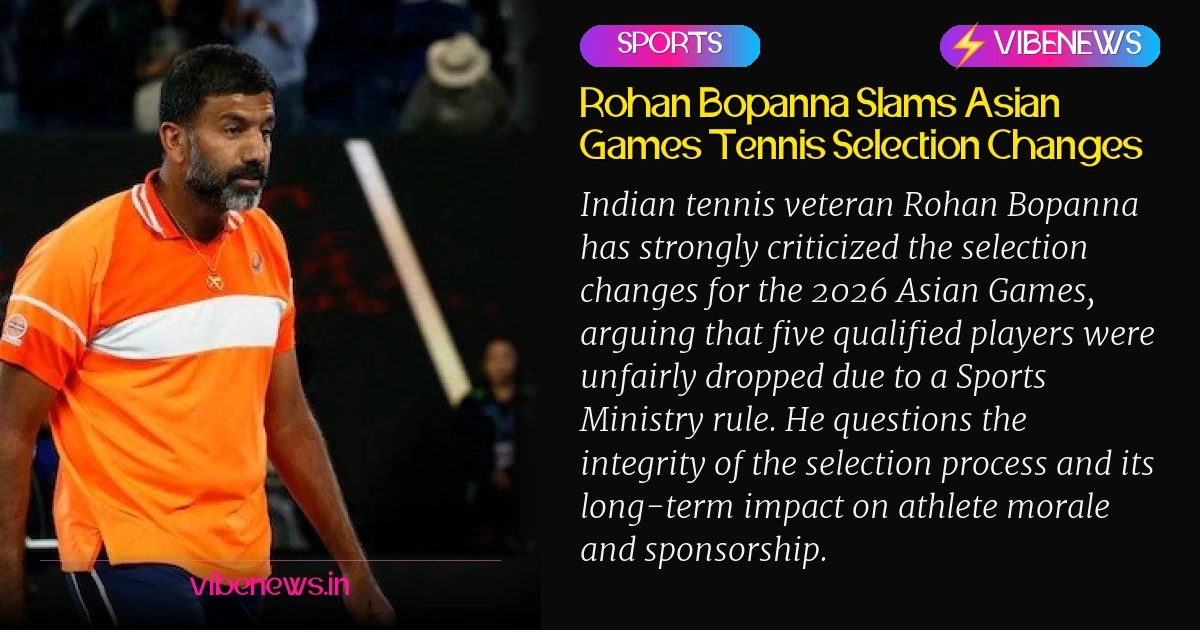
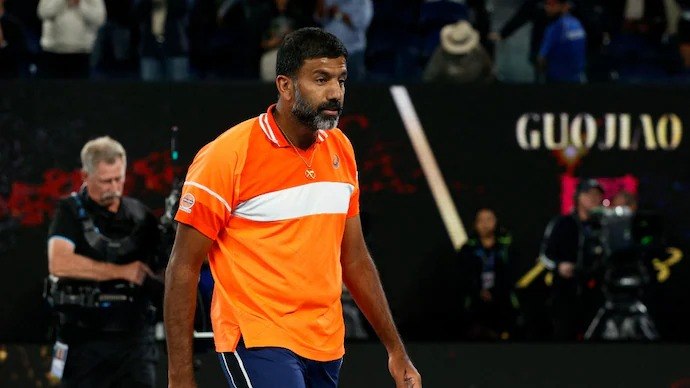
Indian tennis stalwart Rohan Bopanna has ignited a significant debate within the nation’s sporting community, vehemently criticizing the recent changes to the country’s tennis squad for the 2026 Asian Games. The two-time Asian Games gold medallist expressed profound concern that five deserving athletes, who had earned their places through rigorous international performances, have been unfairly sidelined.
At the heart of this controversy lies a directive from the Sports Ministry, which reportedly restricts participation to players ranked among the top eight in Asia. Bopanna argues that this rigid application of the rule undermines the very essence of merit-based selection and the spirit of competitive sport, especially when athletes have already met established qualification criteria.
A Champion’s Voice for Displaced Athletes
Bopanna’s impassioned statement, widely shared on social media, passionately defends the affected players: Sahaja Yamalapalli, Vaishnavi Adkar, Manas Dhamne, Prarthana Thombare, and Vaidehee Chaudhari. He highlighted that these athletes, including India’s top two women’s singles players, had secured their rankings and spots through arduous international competition, emphasizing that their achievements were "no shortcuts, no favors."
The veteran player questioned the rationale behind having a qualification process and ranking systems if a committee can arbitrarily overturn results based on pre-determined outcomes. He articulated his frustration, stating, "If outcomes are already decided, why have qualification at all? Why rankings?" This sentiment resonates deeply with athletes who dedicate years to achieving specific performance benchmarks.
Beyond the Court: Impact on Trust and Investment
The former world No. 1 doubles player underscored that the implications of this decision extend far beyond the immediate disappointment of the five athletes. He suggested it sends a chilling message to parents and sponsors who invest significant resources and faith in young talent based on merit and performance. Bopanna argued that such committee-driven decisions, which label players as "not medal prospects" before they even compete, devalue the judgment of those who support athletes from the grassroots level.
This approach, he contends, risks eroding trust in the national sporting system and discouraging future investment in promising careers. For many athletes, securing sponsorship and parental support is crucial for their development, covering costs for training, travel, and competition. Decisions perceived as arbitrary can jeopardize these vital lifelines, potentially forcing talented individuals out of the sport.
The Philosophy of Sporting Merit
Bopanna’s critique delves into the fundamental philosophy of sport itself, asserting that athletic success often defies prediction, with underdogs frequently rewriting narratives. He firmly believes that a nation cannot foster a robust sporting culture or economy by allowing boardroom decisions to dictate who is permitted to compete.
Instead, he advocates for letting athletes prove their worth on the court, allowing years of dedication and hard work to culminate in genuine competition, rather than being dismissed by a "spreadsheet." This perspective champions the unpredictable nature of sport and the belief that opportunity should be earned through performance, not administrative fiat.
India’s Enduring Tennis Legacy at the Asian Games
India boasts a distinguished and proud history in tennis at the Asian Games, consistently contributing significantly to the nation’s overall medal tally. Over the years, Indian tennis players have secured an impressive 34 medals, including 10 gold, showcasing a strong tradition of excellence and consistent performance in the discipline.
This consistent success underscores the critical importance of a fair, transparent, and athlete-centric selection process to maintain and build upon this legacy. The upcoming Aichi-Nagoya Asian Games, scheduled from September 19 to October 4, 2026, represent another crucial opportunity for India to shine on the continental stage, making the current selection debate particularly poignant for the sport’s future trajectory and the morale of its athletes.
Navigating Ministry Mandates and Federation Autonomy
The Sports Ministry’s rule, limiting participation to players ranked among the top eight in Asia, is ostensibly designed to ensure that only the most competitive athletes represent the country, thereby theoretically maximizing medal prospects. However, Bopanna’s criticism highlights a potential disconnect between the spirit of this rule and its practical application, especially when it overrides established qualification pathways.
This incident also brings to the forefront the often-complex relationship between national sports federations, such as the All India Tennis Association, and the Sports Ministry. While the Ministry provides crucial funding and sets overarching guidelines, federations are typically entrusted with the technical expertise required for athlete selection. The current debate questions whether a rigid numerical cutoff, applied by a committee, truly reflects an athlete’s current form, potential, or the unique dynamics of a multi-sport event like the Asian Games, particularly when it appears to disregard prior achievements.
Editorial Context
This controversy surrounding the Asian Games tennis selections is far more than an isolated incident; it reflects a recurring tension within Indian sports administration between athlete merit, federation autonomy, and government oversight. In the long term, such disputes can significantly impact athlete morale, career trajectories, and the overall development of sports in the country. A system perceived as arbitrary or unfair risks deterring young talent and alienating crucial private investment from sponsors and parents.
For Indian sports to truly flourish on the international stage, a transparent, consistent, and athlete-centric selection policy is paramount. This incident underscores the urgent need for a clear framework that balances national objectives with the fundamental principles of fair play and earned opportunity, ensuring that the hard work and dedication of athletes are always respected and rewarded. The resolution of this particular issue will undoubtedly set a significant precedent for how future selections are handled, potentially shaping the trust and confidence athletes place in their national sporting bodies for years to come.
TL;DR
- Rohan Bopanna criticized the 2026 Asian Games tennis selections, alleging five qualified players were dropped.
- The controversy stems from a Sports Ministry rule limiting participation to Asia’s top eight ranked players.
- Affected players include Sahaja Yamalapalli, Vaishnavi Adkar, Manas Dhamne, Prarthana Thombare, and Vaidehee Chaudhari.
- Bopanna argues the decision undermines merit, questions the purpose of qualification, and impacts athlete morale and sponsorship.
- He emphasized that sporting outcomes should be decided on the court, not by administrative committees.
- India has a strong tennis legacy at the Asian Games, with 34 medals including 10 golds.