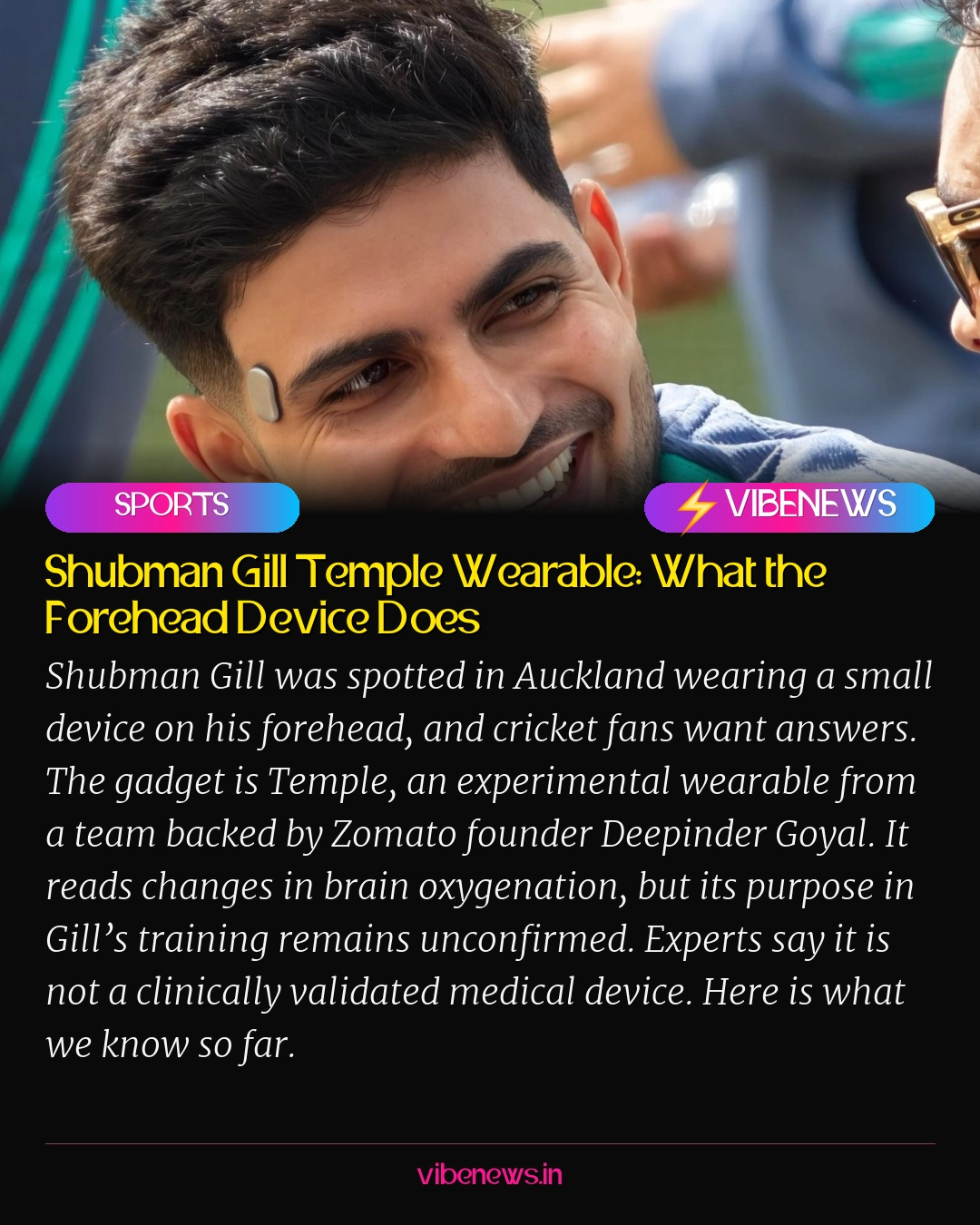
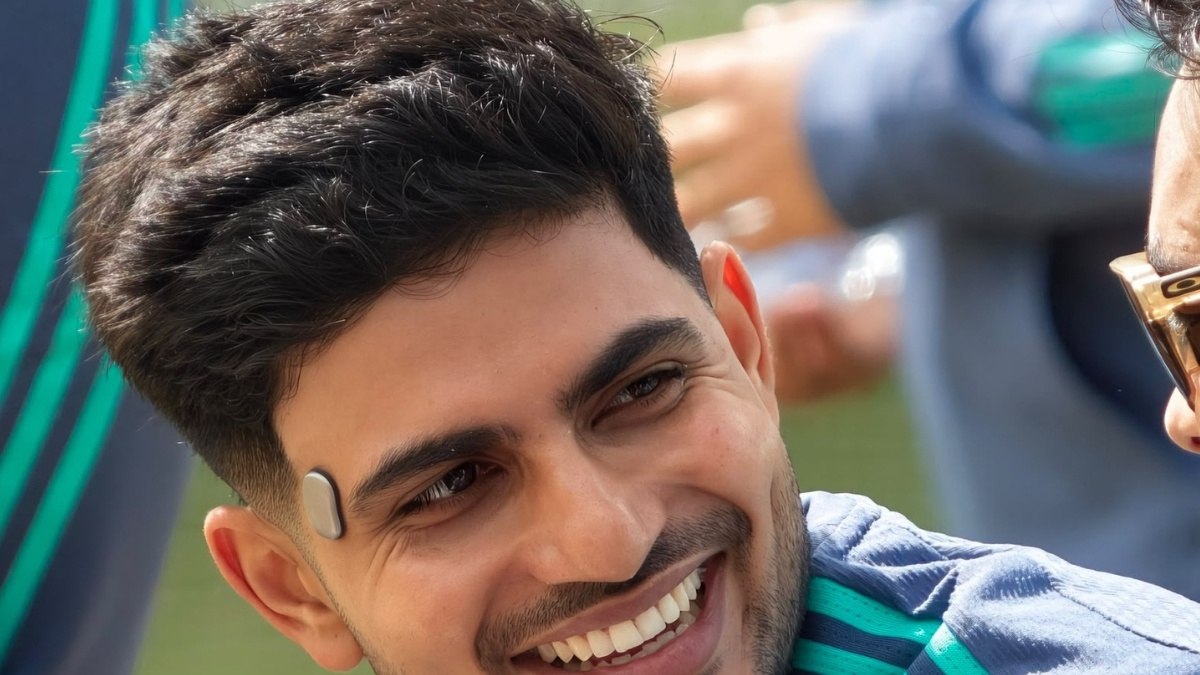
India Test and ODI captain Shubman Gill was spotted wearing a small device on his forehead during preparations in Auckland on Thursday, October 29, ahead of the upcoming ODI series against New Zealand.
The device is called Temple. It is an experimental fitness tracker developed by a team backed by Zomato founder Deepinder Goyal, and the sight of it on a cricketer’s head has sent fans searching for answers.
Gill was seen using the wearable during a training session. Photos circulating on social media showed the small unit positioned at the side of his head, and that single image was enough to turn a routine practice day into a talking point.
What Temple actually measures
Most fitness trackers on the market focus on the heart. They count steps, log heart rate and estimate how hard you pushed during a workout. Temple is built to go somewhere else entirely.
The wearable is designed to monitor changes in cerebral blood flow and brain oxygenation. In other words, it is meant to collect signals associated with the brain’s physiological responses rather than the body’s more familiar numbers.
It sits on the side of the forehead, close to the temple, and uses light-based sensing technology to estimate changes in blood oxygenation. That placement is the reason for the device’s name and the reason it looks so unusual on an athlete.
Its developers hope the information can help users understand how physical exertion, posture, recovery and stress affect the body. Those are four variables every professional athlete tries to manage, and each one is hard to read accurately from the outside.
Why an elite cricketer would be interested
For top athletes, training load and recovery are central to performance. A player who pushes too hard risks injury, and a player who rests too much can lose match sharpness. Coaches and medical staff spend a great deal of effort trying to find the right balance.
Temple is intended to add another layer of physiological data to that picture. According to the reporting, it could help researchers and athletes explore how the body responds to demanding training sessions and competition.
That is the reason the device has drawn so much curiosity around Gill. Its use, however, has not been explained in public. Neither the precise purpose of his trial nor any effect it may have on his cricket performance has been publicly confirmed.
The mystery is what keeps the story moving. Fans can see the gadget clearly, but they cannot see the data behind it, the reason he is testing it, or whether it is part of a formal programme.
Not the first high-profile athlete to wear it
Gill is not the only elite name linked to the device. Indian badminton star PV Sindhu has also been spotted wearing Temple during international competition and training.
Her appearances have added weight to the experiment. When two athletes from different sports are seen with the same unfamiliar device, it becomes harder to dismiss the technology as a passing curiosity.
Still, being seen wearing a device is not the same as proof that it works. Neither athlete’s use has been tied to a published result, and the reporting does not describe any performance improvement attributed to Temple.
The medical caution that matters
Temple should not be confused with a clinically validated diagnostic device. That distinction is the most important point in the entire story, and it is the one most likely to get lost once a photo goes viral.
Medical experts have warned that wearable estimates of cerebral blood flow and oxygenation can be affected by movement. Blood flow in the surrounding tissues can also distort the readings. In practice, that means a number on a screen may not reflect exactly what is happening in the brain.
The caution goes further. There is currently insufficient evidence that using such a wearable improves memory, concentration or athletic performance.
There is currently insufficient evidence that using such a wearable improves memory, concentration or athletic performance.
Users are also being told that the readings should not replace medical assessments or professional advice. For anyone tempted to copy an elite athlete’s gear, that warning is not a footnote. It is the core of the story.
Where the technology stands
Temple represents an emerging area of sports technology. It is not yet a proven tool, and its practical benefits will depend on further testing and scientific validation.
That leaves the device in an unusual position. It is visible enough to be recognised on the field and in training camps, yet its scientific case is still being built. The gap between how it looks and what it has been shown to do is where the curiosity lives.
For now, the facts are limited but clear. A device called Temple, backed by a team linked to Deepinder Goyal, has appeared on the head of one of India’s most visible cricketers in Auckland. Its purpose in his preparation has not been explained, and the experts who have looked at the technology are asking for patience before anyone treats its numbers as truth.
Gill’s ODI series against New Zealand is the next big test for him as a captain. Whether the device becomes part of his routine, or fades back into the background, will depend on what the testing shows over time.
TL;DR
- Shubman Gill was spotted wearing a small experimental device on his forehead during India’s preparations in Auckland on Thursday, October 29.
- The device is Temple, a wearable developed by a team backed by Zomato founder Deepinder Goyal.
- Temple monitors changes in cerebral blood flow and brain oxygenation using light-based sensing near the temple.
- Gill’s exact purpose for using the device and its effect on his cricket have not been publicly confirmed.
- PV Sindhu has also been spotted wearing Temple during international competition and training.
- Medical experts warn Temple is not a clinically validated diagnostic device and should not replace professional advice.