
Cyberabad Police have started steps to introduce a one-way traffic system across the Biodiversity Junction-Mindspace-Knowledge City-Hitec City corridor, a move aimed at easing peak-hour congestion on one of Hyderabad’s most crowded office stretches.
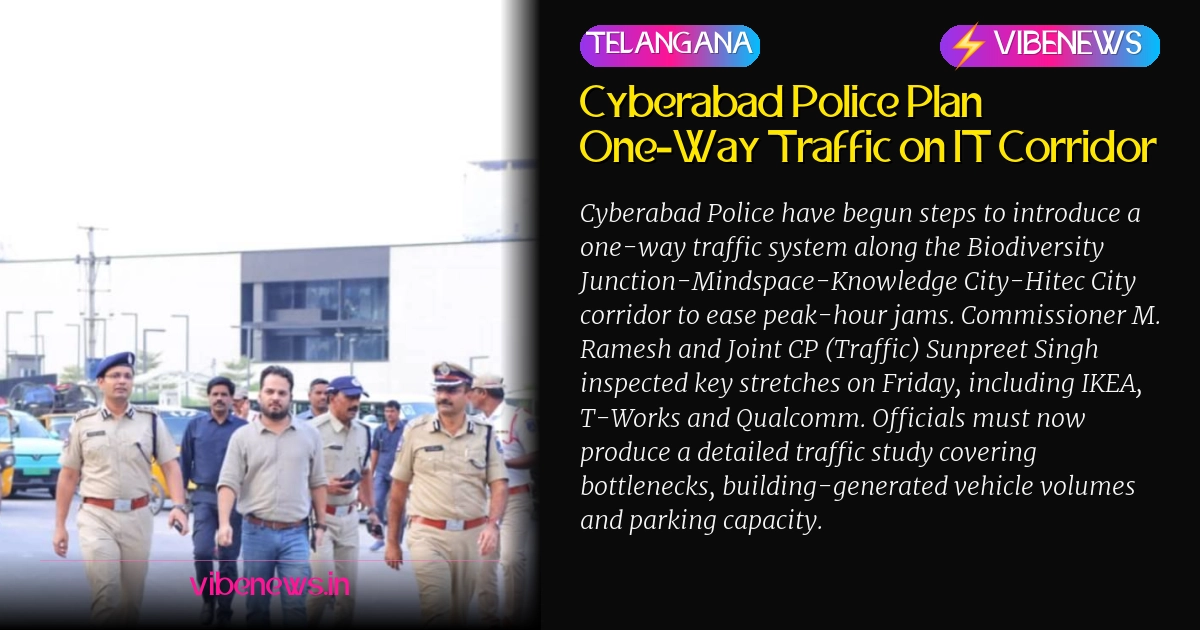
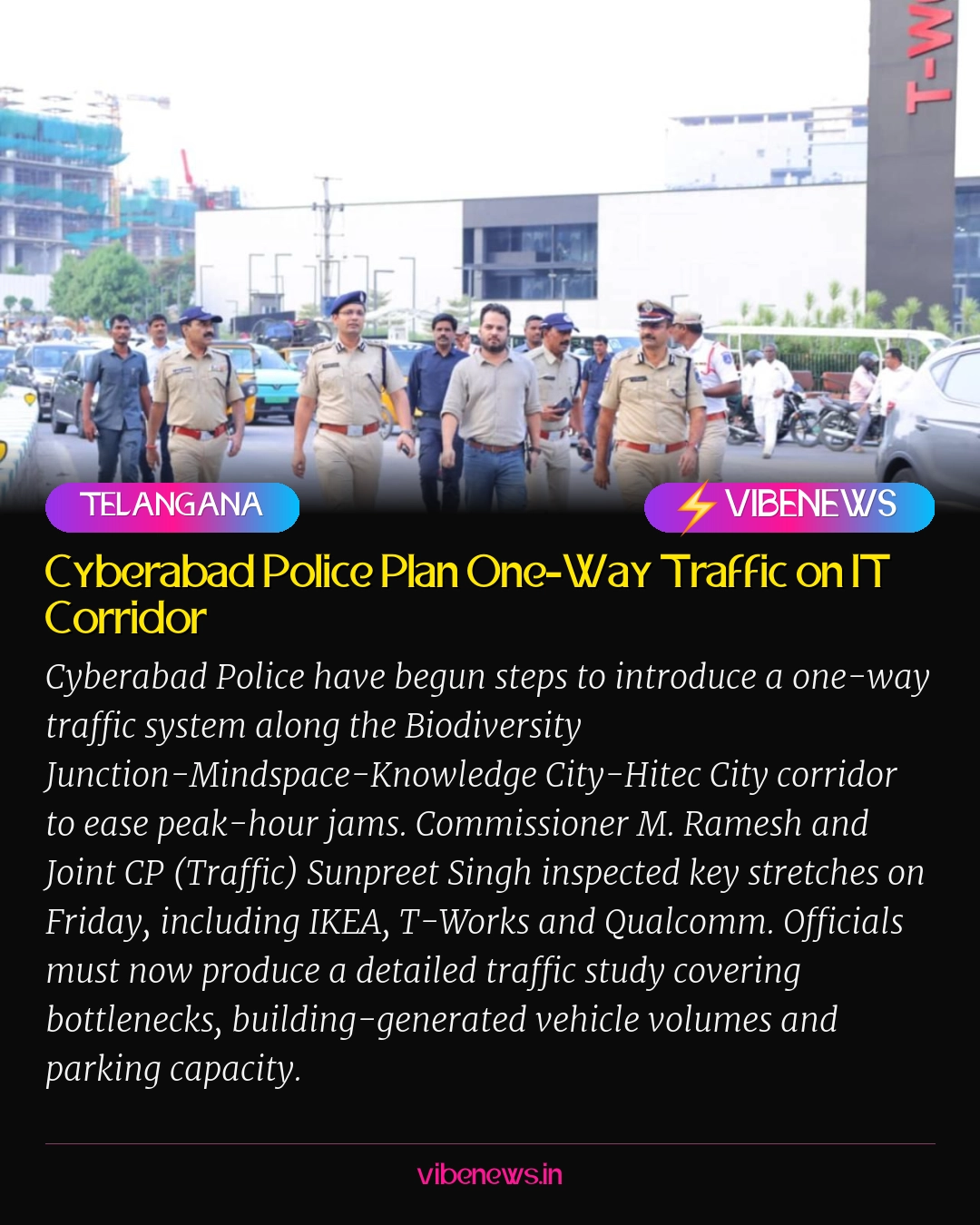
The push was set in motion on Friday, when Cyberabad Police Commissioner M. Ramesh went out on the ground. He was accompanied by Joint Commissioner of Police (Traffic) Sunpreet Singh and other officials, who carried out a field inspection covering Biodiversity Junction, IKEA, T-Works, Qualcomm, Dallas Centre Road and the surrounding areas.
What the proposed loop is meant to fix
The proposed one-way loop is designed to streamline traffic movement around T-Hub, IKEA, Knowledge City and Mindspace. The core idea is simple. Fewer points where vehicles cross or collide means fewer bottlenecks, and fewer bottlenecks should mean less time stuck at signals and junctions during the hours when offices empty and fill.
For anyone who drives, rides or takes a bus through this part of the city, that promise matters. The corridor carries heavy daily movement, and the source material frames the goal as reducing congestion and traffic conflict points. It does not, however, say how many vehicles use the stretch each day or how much time commuters currently lose there.
A study before any changes on the road
Ramesh did not announce a finished plan. Instead, he directed officials to prepare a detailed traffic study. The brief he gave is specific, and it reads like a checklist for the problems that have been building on this corridor.
Ramesh directed officials to prepare a detailed traffic study to identify bottlenecks, vehicle volumes generated by buildings, parking availability and capacity, supported by relevant visuals.
That instruction points to a few clear priorities. The first is bottlenecks, the exact spots where traffic backs up. The second is vehicle volumes generated by individual buildings, which means the traffic load is being traced to the offices and campuses that create it. The third is parking, both how much is available and how much capacity exists. Parking is often the hidden cause of congestion, because vehicles circling for spaces add to the very jam they are trying to escape. The study is also expected to come with visuals, which suggests the findings will be presented in a form that can be checked on the ground.
Why the study matters more than the announcement
A one-way system can look straightforward on a map and still go wrong on a busy weekday. Turning one road into a loop changes where every vehicle goes, which junctions take the extra load, and where people have to detour. The study is the step that tests whether the idea works before it reaches the daily routes of thousands of commuters.
Who was in the field
The inspection was not only a police exercise. TGSRTC officials took part, which signals that bus movement was part of the discussion. For commuters who depend on public transport along this corridor, that involvement is one of the most important details in the report. Any change to traffic flow affects where buses can stop, how they turn and how long they spend on the road.
Representatives of the Society for Cyberabad Security Council (SCSC) also joined the inspection. Their presence shows that the effort involves more than enforcement. The inspection was a joint look at how the roads are used by the people and organisations that rely on them.
The Telangana angle for Hyderabad commuters
This is a Hyderabad story first. The corridor runs through the Hitec City and Knowledge City belt, where large numbers of office workers, cab drivers, delivery riders and bus passengers share the same stretches of road. When junctions jam here, the effects spread across the city’s western tech zone, and the Cyberabad Police jurisdiction is the authority steering the change.
For Telangana residents, the stakes are practical. A traffic plan that cuts peak-hour delays would change daily travel time for people who move through these junctions every working day. A plan that is poorly designed could do the opposite, pushing more vehicles onto side roads that were never built to carry them.
What commuters do not know yet
The source material leaves several key questions open. It does not give a start date for the one-way system. It does not list which lanes or junctions would change first, or which turns would be blocked or redirected. It does not describe the timing of any restrictions, or whether the system would apply all day or only during peak hours.
These gaps matter. Commuters planning routes need specifics, and drivers need warning before a familiar turn disappears. Until the study is complete and the plan is made public, the safest reading is that the corridor is under review, not that new rules are already in force.
The real test ahead
The Cyberabad Police have set the process in motion with a field inspection and a directive for a detailed study. The next step is the study itself, with its focus on bottlenecks, building-generated traffic, and parking capacity. If the findings are used to shape the one-way loop, the corridor could see a major shift in how vehicles move around T-Hub, IKEA, Knowledge City and Mindspace. If the study points elsewhere, the plan could change shape before any sign goes up.
For now, the story is clear and concrete. Police have looked at the corridor in person, they have ordered a detailed review, and they want the data to show exactly where the city’s traffic is breaking down. Commuters on the Biodiversity Junction to Hitec City route will be watching closely, because the answers will decide how they reach their desks next.
TL;DR
- Cyberabad Police have begun steps to introduce a one-way traffic system on the Biodiversity Junction-Mindspace-Knowledge City-Hitec City corridor.
- The move aims to reduce peak-hour congestion and traffic conflict points around T-Hub, IKEA, Knowledge City and Mindspace.
- Commissioner M. Ramesh and Joint CP (Traffic) Sunpreet Singh led a field inspection on Friday.
- TGSRTC officials and Society for Cyberabad Security Council representatives also took part in the inspection.
- Ramesh has directed officials to prepare a detailed traffic study covering bottlenecks, building-generated vehicle volumes and parking.
- No start date or lane-level details for the one-way system have been announced yet.