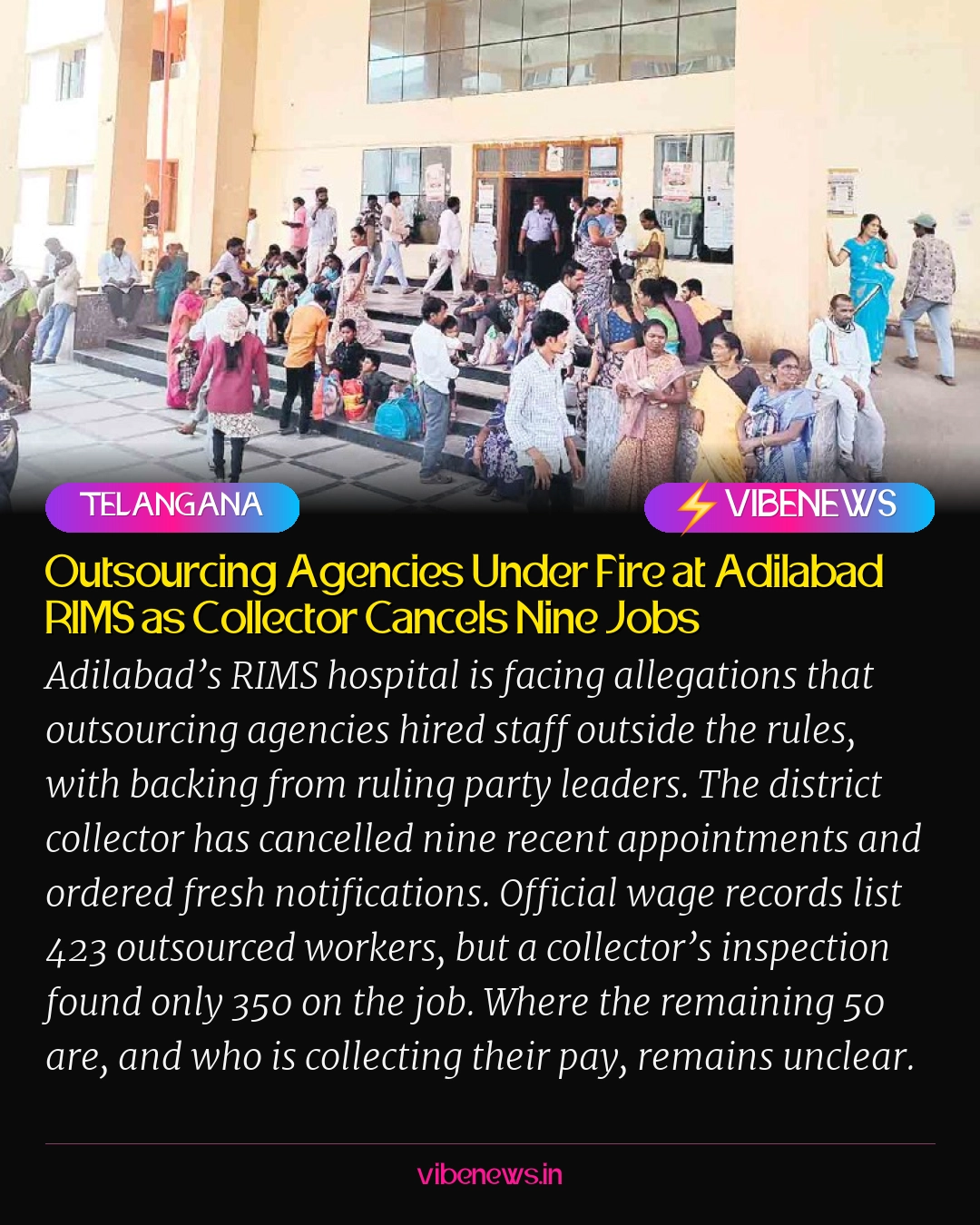
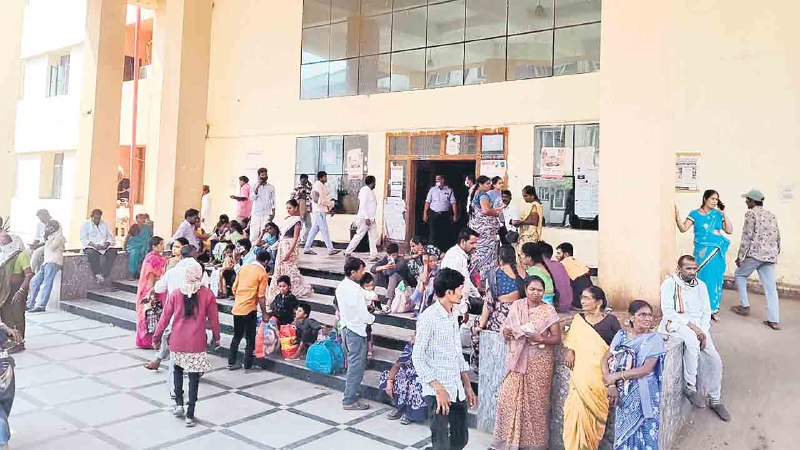
The Adilabad district collector has cancelled nine outsourced job appointments at the Rajiv Gandhi Institute of Medical Sciences, better known as RIMS, after complaints that the hiring process ignored the rules. The collector, Rajarshi Shah, ordered fresh notifications for those posts.
The trouble at RIMS is not new, but the numbers now on the table make it hard to ignore. Outsourcing agencies have a long-running hold on hiring for sanitation, hospital services and medical college posts at the institute. Local reports say these agencies act as they please, and that they get protection from leaders of the ruling party. Critics say the agencies do not follow the rules, and nobody has publicly named the agencies or the leaders in the allegations.
A headcount that does not add up
The core of the story is a mismatch in the payroll. Official figures show that 423 outsourced workers at RIMS are paid every month. When the collector looked into how many people actually work under the outsourcing system, he found 350 employees. That leaves 50 names on the payroll whose whereabouts are unknown. It is not clear where those 50 people work, whether they show up for duty at all, or who has been drawing their salaries.
The report does not say the 50 missing workers are ghost employees. It only says the gap has not been explained. Still, a difference of that size in a public hospital raises serious questions about how wages are checked and who signs off on them.
The payment setup has also changed hands recently. About two months ago, outsourced staff at RIMS were paid through Mepma. Now two agencies have been given responsibility for both hiring and salary distribution. That shift took place without much public notice, which is one reason suspicions have grown.
Eleven posts, quietly filled
The most immediate trigger was a recruitment drive at the RIMS super speciality hospital. One agency filled 11 posts, according to appointment letters issued by the agency. The posts included an assistant librarian, four lab technician grade-2 positions, two lab attendants, two library attendants and one OT technician.
Those appointments were made without the kind of public fanfare that usually comes with government recruitment. Reports say the hiring was carried out quietly, and that is what worried people who track the hospital. Outsourced posts are not supposed to move that way. Staff members often believe that the people hired through these channels are chosen for connections rather than merit.
What the rules require
Outsourced recruitment at a government hospital follows a set process, and the sequence matters. The job details and eligibility criteria must be verified with the district employment officer, who serves as convenor of the outsourcing selection committee. Only after that verification is an announcement issued that says which agency will get which jobs.
Next, the selection committee has to apply the rule of reservation when choosing candidates. The committee prepares a list of eligible people and hands it to the collector, who chairs the committee. Appointment letters are issued only after the collector approves the list.
The collector’s office says that in the recent hiring, these steps were not followed. Those allegations led to the decision to cancel nine of the 11 posts and to order that fresh notifications be issued. The remaining two posts are not covered by the cancellation in the reports available.
A hospital already under scrutiny
The timing adds pressure. A fire broke out in the children’s ward at RIMS recently, and the collector reviewed hospital services in the aftermath. That review is how the outsourcing numbers came into focus. Scrutiny of staffing is now tied to questions about patient safety, not just paperwork.
Hospitals depend on support staff such as lab attendants, OT technicians and sanitation workers. When those posts are filled through agencies with weak oversight, the effects reach beyond the payroll. Patients and families rely on those staff being present, trained and accountable.
Why Adilabad readers should care
This is a Telangana story with a direct local footprint. RIMS is the main government medical institution serving Adilabad, and its staffing problems affect people across the district who depend on it for treatment. Every unfilled or ghost post means less care for someone waiting in a ward. Every disputed appointment shakes trust in how public jobs are handed out in the district.
The political angle cannot be ignored either. The allegations say agencies are protected by ministers and other public representatives from the ruling party. Those claims have not been proven in the material available. Still, they are the reason many residents now see the case as a test of whether rules apply equally to everyone who wants a government-linked contract.
What is still unknown
Several questions remain open. The reports do not say where the 50 missing outsourced employees are assigned. They do not explain who is receiving their wages. They also do not name the agencies involved in the disputed hiring beyond the general references to two agencies now handling recruitment and payments. Nor do they include a direct response from the agencies or from any political leader accused of backing them.
The collector’s cancellation of nine posts shows that the district administration has acted on at least part of the complaints. Whether the new notifications will follow the rules, and whether the 50-person gap will be closed, will determine if this episode ends as a fix or as another cover-up story.
For now, the RIMS case stands as a clear example of how outsourcing can slip past the checks meant to protect public money and public services. The numbers on paper and the people on duty do not match, and until someone accounts for the difference, the questions will keep coming.
TL;DR
- Adilabad collector Rajarshi Shah cancelled nine outsourced job appointments at RIMS over alleged rule violations.
- Official records show 423 outsourced workers paid monthly, but the collector’s inspection found only 350 employees.
- The whereabouts of the remaining 50 workers, and who collects their wages, remain unexplained.
- Two agencies now handle recruitment and salary distribution, after payments previously went through Mepma.
- Critics allege agencies act freely with backing from ruling party leaders, claims not yet proven.