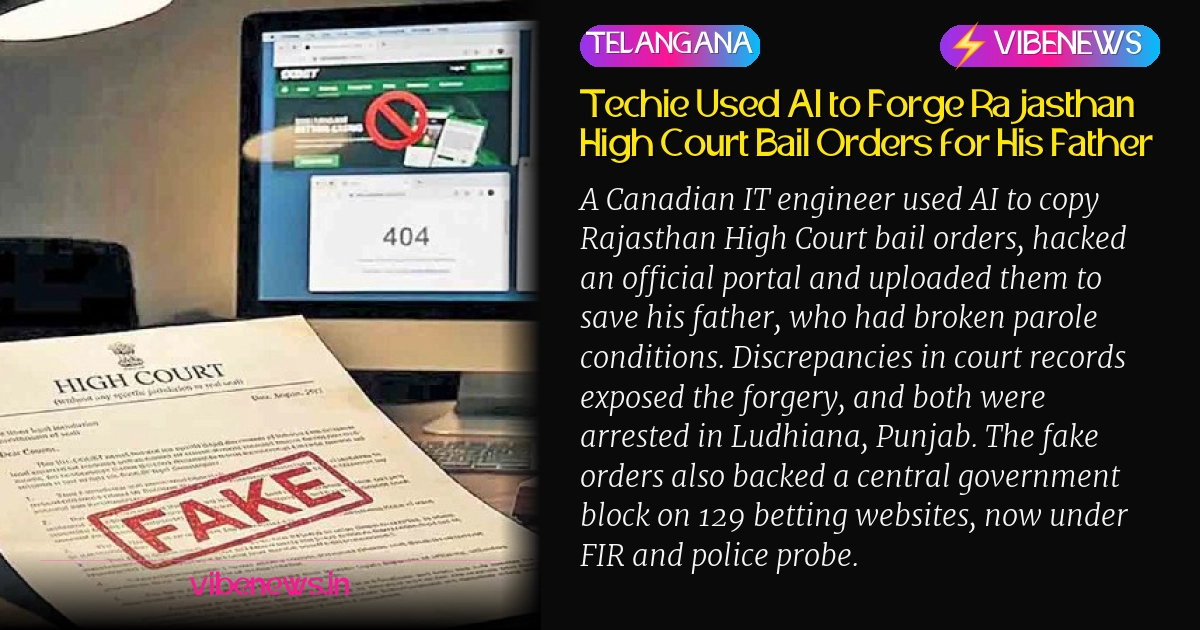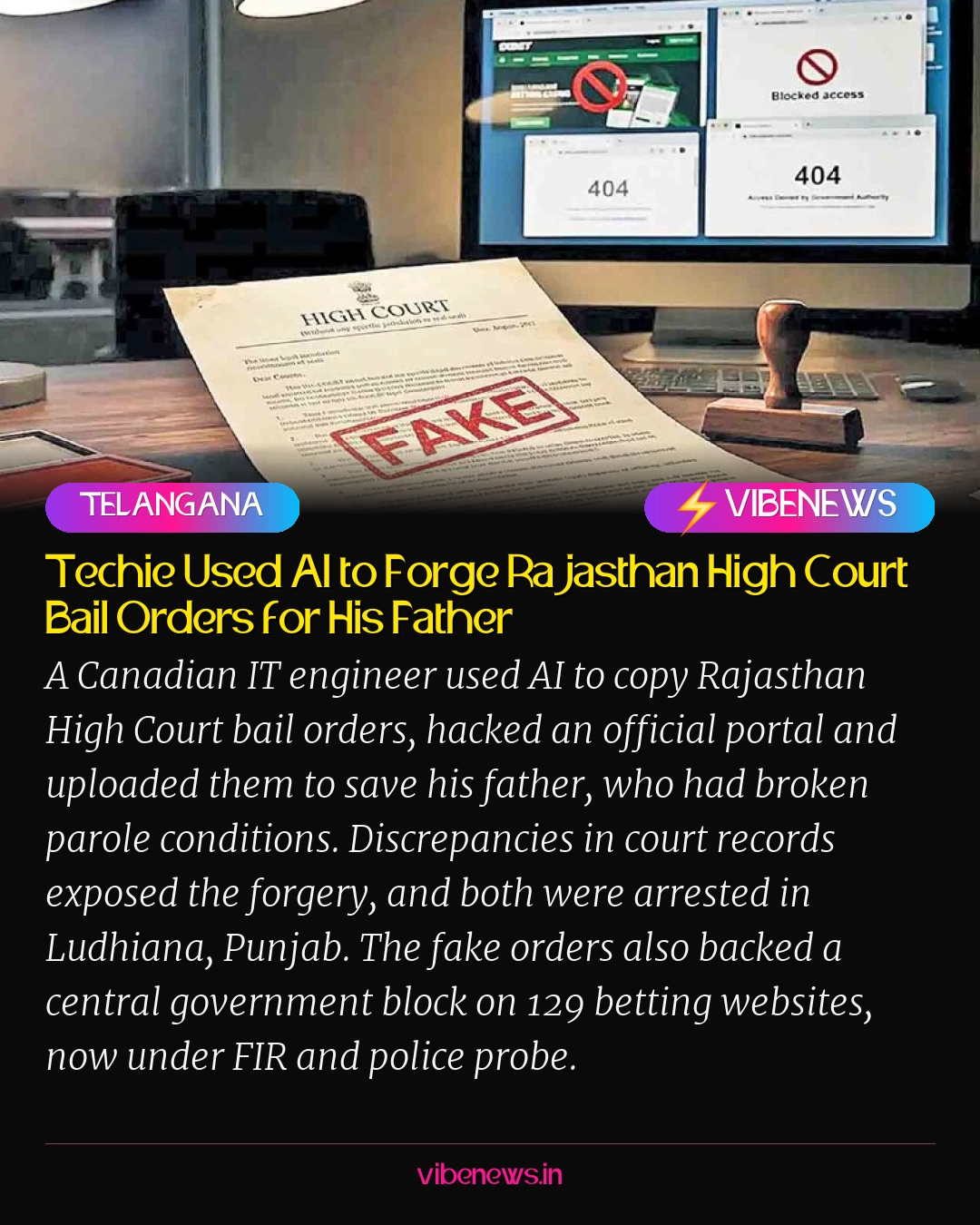

A Canadian IT engineer allegedly forged Rajasthan High Court bail orders using artificial intelligence to rescue his father, who had walked out of jail on parole and then violated its conditions. Police arrested both father and son in Ludhiana, Punjab, after the fake documents were traced back to them.
The father had been released on parole because of a medical emergency. When he broke the terms of that release, his son reportedly panicked and decided to fix the problem on paper. He went through more than 4,000 old bail orders to learn how the courts wrote them.
Copying the court’s voice
The engineer did not just copy a template. He studied the legal language, the exact formatting and the official seals that appear on Rajasthan High Court orders. With AI tools, he produced documents that looked almost identical to the real thing.
The forgeries did not stay on his laptop. He hacked into an official portal and uploaded a fake 30-day bail order directly into the government system. From there, he took the paperwork to the local court in Suratgarh and presented it in person.
For a while, nothing looked wrong. The cybercrime only surfaced when irregularities in the court registry raised suspicions among officials. Once the discrepancies were flagged, police began searching for the people behind the papers. The search ended in Ludhiana, where the father and son were both taken into custody.
When fake orders reached the government
The story would have stayed a local criminal case if the forged documents had not travelled much further. Two fake court orders, presented as coming from the Rajasthan High Court and the Allahabad High Court in Uttar Pradesh, were used to justify a central government decision.
The Department of Telecommunications, known as DoT, directed internet service providers to block 129 illegal betting websites this year. Those blocking orders relied on the two court orders. According to an investigation that exposed the problem, neither order was genuine.
The fake orders passed through India’s official content takedown system, which is widely regarded as one of the strictest of its kind in the world. That is what makes the case so unsettling. A system built to stop illegal content was pushed into action by forged legal paperwork, and it did not catch the fraud before the blocks went out.
DoT issued two blocking orders, on July 21 and September 2. Both were available on its website as part of routine uploads. Attached to them were email copies of what were described as court orders asking for the removal of dozens of websites.
When the investigation checked those court orders on the websites of the two high courts, it could not find them. The Rajasthan High Court responded directly to the questions raised about the documents. In its reply, the court said the orders cited by DoT were fake and that they were not on its server.
The orders mentioned in the DoT communication are fake and are not available on the High Court’s server.
That single line changes the story. Until the court spoke, the question was whether a forged document had slipped through a local courtroom. After the court’s response, it became clear that forged orders had made their way into a national blocking process that affects what millions of internet users can access.
An FIR has now been registered based on the findings of the investigation, and police have begun a formal probe. Officials have not yet said how the fake orders were passed along to DoT or who else may have been involved in getting them into the system.
What the case reveals about the system
The father’s parole violation is the human reason this began. The son’s response was to break into a government system and forge court papers, a step that turned a family crisis into a case with consequences far beyond one courtroom.
For now, the central issue is trust. Courts rely on official portals and registries to verify documents. Government departments rely on court orders to act quickly against illegal websites. When a forged order can pass through both layers, the weak point is no longer just one family or one court. It is the system that was supposed to catch the forgery.
The questions that remain are the ones the authorities will have to answer. How did the forged orders get past the checks on the official takedown system? Which websites were blocked on the strength of those orders, and were any of them legitimate? And how many other documents may have been uploaded before anyone noticed?
Until those answers come, the case stands as a stark example of how a desperate act by one man can ripple outward, touching a courtroom in Rajasthan, a police station in Punjab and the internet access of people across the country.
TL;DR
- A Canadian IT engineer allegedly used AI to forge Rajasthan High Court bail orders to help his paroled father.
- He reviewed more than 4,000 old bail orders to copy legal language, formatting and official seals.
- He hacked an official portal and uploaded a fake 30-day bail order into the government system.
- The forgery was exposed at Suratgarh court after registry discrepancies raised suspicions, and both were arrested in Ludhiana.
- DoT blocked 129 betting websites based on two fake court orders, and an FIR has now been registered.
- The Rajasthan High Court said the orders cited by DoT are fake and not on its server.