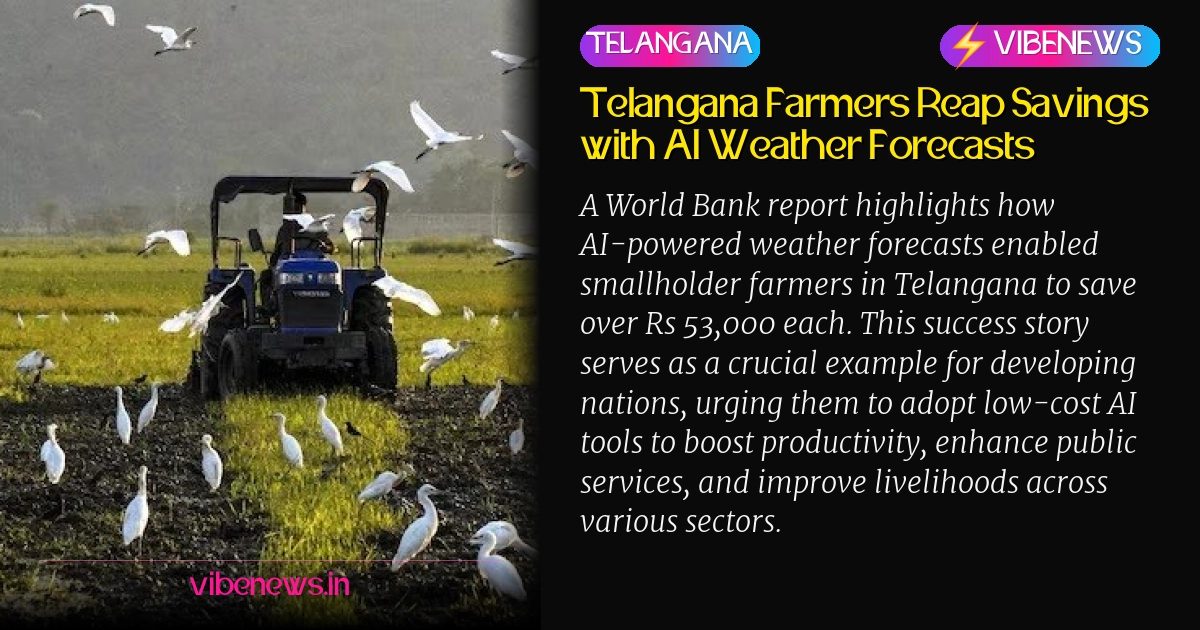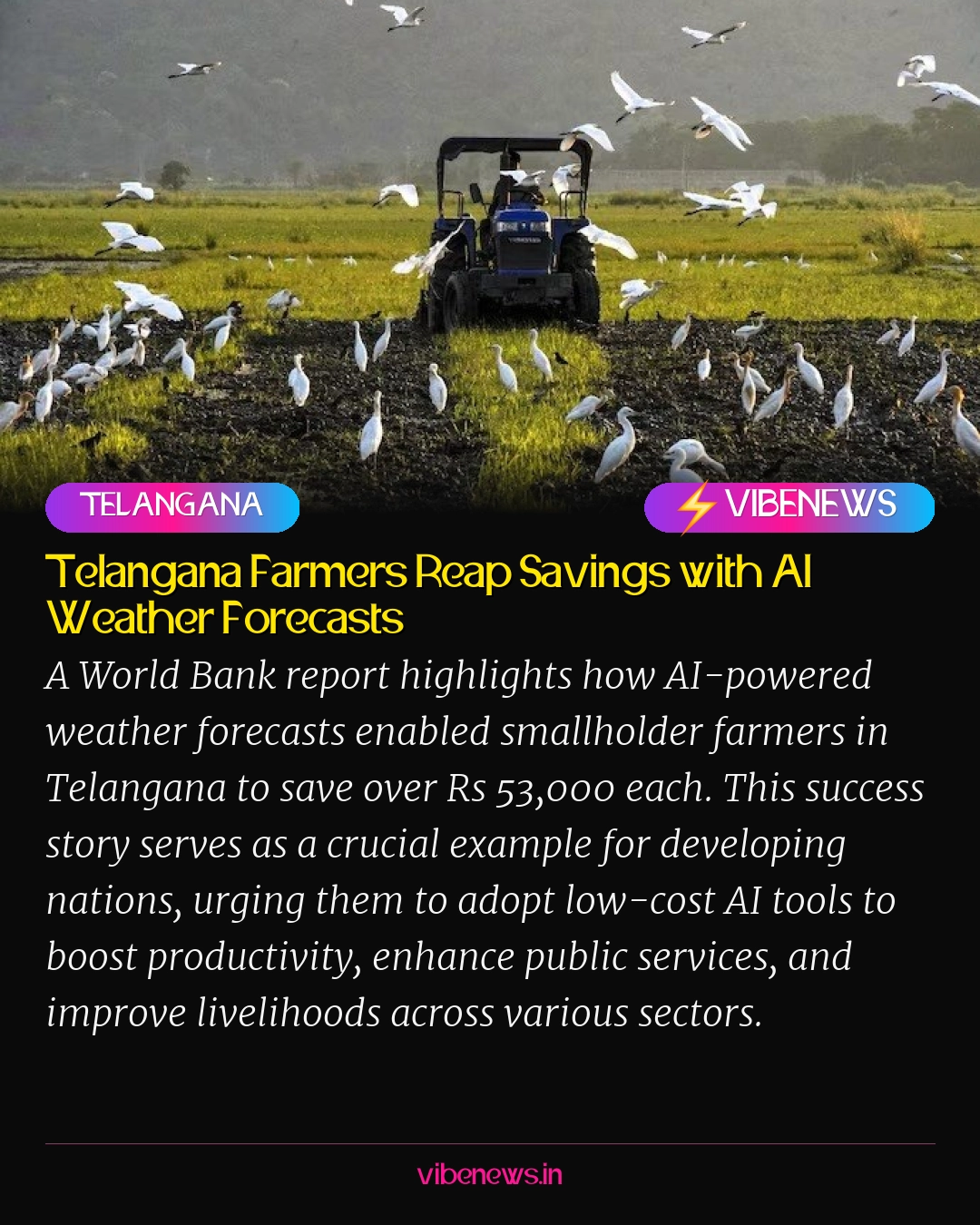
A groundbreaking report from the World Bank, titled "World Development Report 2026: The Promise of Artificial Intelligence," has brought to light a significant success story from India. The report details how artificial intelligence-powered weather forecasts have empowered smallholder farmers in Telangana, enabling them to save as much as USD 560, equivalent to over INR 53,300, by strategically adjusting their farming practices in response to specific climatic risks.
Released recently, the comprehensive assessment is the first of its kind to delve into the implications of AI for developing countries. It underscores the immense potential for AI to enhance the productivity of millions of small businesses and farmers, showcasing how governments and enterprises in these regions are already beginning to harness the technology’s power.
Precision Agriculture in Telangana
The World Bank report specifically references a 2025 study conducted across the Medak and Mahbubnagar districts of Telangana. This research revealed that an AI weather forecasting system provided crucial, timely information to smallholder farmers, who traditionally had limited access to reliable data from government agencies or extension services.
Armed with these precise forecasts, farmers were able to make informed decisions. Some increased their farm expenditures by up to one-third, investing in necessary inputs at optimal times, while others reaped substantial net savings by avoiding losses due to adverse weather. This behavioral shift, driven by data, directly translated into tangible economic benefits for individual farming households.
A Blueprint for Global Development
The success witnessed in Telangana serves as a powerful testament to the World Bank’s broader recommendation: developing countries should prioritize the rapid adoption of small, low-cost AI tools. The report argues that such applications, when spread widely across an economy, can deliver direct and significant gains, improving livelihoods and boosting overall economic productivity.
This approach contrasts with the strategy of making massive investments in large language models, which tend to be concentrated within a few large firms. Instead, the World Bank advocates for practical, accessible AI solutions that can be deployed at scale to address everyday challenges faced by ordinary citizens and small enterprises.
Beyond the Farm: Societal Benefits of AI
The report emphasizes that the advantages of AI extend far beyond mere economic gains. It highlights the potential for predictive AI analytics and decision support systems to revolutionize back-office administrative work within government sectors. Such applications promise substantial payoffs by enhancing efficiency and effectiveness.
Governments, the report suggests, could leverage AI to significantly improve critical public services. This includes optimizing tax collection processes, streamlining the delivery of social programs, enhancing disaster response mechanisms, improving healthcare outcomes through better diagnostics and resource allocation, and personalizing educational experiences for students.
Navigating the New Technological Frontier
Indermit Gill, Senior Vice President and Chief Economist of The World Bank Group, offered a stark perspective on the urgency of this technological shift. He remarked that developing economies, having missed the first Industrial Revolution and paid the price for centuries, cannot afford to be left behind in the current AI revolution.
The report advises developing nations to focus on the practical, immediate applications of AI that can genuinely improve productivity and public services. It suggests leaving the philosophical debates about AI’s long-term existential risks to the richer nations, while prioritizing tangible benefits that can uplift millions.
Editorial Context: The Long-Term Impact of Smart Farming
The World Bank’s findings from Telangana represent more than just an isolated success story; they offer a critical glimpse into the future of development. Over the long term, the widespread adoption of AI in agriculture holds profound implications for food security, economic resilience, and climate change adaptation in vulnerable regions.
By providing farmers with precise, actionable weather insights, AI can significantly reduce crop losses, optimize resource use like water and fertilizer, and enable better planning for planting and harvesting cycles. This not only boosts individual farmer incomes but also contributes to national food self-sufficiency and reduces reliance on volatile global markets.
Furthermore, this development addresses a crucial aspect of the digital divide. By focusing on low-cost, accessible AI tools, the initiative ensures that the benefits of advanced technology are not confined to urban centers or large corporations but reach the grassroots level, empowering the most vulnerable segments of society. It sets a precedent for how technology can be democratized to foster inclusive growth.
For policymakers, the Telangana model presents a clear directive: invest in digital infrastructure, promote data literacy, and create regulatory frameworks that encourage the development and deployment of practical AI solutions. The long-term vision is one where technology acts as an equalizer, enabling developing nations to leapfrog traditional stages of development and build more resilient, prosperous societies.
TL;DR
- AI-powered weather forecasts helped Telangana farmers save up to USD 560 (over INR 53,300) per farmer.
- The World Bank’s "World Development Report 2026" highlighted this success in Medak and Mahbubnagar districts.
- The report urges developing countries to adopt small, low-cost AI tools for widespread economic and social benefits.
- Beyond agriculture, AI can improve public services like tax collection, social programs, healthcare, and education.
- The World Bank emphasizes focusing on practical, distributed AI applications rather than large, centralized models.
- This initiative offers a blueprint for enhancing food security, economic resilience, and bridging the digital divide in developing nations.