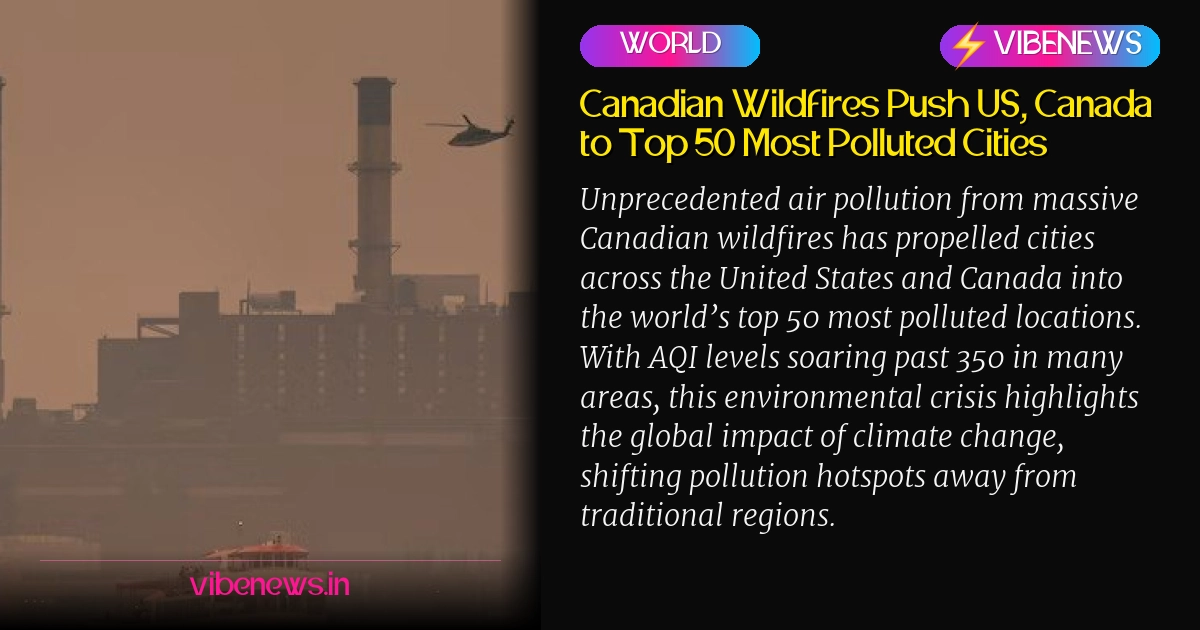
The world’s most polluted cities list has seen an unprecedented shift, with all top 50 locations now concentrated in the United States and Canada due to massive Canadian wildfires. This dramatic change, recorded on July 17, 2026, by AQI.in, marks a significant departure from typical rankings dominated by South Asian cities, including those in India.
The Air Quality Index (AQI) in over 20 North American cities has surged past 350, with some areas like Detroit briefly registering readings above 700, and parts of Michigan’s Upper Peninsula exceeding 1,000. This severe air quality crisis is primarily driven by smoke from over 850 active wildfires burning across Canada, spreading hazardous levels of fine particulate matter, known as PM2.5, hundreds of kilometers south.
This unusual scenario provides a critical global perspective, demonstrating how climate change is reshaping environmental challenges worldwide. While Indian cities frequently grapple with severe air pollution, the current crisis in North America underscores the universal vulnerability to extreme weather events and their far-reaching consequences, demanding attention to global climate action.
North America’s Unprecedented Air Quality Crisis
According to live rankings published by AQI.in, cities in Ontario such as Waterloo, London, and Brantford are leading the list of the world’s most polluted places. Several American cities across the Midwest and Northeast are also severely affected, including major urban centers like New York City, Chicago, and Washington DC.
The pollution is not a result of typical urban emissions from vehicles or factories. Instead, it is entirely driven by the extensive smoke plumes originating from more than 850 active wildfires currently burning across Canada. Over 100 of these fires are out of control, forcing tens of thousands of people to evacuate their homes across provinces like Manitoba, Saskatchewan, and Ontario.
Understanding PM2.5 and Health Risks
As forests burn, they release enormous amounts of PM2.5, which are microscopic particles. These particles are small enough to penetrate deep into the lungs and even enter the bloodstream, posing significant health risks to millions of residents.
This has led to widespread air quality alerts across more than 20 US states, stretching from Minnesota to New York. Authorities in southern Ontario have urged residents to remain indoors whenever possible to minimize exposure to the hazardous air.
Why is the Smoke Trapped?
Meteorologists explain that a strong high-pressure system, combined with an ongoing heatwave, has played a crucial role in exacerbating the situation. This weather pattern has trapped the smoke close to the ground, preventing it from dispersing into the upper atmosphere.
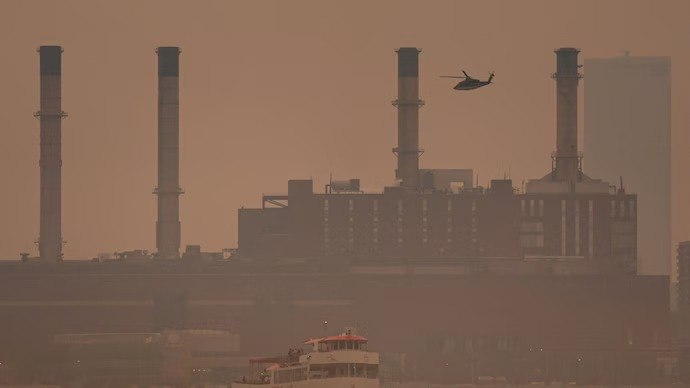
The lack of dispersion means that the dangerous levels of PM2.5 pollution remain concentrated at breathable levels, significantly reducing visibility and creating an apocalyptic-like sky in many affected regions, as captured by pilots over areas like Thunder Bay, Ontario.
Climate Change: A Driving Factor
Experts are increasingly linking such widespread and intense smoke events to the broader impacts of climate change. Scientists note that hotter, drier conditions, fueled by a changing climate, are allowing wildfires to grow larger and burn for longer periods.
This trend suggests that events of this magnitude may become more frequent in the future. The current crisis in North America serves as a grim glimpse of what a future altered by climate change could entail for global air quality and public health.
Outlook: When Will Air Quality Improve?
The poor air quality is likely to persist until there is a significant change in weather patterns that can push the smoke away or until substantial rainfall helps clear the atmosphere. Forecasts from Environment and Climate Change Canada (ECCC) and the US National Weather Service (NWS) indicate that shifting winds over the coming days could gradually improve conditions in some areas.
However, fresh smoke from ongoing wildfires may continue to affect parts of Canada and the northeastern US. Millions across North America could continue breathing unhealthy air until the fires are brought under control or more favorable weather conditions prevail.
TL;DR
- All top 50 most polluted cities globally are currently in the <strong>United States</strong> and <strong>Canada</strong>, a significant shift from typical South Asian dominance.
- Massive <strong>Canadian wildfires</strong>, with over <strong>850 active blazes</strong>, are the primary cause, releasing dangerous <strong>PM2.5</strong> particulate matter.
- <strong>Air Quality Index (AQI)</strong> readings have soared past <strong>350</strong> in many areas, with some locations like <strong>Detroit</strong> exceeding <strong>700</strong> and <strong>Michigan’s Upper Peninsula</strong> reaching <strong>1,000</strong>.
- A strong high-pressure system and heatwave are trapping the smoke, leading to widespread air quality alerts across more than <strong>20 US states</strong>.
- Experts attribute the increasing frequency and intensity of such widespread smoke events to <strong>climate change</strong>, fueling hotter and drier conditions.
- Millions across North America face persistent unhealthy air until weather patterns shift or the fires are brought under control.