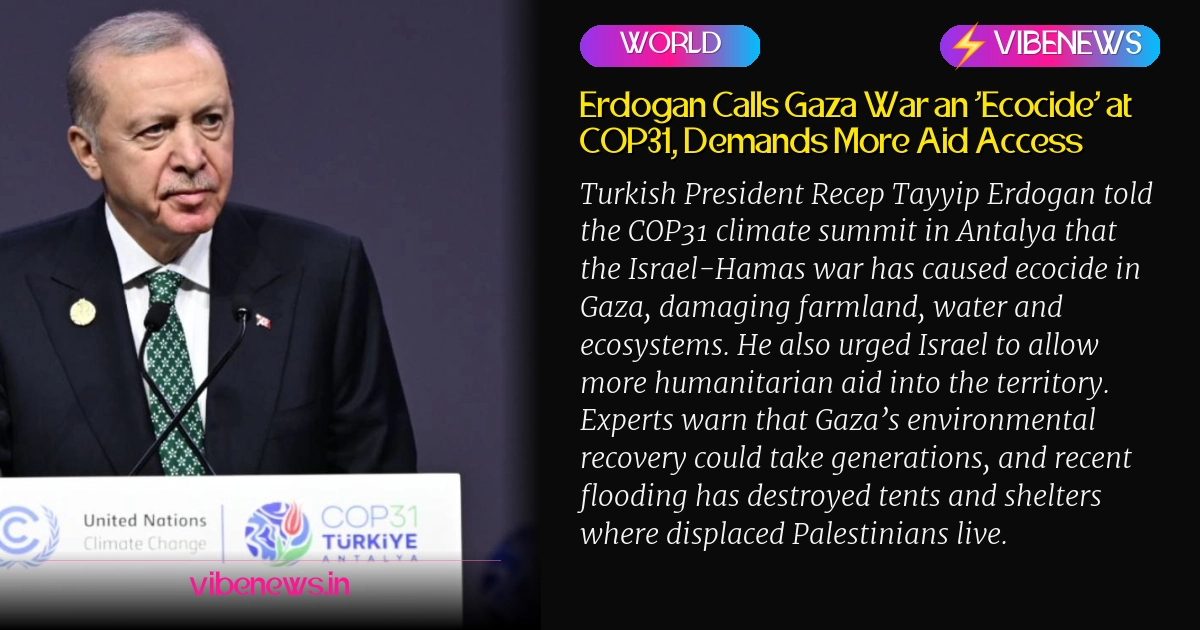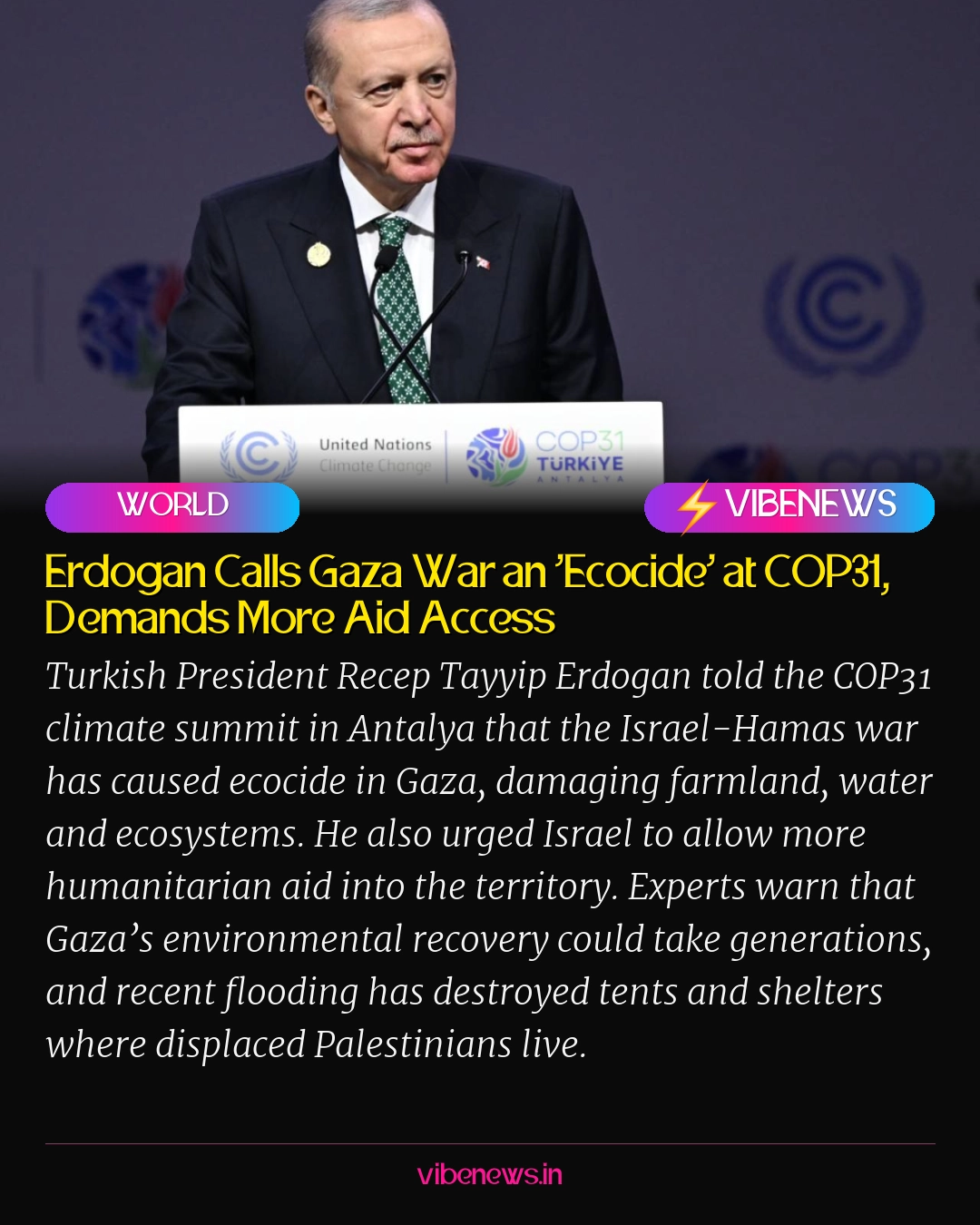
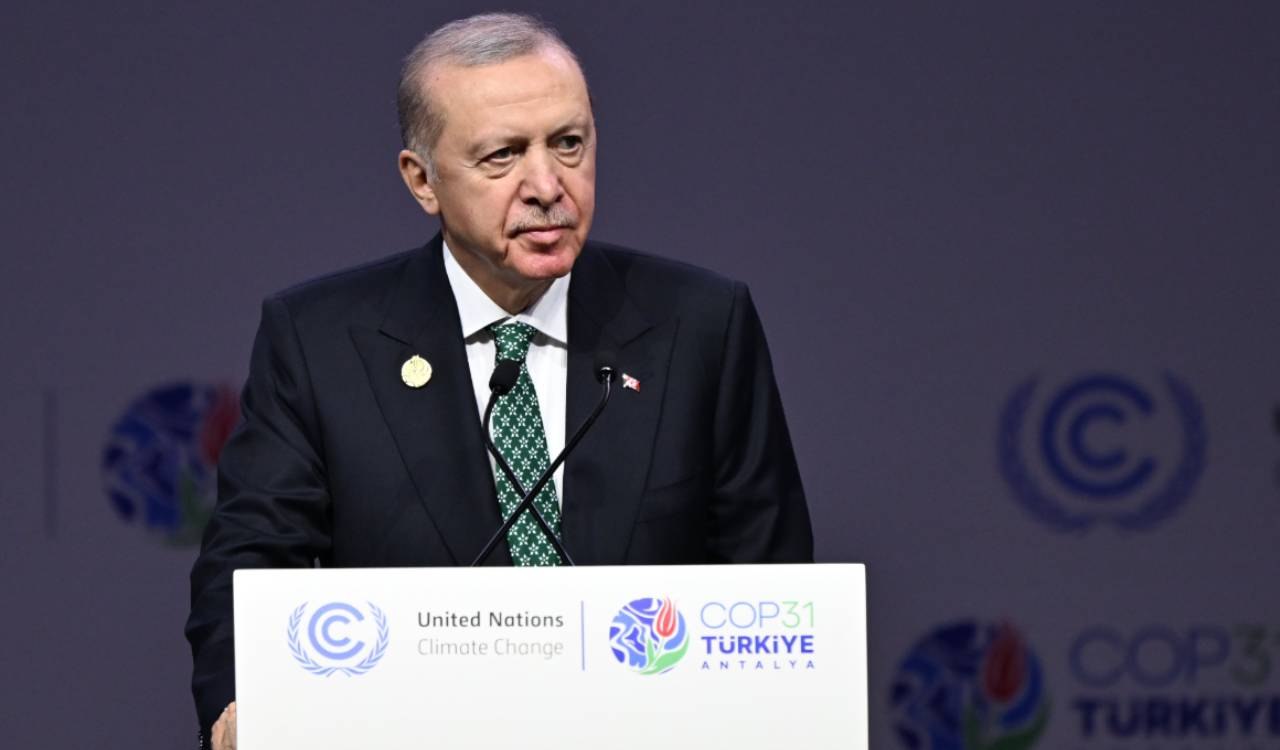
Turkish President Recep Tayyip Erdogan on Wednesday called the Israel-Hamas war in Gaza an “ecocide” while speaking at the COP31 climate summit in Antalya, Turkiye. He used the global climate forum to press the world to recognise the environmental damage and to ask the Israeli government to grant more aid access to the Palestinian territory.
Erdogan’s remarks drew applause from world leaders and other climate envoys in the hall. He went further than the environmental framing, tying the damage directly to the death toll and the question of genocide.
“What has taken place in Gaza is not only a genocide, but it is also an ecocide.”
The genocide claim is not new. A UN-backed panel of independent experts concluded last year that Israel had committed genocide in Gaza. Israel vehemently denies those allegations and has accused the panel of antisemitism. Israel’s Foreign Ministry did not immediately respond to requests for comment, and the country was not invited to COP31.
What Erdogan put on the table in Antalya was the ground-level damage. He described centuries-old olive trees cut down, soil and water polluted, and cities turned into enormous piles of rubble. He also pointed to torrential rain and flooding that have swamped tens of thousands of tents and shelters, compounding the destruction of Gaza’s infrastructure.
The flooding on the ground
The rain is not an abstract problem. In recent days, heavy rainfall and flooding destroyed many of the tents and makeshift shelters where Palestinian residents now live. At least four people were killed earlier this week when a sand embankment collapsed on their shelter. Many displaced people were left without food, drinking water or a dry place to sleep.
Aid is entering the territory, but the amount is far below what came in before the war started. Many items remain blocked by Israel, according to the reporting.
What the numbers show
A 2025 report by the UN Environment Programme laid out how badly the land has been hit since the war began. Remote sensing assessments showed that by May 2025, more than 97 per cent of tree crops, 82 per cent of annual crops, 95 per cent of shrubland and 89 per cent of grass and fallow land had been damaged.
Mohammed Usrof, co-founder and executive director of the Palestinian Institute for Climate Strategy, put the farming loss in stark terms. “As of now, our families only have 3 per cent of cropland to use, and that is assuming it’s distributed across 2 million Palestinians” in the Gaza Strip. “Not talking about these losses undermines Palestinians’ food supply, livelihoods and ability to remain on their land,” he said.
The UN report also found that the conflict has “all but eliminated” fishing livelihoods in Gaza, and that marine ecosystems have been contaminated with munitions, sewage and solid waste. Aid groups say the territory’s ability to dispose of garbage, treat sewage and deliver clean water has been virtually decimated after three years of war. That has made already grim living conditions worse and raised health risks for hundreds of thousands of people who lack adequate shelter, food and medicine.
A recovery measured in years
Ghiwa Nakat, executive director at Greenpeace MENA, said the damage reaches into daily survival. “For people in Gaza, this translates into severely limited access to safe drinking water, greater exposure to waterborne diseases and toxic substances, deepening food insecurity and the loss of livelihoods dependent on agriculture and fishing.”
Nakat also warned that the recovery will not come quickly. “The environmental damage will not end when the war ends,” she said. “Contaminated soil and groundwater, destroyed ecosystems and the collapse of essential environmental infrastructure could undermine public health, food security and livelihoods for generations, threatening communities’ resilience and their ability to recover.”
The death toll behind the rhetoric
Israel launched its campaign in Gaza after Hamas-led militants attacked southern Israel on October 7, 2023. Militants killed around 1,200 people and took 251 hostages. Israel’s retaliatory offensive has killed more than 74,000 people, according to local health authorities, and has destroyed much of Gaza.
The Health Ministry, part of Gaza’s Hamas-run government, does not distinguish between civilians and combatants in its count. It says women and children make up nearly half of the dead.
Rhetoric at the climate table
The personal feud between the two leaders makes the speech harder to read as a purely scientific appeal. Erdogan has been an outspoken critic of Israel, and Israeli Prime Minister Benjamin Netanyahu has called him an antisemitic “tyrant.” In September, Netanyahu told the UN General Assembly that “the latest country to become a superspreader of antisemitic lies is Turkiye.”
By bringing the charge of ecocide into a climate summit, Erdogan moved the Gaza conflict into a room that is supposed to be about carbon, temperatures and floods. Whether that shifts how other governments talk about the war remains to be seen, but the applause in Antalya suggests that at least some leaders were willing to hear the argument in those terms.
The summit around it
World leaders began formal talks at COP31 this week. They are seeking agreement on concrete steps to curb global warming after a year marked by deadly floods, heat waves and other climate-related disasters. More than 70 world leaders and senior government officials are speaking at the summit, but some key figures are missing. Heads of state from the United States, China and India are not attending.
TL;DR
- Turkish President Erdogan called the Gaza war an “ecocide” while speaking at the COP31 climate summit in Antalya.
- He urged the Israeli government to grant more aid access to the Palestinian territory.
- A UN-backed panel concluded last year that Israel committed genocide in Gaza; Israel denies the allegations.
- A UN report found over 97 per cent of tree crops in Gaza were damaged by May 2025.
- Recent flooding destroyed many shelters; at least four people died when a sand embankment collapsed.
- Greenpeace MENA warns Gaza’s environmental recovery could take generations.